115195
论文已发表
注册即可获取德孚的最新动态
IF 收录期刊
- 3.6 Breast Cancer (Dove Med Press)
- 4.3 Clin Epidemiol
- 2.6 Cancer Manag Res
- 3.2 Infect Drug Resist
- 4.1 Clin Interv Aging
- 6.1 Drug Des Dev Ther
- 4.1 Int J Chronic Obstr
- 8.7 Int J Nanomed
- 2.5 Int J Women's Health
- 3.2 Neuropsych Dis Treat
- 2.4 OncoTargets Ther
- 2.6 Patient Prefer Adher
- 2.6 Ther Clin Risk Manag
- 3.1 J Pain Res
- 3.5 Diabet Metab Synd Ob
- 4.5 Psychol Res Behav Ma
- 3.4 Nat Sci Sleep
- 2.4 Pharmgenomics Pers Med
- 2.6 Risk Manag Healthc Policy
- 4.6 J Inflamm Res
- 2.3 Int J Gen Med
- 3.9 J Hepatocell Carcinoma
- 3.3 J Asthma Allergy
- 2.5 Clin Cosmet Investig Dermatol
- 3.0 J Multidiscip Healthc

益母草碱通过增加细胞凋亡和抑制耐药相关蛋白来促进人宫颈癌细胞的顺铂敏感性
Authors Lin M, Pan C, Xu W, Li J, Zhu X
Received 2 March 2020
Accepted for publication 27 April 2020
Published 15 May 2020 Volume 2020:14 Pages 1885—1895
DOI https://doi.org/10.2147/DDDT.S252112
Checked for plagiarism Yes
Review by Single-blind
Peer reviewer comments 2
Editor who approved publication: Dr Qiongyu Guo
Background: Cisplatin-based neoadjuvant chemotherapy and concurrent radiotherapy and chemotherapy are the main treatment for advanced cervical cancer. However, the development of multidrug resistance (MDR) leads to chemotherapy failure, tumor recurrence and poor survival. In this research, we investigated the effect and corresponding mechanism of leonurine on cisplatin sensitivity of cervical cancer cells.
Methods: Anti-cervical cancer efficacy of leonurine and leonurine combined with cisplatin was examined in C33A and Ms751 cells. The cell counting kit-8 assay and bromodeoxyuridine assay were applied for measuring cell proliferation. CompuSyn software was used to calculate the combination index and assess the synergistic effect of leonurine and cisplatin on cell proliferation. The cell cycle distribution and cell apoptosis were analyzed by flow cytometry. The expression of cleaved caspase-3, poly ADP-ribose polymerase (PARP), B-cell lymphoma-2 associated X (BAX), B-cell lymphoma-2 (BCL-2), P glycoprotein (P-Gp) protein and multiple drug resistance protein 1 (MRP1) was analyzed by Western blotting.
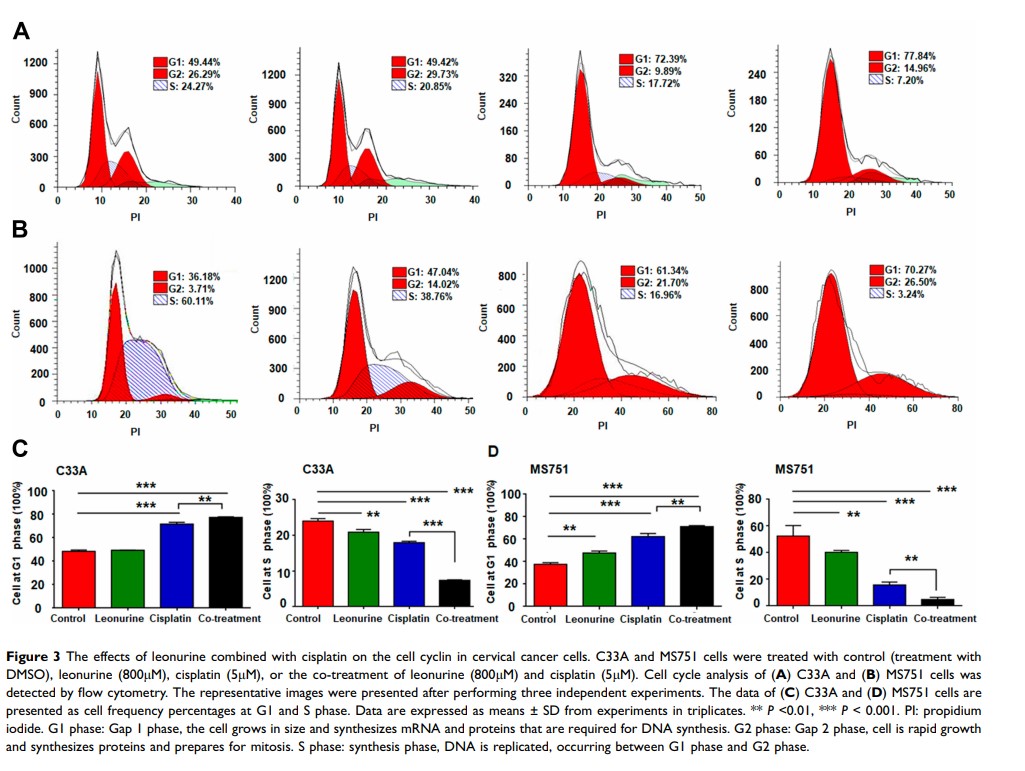
Results: Leonurine had time- and dose-dependent anti-proliferative effects on C33A and MS751 cells. Leonurine and cisplatin combination was more efficacious in inhibiting the growth of cervical cancer cells than either of the two drugs. The combined application has shown that the cervical cancer cells were arrested at G1 phase after treatments. Moreover, flow cytometry analysis indicated that the combined treatment could cause more cell apoptosis than the single drug treatment. Consistently, combined treatment elevated BAX/BCL-2 ratio, and the expression of BAX, PARP and cleaved caspase-3 proteins. Mechanistic investigations uncovered that the tumor-inhibiting effects of the co-treatment were mediated by repressing MDR, including MRP1 and P-Gp protein, thereby enhancing the efficiency of cisplatin.
Conclusion: Leonurine and cisplatin have synergistic antitumorigenic effects on cervical cancer. Combination with leonurine may serve as a novel strategy for enhancing cisplatin sensitivity via the inhibition of the expression of MRP1 and P-Gp.
Keywords: cervical cancer, leonurine, cisplatin, multidrug resistance