115195
论文已发表
注册即可获取德孚的最新动态
IF 收录期刊
- 3.6 Breast Cancer (Dove Med Press)
- 4.3 Clin Epidemiol
- 2.6 Cancer Manag Res
- 3.2 Infect Drug Resist
- 4.1 Clin Interv Aging
- 6.1 Drug Des Dev Ther
- 4.1 Int J Chronic Obstr
- 8.7 Int J Nanomed
- 2.5 Int J Women's Health
- 3.2 Neuropsych Dis Treat
- 2.4 OncoTargets Ther
- 2.6 Patient Prefer Adher
- 2.6 Ther Clin Risk Manag
- 3.1 J Pain Res
- 3.5 Diabet Metab Synd Ob
- 4.5 Psychol Res Behav Ma
- 3.4 Nat Sci Sleep
- 2.4 Pharmgenomics Pers Med
- 2.6 Risk Manag Healthc Policy
- 4.6 J Inflamm Res
- 2.3 Int J Gen Med
- 3.9 J Hepatocell Carcinoma
- 3.3 J Asthma Allergy
- 2.5 Clin Cosmet Investig Dermatol
- 3.0 J Multidiscip Healthc

长非编码 RNA SNHG16 激活 USP22 表达,通过 miR-132-3p 海绵化促进结直肠癌的进展
Authors He X, Ma J, Zhang M, Cui J, Yang H
Received 4 January 2020
Accepted for publication 21 April 2020
Published 18 May 2020 Volume 2020:13 Pages 4283—4294
DOI https://doi.org/10.2147/OTT.S244778
Checked for plagiarism Yes
Review by Single-blind
Peer reviewer comments 4
Editor who approved publication: Dr Carlos E Vigil
Background: Colorectal cancer (CRC) is the most common cause of cancer-related mortality in the world. Long non-coding RNAs (lncRNAs) are involved in the development of many cancers. However, studies on the effect of lncRNA small nucleolar RNA host gene 16 (SNHG16) on the proliferation, metastasis and apoptosis of CRC are still few.
Methods: Quantitative real-time polymerase chain reaction (qRT-PCR) was performed to determine the expression levels of SNHG16, microRNA-132-3p (miR-132-3p) and ubiquitin specific peptidase 22 (USP22). The proliferation, apoptosis, migration and invasion of CRC cells were evaluated by the 3-(4,5-dimethyl-2 thiazolyl)-2,5-diphenyl-2-H-tetrazolium bromide (MTT) assay, flow cytometry and transwell assay, respectively. Dual-luciferase reporter assay was used to verify the interactions among SNHG16, miR-132-3p and USP22. Also, Western blot analysis was used to assess the protein levels of USP22 and metastasis-related markers. Moreover, mice xenograft models were used to determine the effect of SNHG16 on CRC tumor growth in vivo.
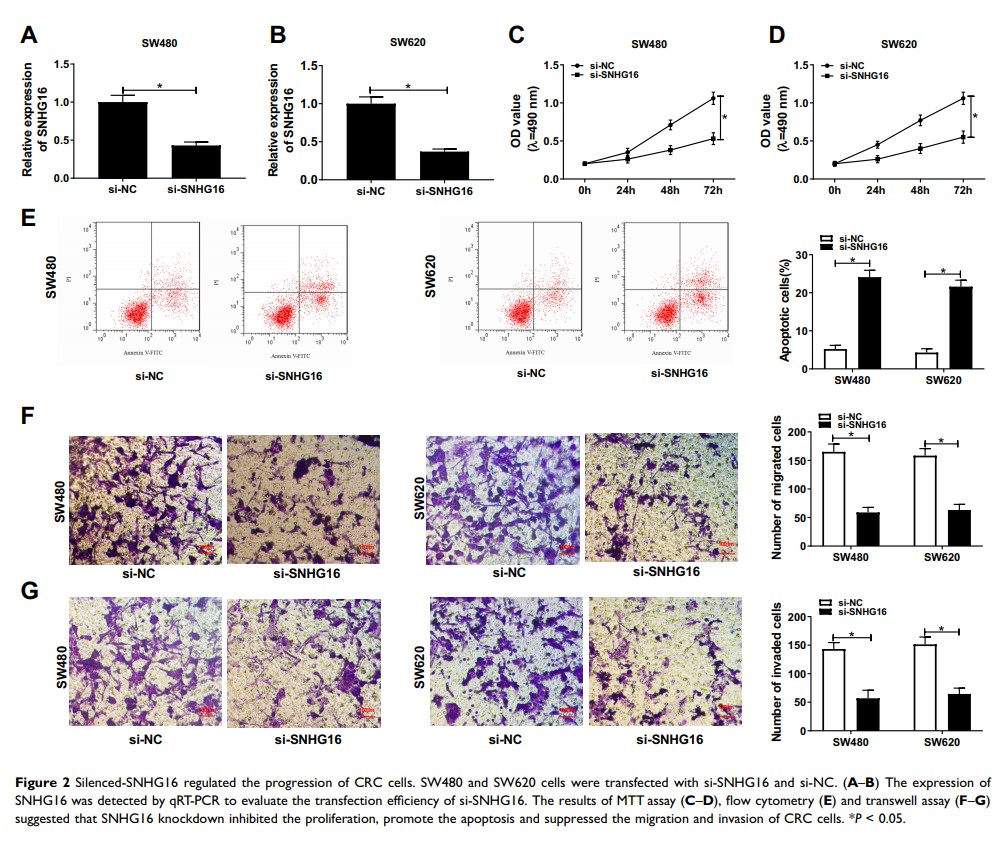
Results: SNHG16 was highly expressed in CRC tissues and cells. Knockdown of SNHG16 reduced the proliferation, migration, invasion, and promoted the apoptosis of CRC cells. MiR-132-3p could interact with SNHG16, and its inhibitor recovered the suppression effect of silenced SNHG16 on CRC cell progression. Besides, USP22 was a target of miR-132-3p, and its overexpression restored the inhibition effect of miR-132-3p mimic on CRC cell progression. In addition, interference of SNHG16 reduced CRC tumor growth in vivo.
Conclusion: LncRNA SNHG16 might act as an oncogene in CRC. The discovery of the SNHG16/miR-132-3p/USP22 pathway provided new thinking for the treatment of CRC.
Keywords: colorectal cancer, progression, SNHG16, miR-132-3p, USP22