115195
论文已发表
注册即可获取德孚的最新动态
IF 收录期刊
- 3.6 Breast Cancer (Dove Med Press)
- 4.3 Clin Epidemiol
- 2.6 Cancer Manag Res
- 3.2 Infect Drug Resist
- 4.1 Clin Interv Aging
- 6.1 Drug Des Dev Ther
- 4.1 Int J Chronic Obstr
- 8.7 Int J Nanomed
- 2.5 Int J Women's Health
- 3.2 Neuropsych Dis Treat
- 2.4 OncoTargets Ther
- 2.6 Patient Prefer Adher
- 2.6 Ther Clin Risk Manag
- 3.1 J Pain Res
- 3.5 Diabet Metab Synd Ob
- 4.5 Psychol Res Behav Ma
- 3.4 Nat Sci Sleep
- 2.4 Pharmgenomics Pers Med
- 2.6 Risk Manag Healthc Policy
- 4.6 J Inflamm Res
- 2.3 Int J Gen Med
- 3.9 J Hepatocell Carcinoma
- 3.3 J Asthma Allergy
- 2.5 Clin Cosmet Investig Dermatol
- 3.0 J Multidiscip Healthc

Wnt/β-连环蛋白通路关键基因的变异作为宫颈癌易感性的预测因子
Authors Wang B, Wang M, Li X, Yang M, Liu L
Received 6 February 2020
Accepted for publication 22 April 2020
Published 20 May 2020 Volume 2020:13 Pages 157—165
DOI https://doi.org/10.2147/PGPM.S248548
Checked for plagiarism Yes
Review by Single-blind
Peer reviewer comments 2
Editor who approved publication: Dr Martin H. Bluth
Background: Cervical cancer is the fourth most common and fatal tumor among women worldwide. The Wnt/β-catenin signaling pathway was etiologically involved in the cervical cancer model. Herein, we aimed to investigate whether germline genetic variations within the Wnt/β-catenin pathway can be genetic risk factors of cervical cancer.
Patients and Methods: A total of 305 samples (147 patients, 158 controls) were included. Eight genetic variations located in APC (rs454886), GSK3β (rs3755557), CTNNB1 (rs11564475, rs1798802, rs3864004, rs2293303, and rs4135385), and TCF7L2 (rs7903146) were genotyped via Sanger sequencing. The χ 2 test and non-conditional logistic regression were used in the single-locus analysis. Gene–gene interactions and haplotype construction in case–control samples were performed by the GMDR method and Haploview software, respectively.
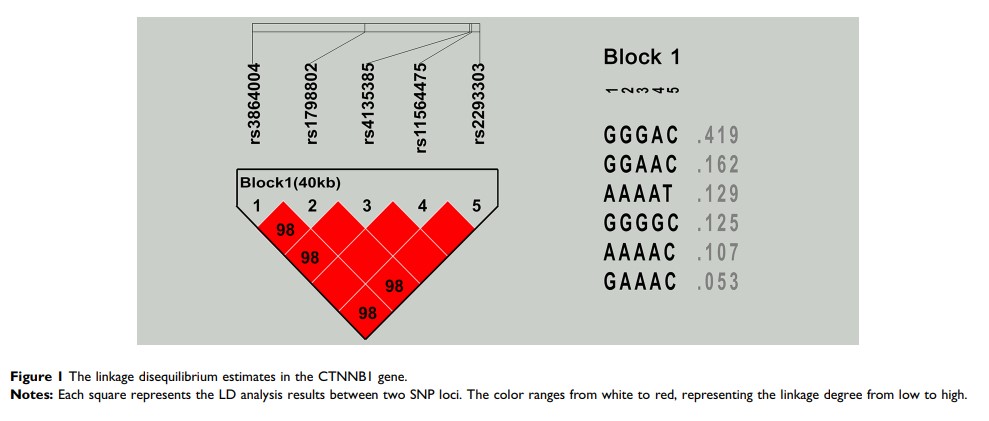
Results: The frequency of CTNNB1 rs1798802 GA+AA genotype was significantly lower in cervical cancer patients adjusted for age (OR=0.626, 95% CI=0.398– 0.984). The mutant alleles of rs3864004 (A) and rs2293303 (T) located in CTNNB1 showed 1.513 (1.038– 2.207), and 1.654 (1.020– 2.683) fold increased risk of cervical cancer, respectively. Haplotype analysis showed no association between haplotypes of the CTNNB1 gene and cervical cancer risk. No significant contribution of interactions among genes in the Wnt pathway was identified.
Conclusion: We concluded that the genetic variants in the CTNNB1 gene might contribute to the development of cervical cancer.
Keywords: cervical cancer, Wnt/β-catenin signaling pathway, single nucleotide polymorphism, APC, GSK3β, CTNNB1, TCF7L2