115195
论文已发表
注册即可获取德孚的最新动态
IF 收录期刊
- 3.6 Breast Cancer (Dove Med Press)
- 4.3 Clin Epidemiol
- 2.6 Cancer Manag Res
- 3.2 Infect Drug Resist
- 4.1 Clin Interv Aging
- 6.1 Drug Des Dev Ther
- 4.1 Int J Chronic Obstr
- 8.7 Int J Nanomed
- 2.5 Int J Women's Health
- 3.2 Neuropsych Dis Treat
- 2.4 OncoTargets Ther
- 2.6 Patient Prefer Adher
- 2.6 Ther Clin Risk Manag
- 3.1 J Pain Res
- 3.5 Diabet Metab Synd Ob
- 4.5 Psychol Res Behav Ma
- 3.4 Nat Sci Sleep
- 2.4 Pharmgenomics Pers Med
- 2.6 Risk Manag Healthc Policy
- 4.6 J Inflamm Res
- 2.3 Int J Gen Med
- 3.9 J Hepatocell Carcinoma
- 3.3 J Asthma Allergy
- 2.5 Clin Cosmet Investig Dermatol
- 3.0 J Multidiscip Healthc

姜黄素可通过 Gli1-β-联蛋白影响胃癌细胞的迁移、侵袭和细胞骨架重构
Authors Zhang X, Zhang C, Ren Z, Zhang F, Xu J, Zhang X, Zheng H
Received 31 December 2019
Accepted for publication 8 April 2020
Published 21 May 2020 Volume 2020:12 Pages 3795—3806
DOI https://doi.org/10.2147/CMAR.S244384
Checked for plagiarism Yes
Review by Single-blind
Peer reviewer comments 2
Editor who approved publication: Dr Sanjeev Srivastava
Purpose: The function of curcumin on the gastric cancer cell line, SGC-7901 is unknown. The present study aimed to observe the effects of curcumin on gastric cancer cells through the Shh and Wnt signaling pathways.
Methods: SGC-7901 cells were transfected with si-Gli1 and si-β-catenin siRNA, then cells were stimulated with curcumin and its effects on cell migration, invasion, cytoskeleton remodeling, EMT, apoptosis and cell cycle were investigated by transwell assays, immunofluorescence and flow cytometry assays. The interaction between Gli1 and β-catenin was observed by co-immunoprecipitation.
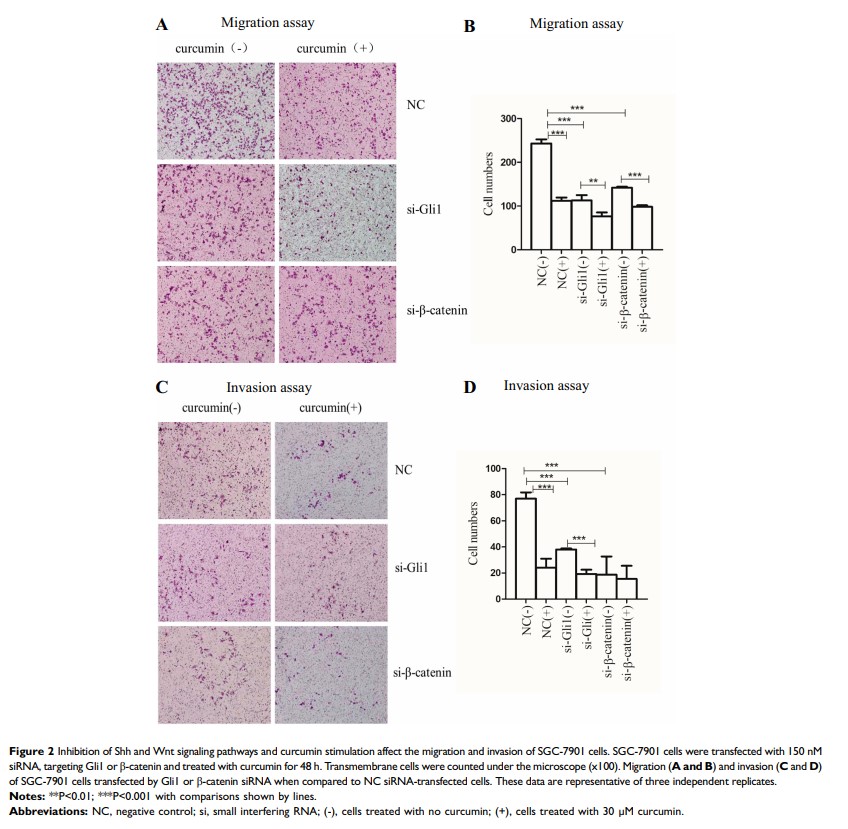
Results: We show that curcumin suppressed the expression of Shh, Gli1 and Foxm1 in the Shh signaling pathway, and the expression of β-catenin in the Wnt signaling pathway in SGC-7901 cells, both in mRNA and protein. As a result, cellular migration, invasion and cytoskeletal remodeling ability decreased. Our results revealed that when stimulated with curcumin, cells showed decreased cellular migration and invasion, while enhanced apoptosis. In addition, curcumin induced cytoskeletal remodeling and S phase cell cycle arrest. The inhibition of Shh and Wnt signaling pathway and the addition of curcumin also inhibited the epithelial–mesenchymal transition process. Furthermore, a physical interaction was observed between Gli1 of the Shh signaling and β-catenin of the Wnt signaling in these cells, but curcumin inhibited the interaction of these two proteins.
Conclusion: The present study indicated that curcumin plays an anti-tumor role through Gli1-β-catenin pathway in gastric cancer SGC-7901 cells.
Keywords: curcumin, Gli1, β-catenin, migration, invasion, cytoskeleton