115195
论文已发表
注册即可获取德孚的最新动态
IF 收录期刊
- 3.6 Breast Cancer (Dove Med Press)
- 4.3 Clin Epidemiol
- 2.6 Cancer Manag Res
- 3.2 Infect Drug Resist
- 4.1 Clin Interv Aging
- 6.1 Drug Des Dev Ther
- 4.1 Int J Chronic Obstr
- 8.7 Int J Nanomed
- 2.5 Int J Women's Health
- 3.2 Neuropsych Dis Treat
- 2.4 OncoTargets Ther
- 2.6 Patient Prefer Adher
- 2.6 Ther Clin Risk Manag
- 3.1 J Pain Res
- 3.5 Diabet Metab Synd Ob
- 4.5 Psychol Res Behav Ma
- 3.4 Nat Sci Sleep
- 2.4 Pharmgenomics Pers Med
- 2.6 Risk Manag Healthc Policy
- 4.6 J Inflamm Res
- 2.3 Int J Gen Med
- 3.9 J Hepatocell Carcinoma
- 3.3 J Asthma Allergy
- 2.5 Clin Cosmet Investig Dermatol
- 3.0 J Multidiscip Healthc

诺法图可用于预测 2 型糖尿病患者的消化道癌风险
Authors Feng LH, Bu KP, Ren S, Yang Z, Li BX, Deng CE
Received 4 March 2020
Accepted for publication 29 April 2020
Published 21 May 2020 Volume 2020:13 Pages 1763—1770
DOI https://doi.org/10.2147/DMSO.S251063
Checked for plagiarism Yes
Review by Single-blind
Peer reviewer comments 2
Editor who approved publication: Prof. Dr. Juei-Tang Cheng
Purpose: Digestive carcinomas remain a major health burden worldwide and are closely related to type 2 diabetes. The aim of this study was to develop and validate a digestive carcinoma risk prediction model to identify high-risk individuals among those with type 2 diabetes.
Patients and Methods: The prediction model was developed in a primary cohort that consisted of 655 patients with type 2 diabetes. Data were collected from November 2013 to December 2018. Clinical parameters and demographic characteristics were analyzed by logistic regression to develop a model to predict the risk of digestive carcinomas; then, a nomogram was constructed. The performance of the nomogram was assessed with respect to calibration, discrimination, and clinical usefulness. The results were internally validated by a bootstrapping procedure. The independent validation cohort consisted of 275 patients from January 2019 to December 2019.
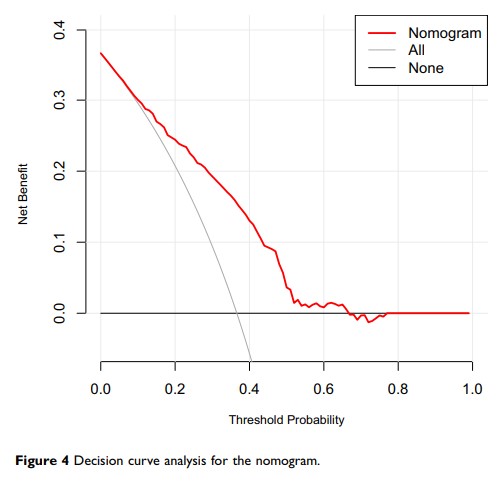
Results: Predictors in the prediction nomogram included sex, age, insulin use, and body mass index. The model showed good discrimination (C-index 0.747 [95% CI, 0.718– 0.791]) and calibration (Hosmer–Lemeshow test P=0.541). The nomogram showed similar discrimination in the validation cohort (C-index 0.706 [95% CI, 0.682– 0.755]) and good calibration (Hosmer–Lemeshow test P=0.418). Decision curve analysis demonstrated that the nomogram would be clinically useful.
Conclusion: We developed a low-cost and low-risk model based on clinical and demographic parameters to help identify patients with type 2 diabetes who might benefit from digestive cancer screening.
Keywords: type 2 diabetes, digestive cancer, prediction, demographic