115195
论文已发表
注册即可获取德孚的最新动态
IF 收录期刊
- 3.6 Breast Cancer (Dove Med Press)
- 4.3 Clin Epidemiol
- 2.6 Cancer Manag Res
- 3.2 Infect Drug Resist
- 4.1 Clin Interv Aging
- 6.1 Drug Des Dev Ther
- 4.1 Int J Chronic Obstr
- 8.7 Int J Nanomed
- 2.5 Int J Women's Health
- 3.2 Neuropsych Dis Treat
- 2.4 OncoTargets Ther
- 2.6 Patient Prefer Adher
- 2.6 Ther Clin Risk Manag
- 3.1 J Pain Res
- 3.5 Diabet Metab Synd Ob
- 4.5 Psychol Res Behav Ma
- 3.4 Nat Sci Sleep
- 2.4 Pharmgenomics Pers Med
- 2.6 Risk Manag Healthc Policy
- 4.6 J Inflamm Res
- 2.3 Int J Gen Med
- 3.9 J Hepatocell Carcinoma
- 3.3 J Asthma Allergy
- 2.5 Clin Cosmet Investig Dermatol
- 3.0 J Multidiscip Healthc

使用生物信息学分析鉴定 2 型糖尿病中的 Hub 基因
Authors Lin Y, Li J, Wu D, Wang F, Fang Z, Shen G
Received 9 January 2020
Accepted for publication 23 April 2020
Published 22 May 2020 Volume 2020:13 Pages 1793—1801
DOI https://doi.org/10.2147/DMSO.S245165
Checked for plagiarism Yes
Review by Single-blind
Peer reviewer comments 2
Editor who approved publication: Dr Antonio Brunetti
Background: Type 2 diabetes mellitus (T2DM) is one of the most common chronic diseases in the world with complicated pathogenesis. This study aimed to identify differentially expressed genes (DEGs) and molecular pathways in T2DM using bioinformatics analysis.
Materials and Methods: To explore potential therapeutic targets for T2DM, we analyzed three microarray datasets (GSE50397, GSE38642, and GSE44035) acquired from the Gene Expression Omnibus (GEO) database. DEGs between T2DM islet and normal islet were picked out by the GEO2R tool and Venn diagram software. Gene Ontology (GO) function and Kyoto Encyclopedia of Genes and Genomes (KEGG) pathway enrichment analysis were performed using the Database for Annotation, Visualization, and Integrated Discovery (DAVID) to identify the pathways and functional annotation of DEGs. Then, protein–protein interaction (PPI) of these DEGs was visualized by Cytoscape with Search Tool for the Retrieval of Interacting Genes/Proteins (STRING).
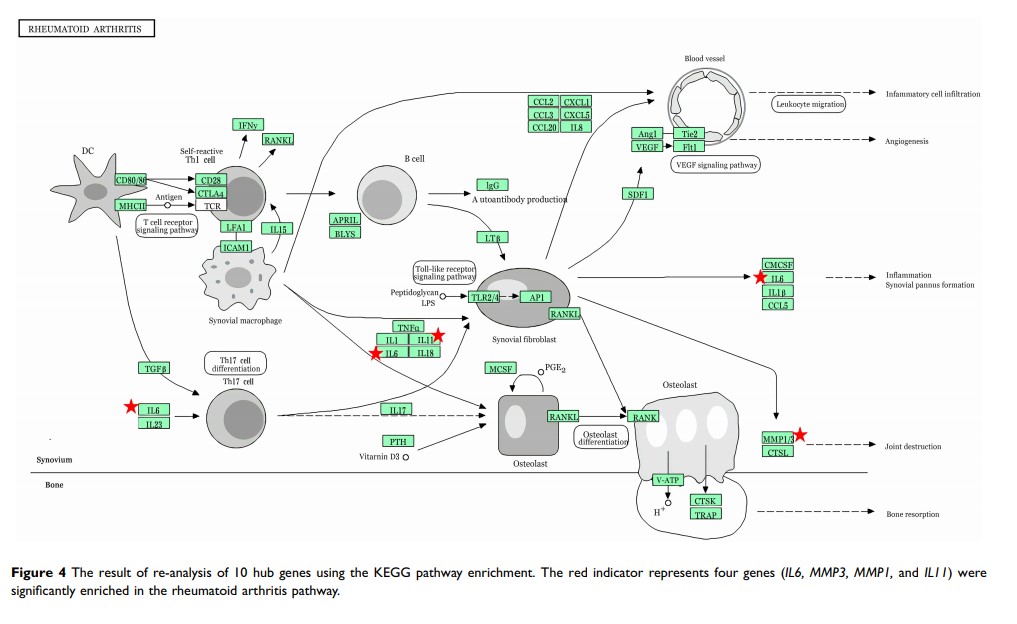
Results: In total, we identified 36 DEGs in the three datasets, including 32 up-regulated genes and four down-regulated genes. The improved functions and pathways of the DEGs enriched in cytokine–cytokine receptor interaction, pathways in cancer, PI3K-Akt signaling pathway, and Rheumatoid arthritis. Among them, ten hub genes with a high degree of connectivity were selected. Furthermore, via the re-analysis of DAVID, four genes (IL6, MMP3, MMP1, and IL11 ) were significantly enriched in the Rheumatoid arthritis pathway.
Conclusion: Our study, based on the GEO database, identified four significant up-regulated DEGs and provided novel targets for diagnosis and treatment of T2DM.
Keywords: bioinformatics analysis, microarray, differentially expressed genes, type 2 diabetes mellitus