115195
论文已发表
注册即可获取德孚的最新动态
IF 收录期刊
- 3.6 Breast Cancer (Dove Med Press)
- 4.3 Clin Epidemiol
- 2.6 Cancer Manag Res
- 3.2 Infect Drug Resist
- 4.1 Clin Interv Aging
- 6.1 Drug Des Dev Ther
- 4.1 Int J Chronic Obstr
- 8.7 Int J Nanomed
- 2.5 Int J Women's Health
- 3.2 Neuropsych Dis Treat
- 2.4 OncoTargets Ther
- 2.6 Patient Prefer Adher
- 2.6 Ther Clin Risk Manag
- 3.1 J Pain Res
- 3.5 Diabet Metab Synd Ob
- 4.5 Psychol Res Behav Ma
- 3.4 Nat Sci Sleep
- 2.4 Pharmgenomics Pers Med
- 2.6 Risk Manag Healthc Policy
- 4.6 J Inflamm Res
- 2.3 Int J Gen Med
- 3.9 J Hepatocell Carcinoma
- 3.3 J Asthma Allergy
- 2.5 Clin Cosmet Investig Dermatol
- 3.0 J Multidiscip Healthc

参与 α-倒捻子素对胶原诱导性关节炎治疗作用的外周免疫细胞中胆碱能抗炎通路的激活
Authors Yin Q, Wu Y, Pan S, Wang D, Tao M, Pei W, Zuo J
Received 14 February 2020
Accepted for publication 25 April 2020
Published 22 May 2020 Volume 2020:14 Pages 1983—1993
DOI https://doi.org/10.2147/DDDT.S249865
Checked for plagiarism Yes
Review by Single-blind
Peer reviewer comments 2
Editor who approved publication: Dr Tuo Deng
Background: Studies have shown that α-mangostin (MG) could exert anti-rheumatic effects in vivo by restoring immunity homeostasis, and have indicated that activation of the choline anti-inflammatory pathway (CAP) may contribute to this immunomodulatory property. The current study was designed to further investigate the effects of MG on the CAP in peripheral immune cells and clarify its relevance to the potential anti-rheumatic actions.
Methods: The catalytic activity of acetylcholinesterase (AChE) and expression of α 7-nicotinic cholinergic receptor (α 7nAChR) in peripheral blood mononuclear cells (PBMCs) from rats with collagen-induced arthritis (CIA) or human volunteers were evaluated after MG treatment. Consequent influences on the immune environment were assessed by flow cytometry and ELISA analyses. Indirect effects on joints resulting from these immune changes were studied in a co-culture system comprised of fibroblast-like synoviocytes (FLSs) and PBMCs.
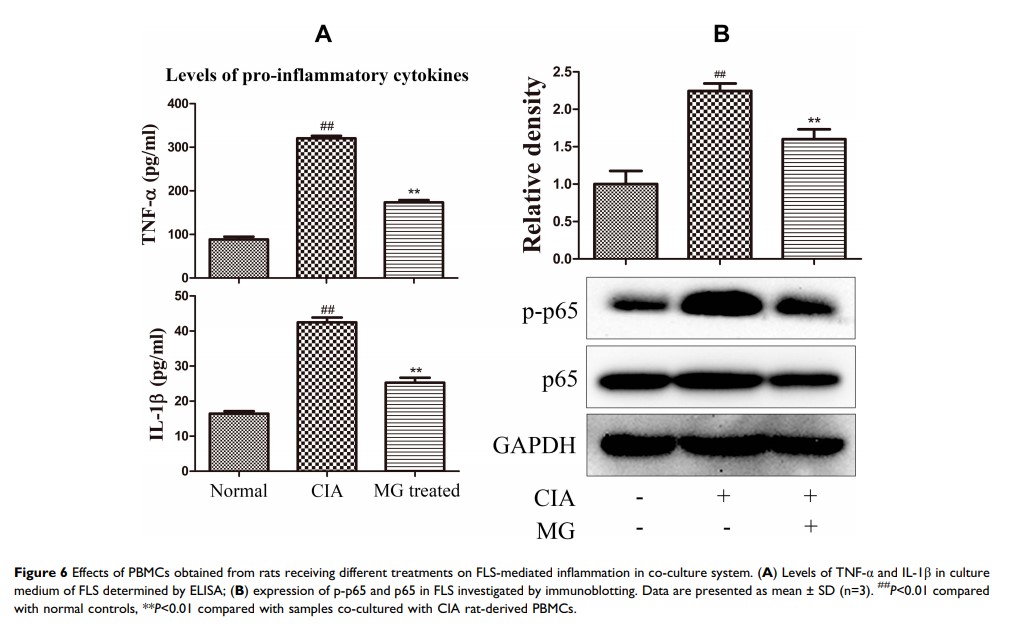
Results: MG promoted α 7nAChR expression in PBMCs both in vivo and in vitro, and inhibited the enzymatic activity of AChE simultaneously. Activation of the CAP was accompanied by a significant decrease in Th17 cells (CD4+IL-17A+), while no obvious changes concerning the distribution of other T-cell subsets were noticed upon MG treatment. Meanwhile, MG decreased the secretion of TNF-α and IL-1β under inflammatory conditions. PBMCs from MG-treated CIA rats lost the potential to stimulate NF-κB activation and pro-inflammatory cytokine production of FLSs in the co-culture system.
Conclusion: Overall, the evidence suggested that MG can improve the peripheral immune milieu in CIA rats by suppressing Th17-cell differentiation through CAP activation, and achieve remission of inflammation mediated by FLSs.
Keywords: rheumatoid arthritis, α-mangostin, choline anti-inflammatory pathway, α 7-nicotinic cholinergic receptor, Th17/Treg