115195
论文已发表
注册即可获取德孚的最新动态
IF 收录期刊
- 3.6 Breast Cancer (Dove Med Press)
- 4.3 Clin Epidemiol
- 2.6 Cancer Manag Res
- 3.2 Infect Drug Resist
- 4.1 Clin Interv Aging
- 6.1 Drug Des Dev Ther
- 4.1 Int J Chronic Obstr
- 8.7 Int J Nanomed
- 2.5 Int J Women's Health
- 3.2 Neuropsych Dis Treat
- 2.4 OncoTargets Ther
- 2.6 Patient Prefer Adher
- 2.6 Ther Clin Risk Manag
- 3.1 J Pain Res
- 3.5 Diabet Metab Synd Ob
- 4.5 Psychol Res Behav Ma
- 3.4 Nat Sci Sleep
- 2.4 Pharmgenomics Pers Med
- 2.6 Risk Manag Healthc Policy
- 4.6 J Inflamm Res
- 2.3 Int J Gen Med
- 3.9 J Hepatocell Carcinoma
- 3.3 J Asthma Allergy
- 2.5 Clin Cosmet Investig Dermatol
- 3.0 J Multidiscip Healthc

LINC02381 通过靶向 miR-133b 促进宫颈癌细胞的细胞活力和迁移
Authors Chen X, Zhang Z, Ma Y, Su H, Xie P, Ran J
Received 4 November 2019
Accepted for publication 19 April 2020
Published 26 May 2020 Volume 2020:12 Pages 3971—3979
DOI https://doi.org/10.2147/CMAR.S237285
Checked for plagiarism Yes
Review by Single-blind
Peer reviewer comments 2
Editor who approved publication: Dr Sanjeev Srivastava
Background: It has been proved that lncRNAs could function as CeRNA for miRNAs in tumor growth and metastasis for cervical cancer. This paper aims to identify the role of LINC02381 in cervical cancer cells.
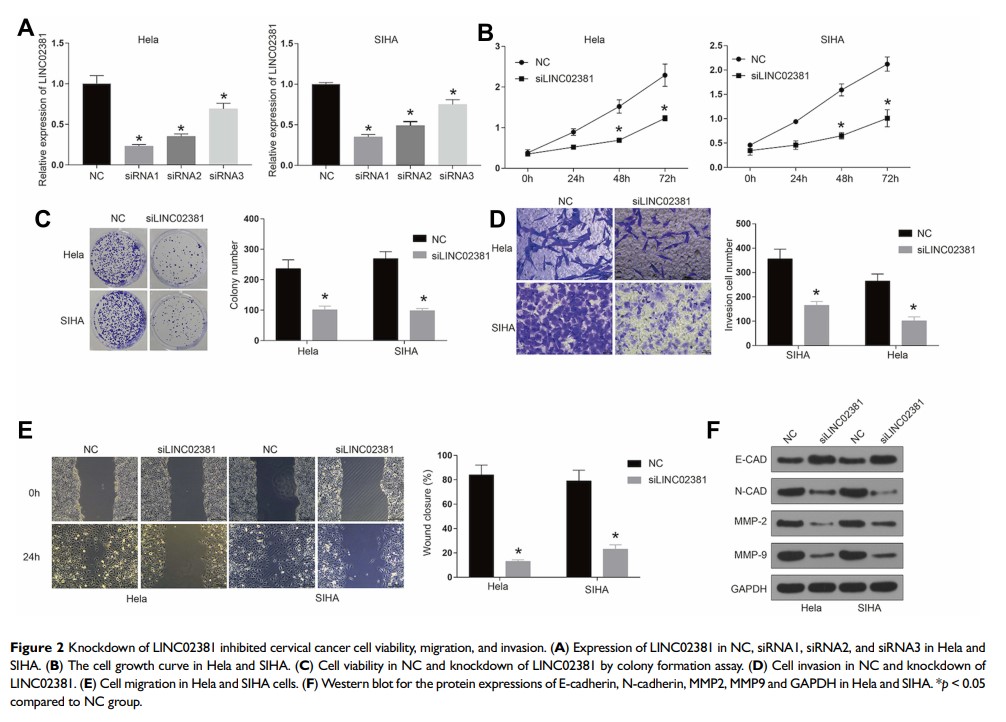
Materials and Methods: RT-qPCR was utilized to measure the expression levels of LINC02381 in cervical cancer tissues and cells. MTT, colony formation assay, transwell assay, RT-qPCR, and Western blotting were performed to investigate the roles of LINC02381 in cervical cancer cells. RegRNA 2.0 was used to predict the miRNA-binding sites of LINC02381. Luciferase reporter assay and RT-qPCR were employed to confirm the sponging effect between miR-133b and LINC02381.
Results: This study showed that LINC02381 was up-regulated in cervical cancer cells and acted as an oncogene in the development of cervical cancer. LINC02381 promoted cell viability and metastasis via sponging miR-133b. Moreover, miR-133b could target its downstream mediator of RhoA and inhibit its expression.
Conclusion: Overall, our results indicated that LINC02381 functions as an oncogene in cervical cancer and could serve as a novel target for cervical cancer therapies in the future.
Keywords: LINC02381, miR-133b, RhoA, cervical cancer, cell viability