115195
论文已发表
注册即可获取德孚的最新动态
IF 收录期刊
- 3.6 Breast Cancer (Dove Med Press)
- 4.3 Clin Epidemiol
- 2.6 Cancer Manag Res
- 3.2 Infect Drug Resist
- 4.1 Clin Interv Aging
- 6.1 Drug Des Dev Ther
- 4.1 Int J Chronic Obstr
- 8.7 Int J Nanomed
- 2.5 Int J Women's Health
- 3.2 Neuropsych Dis Treat
- 2.4 OncoTargets Ther
- 2.6 Patient Prefer Adher
- 2.6 Ther Clin Risk Manag
- 3.1 J Pain Res
- 3.5 Diabet Metab Synd Ob
- 4.5 Psychol Res Behav Ma
- 3.4 Nat Sci Sleep
- 2.4 Pharmgenomics Pers Med
- 2.6 Risk Manag Healthc Policy
- 4.6 J Inflamm Res
- 2.3 Int J Gen Med
- 3.9 J Hepatocell Carcinoma
- 3.3 J Asthma Allergy
- 2.5 Clin Cosmet Investig Dermatol
- 3.0 J Multidiscip Healthc

老年髋部骨折患者早期术后主要心血管事件和院内死亡率的预测:术前不同类型心脏异常的超声心动图报告的作用
Authors Chen X, Ma Y, Deng Z, Li Q, Liao J, Zheng Q
Received 20 February 2020
Accepted for publication 11 May 2020
Published 27 May 2020 Volume 2020:15 Pages 755—762
DOI https://doi.org/10.2147/CIA.S250620
Checked for plagiarism Yes
Review by Single-blind
Peer reviewer comments 2
Editor who approved publication: Dr Zhi-Ying Wu
Introduction: Transthoracic echocardiography (TTE) is a common cardiac screening test before hip fracture surgery. However, the general TTE test delays surgery, so it would be meaningful if we could simplify the TTE by only assessing cardiac abnormality specifically. Therefore, we aimed to establish the most clinically relevant abnormality by comparing the predictive value of each major cardiac abnormality in postoperative cardiac complications and mortality in elderly hip fracture patients.
Patients and Methods: From January 2014 to January 2019, the medical records of all surgically treated elderly patients (> 65 years) with hip fracture were analyzed. The major TTE abnormalities were defined as left ventricular hypertrophy, systolic pulmonary arterial pressure > 25 mm Hg, moderate-severe valve abnormality, left ventricular ejection fraction (LVEF) < 50%, and pericardial effusion. The outcomes were postoperative cardiac complications and in-hospital mortality.
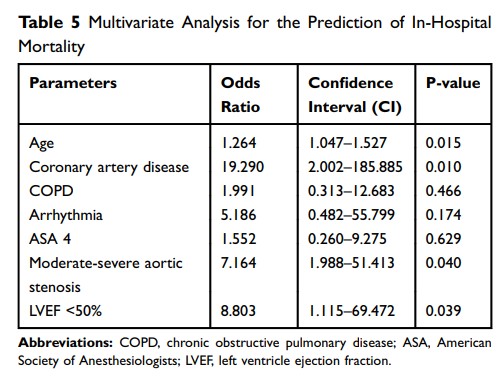
Results: There were 354 patients involved finally. Postoperative cardiac complications were encountered in 7.6% (n=27) of patients. The mortality rate was 2.8% (n=10). History of coronary artery disease (CAD) (OR: 3.281, 95% CI: 1.332– 8.079, p=0.010) and presence of aortic stenosis (AS) (OR:5.656, 95% CI: 1.869– 17.117, p=0.002) were independent predictors of postoperative cardiac complications. In addition, age (OR: 1.264, 95% CI: 1.047– 1.527, p=0.015), history of CAD (OR: 19.290, 95% CI: 2.002– 185.885, p=0.010), presence of AS (OR:7.164, 95% CI: 1.988– 51.413, p=0.040) and LVEF < 50% (OR:8.803, 95% CI: 1.115– 69.472, p=0.039) were independent predictors of mortality. However, the rest of preoperative TTE abnormalities were not associated with postoperative cardiac complications or mortality.
Conclusion: Among the TTE abnormalities presented by elderly patients with hip fracture, moderate-severe AS was the predictor of postoperative cardiac complications. Moreover, moderate-severe AS and LVEF < 50% were the predictors of in-hospital mortality. Therefore, we could simplify the TTE process by assessing aortic valve and LVEF specifically on focused echocardiography, which could avoid surgery delay.
Keywords: aging, hip fracture surgery, mortality, postoperative cardiac complications, echocardiographic abnormality