115195
论文已发表
注册即可获取德孚的最新动态
IF 收录期刊
- 3.6 Breast Cancer (Dove Med Press)
- 4.3 Clin Epidemiol
- 2.6 Cancer Manag Res
- 3.2 Infect Drug Resist
- 4.1 Clin Interv Aging
- 6.1 Drug Des Dev Ther
- 4.1 Int J Chronic Obstr
- 8.7 Int J Nanomed
- 2.5 Int J Women's Health
- 3.2 Neuropsych Dis Treat
- 2.4 OncoTargets Ther
- 2.6 Patient Prefer Adher
- 2.6 Ther Clin Risk Manag
- 3.1 J Pain Res
- 3.5 Diabet Metab Synd Ob
- 4.5 Psychol Res Behav Ma
- 3.4 Nat Sci Sleep
- 2.4 Pharmgenomics Pers Med
- 2.6 Risk Manag Healthc Policy
- 4.6 J Inflamm Res
- 2.3 Int J Gen Med
- 3.9 J Hepatocell Carcinoma
- 3.3 J Asthma Allergy
- 2.5 Clin Cosmet Investig Dermatol
- 3.0 J Multidiscip Healthc

破裂前镜像动脉瘤的血流动力学和形态分析
Authors Yuan J, Huang C, Lai N, Li Z, Jiang X, Wang X, Zhao X, Wu D, Liu J, Xia D, Fang X
Received 16 March 2020
Accepted for publication 6 May 2020
Published 27 May 2020 Volume 2020:16 Pages 1339—1347
DOI https://doi.org/10.2147/NDT.S254124
Checked for plagiarism Yes
Review by Single-blind
Peer reviewer comments 2
Editor who approved publication: Dr Yuping Ning
Objective: Hemodynamic factors are thought to play important roles in the pathogenesis, progression, and rupture of cerebral aneurysms. Previous hemodynamic studies have been based on comparisons between post-ruptured and unruptured aneurysms. Nevertheless, changes of aneurysm morphology after rupture render these results unreliable. Moreover, pressure, age, gender, and the morphology of the parent artery also influence these results. Therefore, in the present study, we identified hemodynamic and morphological characteristics of aneurysms prior to rupture using twelve mirror aneurysms.
Materials and Methods: From our database, we retrospectively analyzed twelve mirror aneurysms (MANs) prior to rupture. Each mirror aneurysm was divided into the prior to rupture or the unruptured group. Patient-specific models were reconstructed from three-dimensional (3D) images of all patients. Hemodynamic and morphological factors were analyzed and compared.
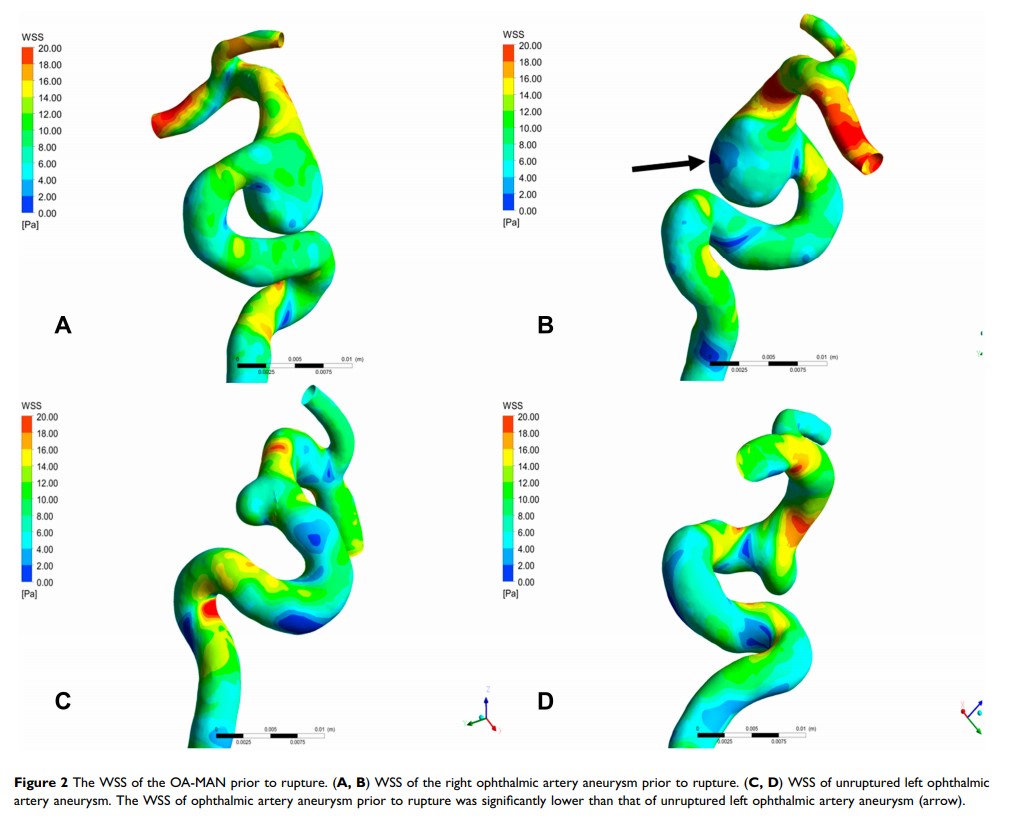
Results: Compared with the unruptured side of MANs, aneurysms prior to rupture were significantly larger and significantly more irregular in shape; they also had significantly higher aspect ratio (AR), size ratio (SR), undulation index (UI), ellipticity index (EI), percentage of low wall shear stress area (LSA) and significantly lower normal wall shear stress (NWSS). The oscillatory shear index (OSI) and nonsphericity index (NSI) in the aneurysms prior to rupture were non-significantly higher than those of the unruptured group.
Conclusion: MANs prior to rupture may be extremely useful models to assess the risk of aneurysm rupture. Larger size, irregular shape, higher AR, SR, UI, NI, and lower WSS may be associated with aneurysms at risk for rupture.
Keywords: mirror aneurysms, computational fluid dynamics, hemodynamics, morphological, rupture