115195
论文已发表
注册即可获取德孚的最新动态
IF 收录期刊
- 3.6 Breast Cancer (Dove Med Press)
- 4.3 Clin Epidemiol
- 2.6 Cancer Manag Res
- 3.2 Infect Drug Resist
- 4.1 Clin Interv Aging
- 6.1 Drug Des Dev Ther
- 4.1 Int J Chronic Obstr
- 8.7 Int J Nanomed
- 2.5 Int J Women's Health
- 3.2 Neuropsych Dis Treat
- 2.4 OncoTargets Ther
- 2.6 Patient Prefer Adher
- 2.6 Ther Clin Risk Manag
- 3.1 J Pain Res
- 3.5 Diabet Metab Synd Ob
- 4.5 Psychol Res Behav Ma
- 3.4 Nat Sci Sleep
- 2.4 Pharmgenomics Pers Med
- 2.6 Risk Manag Healthc Policy
- 4.6 J Inflamm Res
- 2.3 Int J Gen Med
- 3.9 J Hepatocell Carcinoma
- 3.3 J Asthma Allergy
- 2.5 Clin Cosmet Investig Dermatol
- 3.0 J Multidiscip Healthc

中国一家三级医院碳青霉烯类耐药的阴沟肠杆菌的分子特征
Authors Jin C, Zhou F, Cui Q, Qiang J, An C
Received 15 March 2020
Accepted for publication 8 May 2020
Published 28 May 2020 Volume 2020:13 Pages 1575—1581
DOI https://doi.org/10.2147/IDR.S254056
Checked for plagiarism Yes
Review by Single-blind
Peer reviewer comments 2
Editor who approved publication: Professor Suresh Antony
Background: Infections caused by the carbapenem-resistant Enterobacter cloacae (CREC) bring great challenges to the clinical treatment and pose a serious threat to public health. In this study, we investigated the molecular characteristics of CREC in a tertiary hospital.
Materials and Methods: A total of 12 non-duplicate CREC strains isolated during the period of November 2016 to July 2019 were subjected to automated microbial identification and antimicrobial susceptibility testing (AST) using the BD Phoenix-100 identification and antimicrobial susceptibility testing (ID/AST) system. The strains were also subjected to phenotypic screening for the detection of antibiotic resistance genes such as the carbapenemase and other β-lactamase genes, with the use of the polymerase chain reaction assay (PCR). Finally, multi-locus sequence typing (MLST) and pulsed-field gel electrophoresis (PFGE)-based homology analysis were applied.
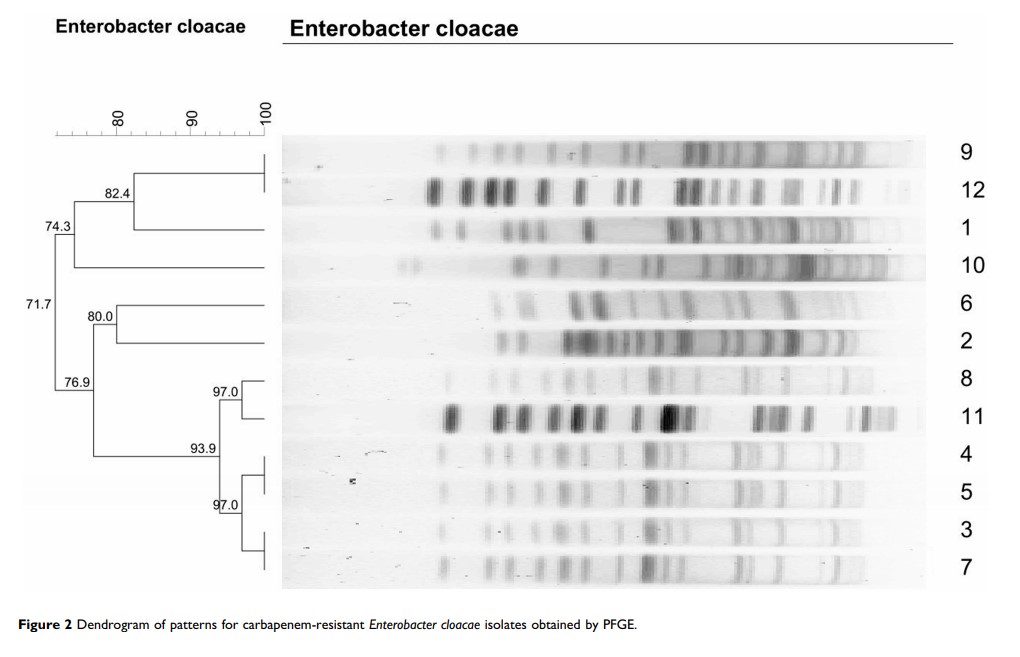
Results: Four types of carbapenemases namely IMP-26, NDM-5, NDM-1, and KPC-2 were identified in 12 CREC strains. IMP-26 was the most prevalent type (6/12 strains, 50 %), followed by NDM-5 (3/12 strains, 25 %). The results of MLST revealed that these 12 strains could be divided into five sequence types (STs) among which ST544 was the dominant type (6/12 strains, 50 %). The PFGE results divided the 12 strains into four clusters.
Conclusion: Our study indicated that the epidemics of the IMP-26-producing E. cloacae ST544 strain did occur in the intensive care unit (ICU) of a tertiary hospital. Therefore, early surveillance and strict implementation of control measures are crucial for the prevention of nosocomial infections and transmissions in hospitals.
Keywords: Enterobacter cloacae , carbapenemase, IMP-26, ST544