115195
论文已发表
注册即可获取德孚的最新动态
IF 收录期刊
- 3.6 Breast Cancer (Dove Med Press)
- 4.3 Clin Epidemiol
- 2.6 Cancer Manag Res
- 3.2 Infect Drug Resist
- 4.1 Clin Interv Aging
- 6.1 Drug Des Dev Ther
- 4.1 Int J Chronic Obstr
- 8.7 Int J Nanomed
- 2.5 Int J Women's Health
- 3.2 Neuropsych Dis Treat
- 2.4 OncoTargets Ther
- 2.6 Patient Prefer Adher
- 2.6 Ther Clin Risk Manag
- 3.1 J Pain Res
- 3.5 Diabet Metab Synd Ob
- 4.5 Psychol Res Behav Ma
- 3.4 Nat Sci Sleep
- 2.4 Pharmgenomics Pers Med
- 2.6 Risk Manag Healthc Policy
- 4.6 J Inflamm Res
- 2.3 Int J Gen Med
- 3.9 J Hepatocell Carcinoma
- 3.3 J Asthma Allergy
- 2.5 Clin Cosmet Investig Dermatol
- 3.0 J Multidiscip Healthc

CircRNA-PTN 使 miR-326 海绵化以促进肝细胞癌的增殖
Authors Jia B, Yin X, Wang Y, Qian J, He Y, Yang C, Yu G, Guo B, Meng X
Received 18 March 2020
Accepted for publication 1 May 2020
Published 29 May 2020 Volume 2020:13 Pages 4893—4903
DOI https://doi.org/10.2147/OTT.S251300
Checked for plagiarism Yes
Review by Single-blind
Peer reviewer comments 2
Editor who approved publication: Dr Federico Perche
Background: Mounting evidences reveal that circular RNAs (circRNAs) are critical to regulate biological behavior and process of tumor. Our objective is to explore the role of circRNA-PTN (circPTN) and explain the exact mechanism in hepatocellular carcinoma (HCC).
Methods: Real-time polymerase chain reaction assay was used to detect the level of circPTN and miR-326. The proliferation of cell was measured by CCK-8 assay and EdU assay. Western blot assay was performed to assess ErbB/PI3K expression. Luciferase and RNA pull-down assays were carried out to confirm the interaction between circPTN and miR-326.
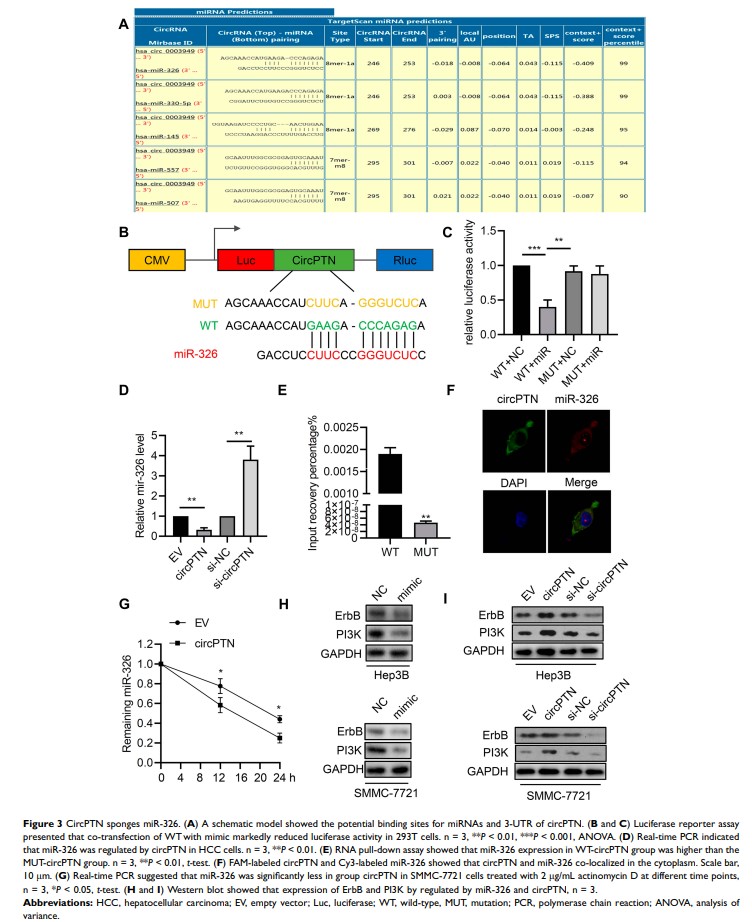
Results: Our results indicated that circPTN was upregulated in human hepatocellular carcinoma tumor tissues and cell lines, compared with paratumor tissues and immortalized normal liver cell line. circPTN could significantly promote HCC tumor growth according to gain-and loss-of-function assays. Additionally, we determined that circPTN acted as a sponge through interacting with miR-326. Overexpression of miR-326 could rescue the cell proliferation inhibition and ErbB/PI3K downregulation in HCC cells by circPTN. Besides, the effects of miR-326 on HCC were missing when circPTN binding sites were mutated.
Conclusion: Our study indicates that circPTN acts as an oncogenic factor via sponging miR-326 in HCC.
Keywords: circRNA-PTN, HCC, miR-326, proliferation