115195
论文已发表
注册即可获取德孚的最新动态
IF 收录期刊
- 3.6 Breast Cancer (Dove Med Press)
- 4.3 Clin Epidemiol
- 2.6 Cancer Manag Res
- 3.2 Infect Drug Resist
- 4.1 Clin Interv Aging
- 6.1 Drug Des Dev Ther
- 4.1 Int J Chronic Obstr
- 8.7 Int J Nanomed
- 2.5 Int J Women's Health
- 3.2 Neuropsych Dis Treat
- 2.4 OncoTargets Ther
- 2.6 Patient Prefer Adher
- 2.6 Ther Clin Risk Manag
- 3.1 J Pain Res
- 3.5 Diabet Metab Synd Ob
- 4.5 Psychol Res Behav Ma
- 3.4 Nat Sci Sleep
- 2.4 Pharmgenomics Pers Med
- 2.6 Risk Manag Healthc Policy
- 4.6 J Inflamm Res
- 2.3 Int J Gen Med
- 3.9 J Hepatocell Carcinoma
- 3.3 J Asthma Allergy
- 2.5 Clin Cosmet Investig Dermatol
- 3.0 J Multidiscip Healthc

在对慢性阻塞性肺疾病患者阻塞性睡眠呼吸暂停的筛查中,肺功能对柏林问卷、改良后的柏林问卷和 STOP-Bang 问卷评分的影响
Authors Wu Q, Xie L, Li W, Xiang G, Hu W, Jiang H, Wu X, Wu X, Li S
Received 3 February 2020
Accepted for publication 13 May 2020
Published 29 May 2020 Volume 2020:15 Pages 1207—1216
DOI https://doi.org/10.2147/COPD.S248139
Checked for plagiarism Yes
Review by Single-blind
Peer reviewer comments 4
Editor who approved publication: Prof. Dr. Chunxue Bai
Purpose: The co-existence of chronic obstructive pulmonary disease (COPD) and obstructive sleep apnea (OSA) has been described as the overlap syndrome. The objective of the study is to investigate the performance of Berlin Questionnaire (BQ), modified Berlin Questionnaire (MBQ), and STOP-Bang score in screening overlap syndrome from COPD subjects and investigate how pulmonary function interferes with questionnaire scoring.
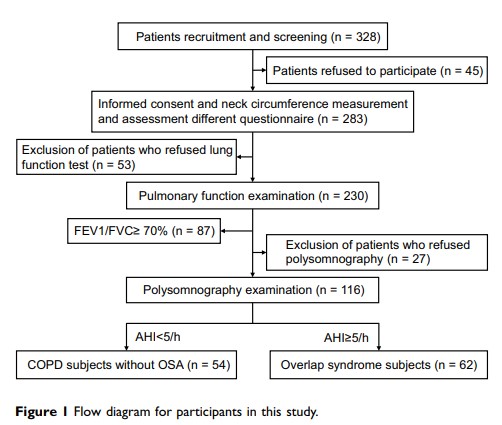
Subjects and Methods: Among 116 COPD subjects included in this study, 62 were overlap syndrome subjects and 54 were COPD subjects without OSA. Subjects included were asked to fill out the questionnaires to collect demographic characteristics of subjects and questionnaire scores of BQ, MBQ, and STOP-Bang; perform pulmonary function test to confirm their COPD diagnosis; and perform polysomnography.
Results: AUC (area under the curve) of BQ, MBQ, and STOP-Bang score in screening OSA among patients with COPD was 0.71 (0.64– 0.79), 0.75 (0.67– 0.83), and 0.72 (0.64– 0.80). In COPD subjects without OSA, FEV1%pred was statistically associated with the misdiagnosis of BQ (P= 0.0091), MBQ (P= 0.0143), and STOP-Bang (P= 0.0453). In patients with overlap syndrome, FVC%pred affected the risk of misdiagnosis of the three questionnaires (BQ: P= 0.0413; MBQ: P= 0.0150; STOP-Bang: P= 0.0241). BMI and neck circumferences (NC) were negatively correlated with FEV1%pred (BMI: P= 0.0454; NC: P= 0.0230) and FVC%pred (BMI: P= 0.0042; NC: P= 0.0367) in overlap subjects. In contrast, BMI was positively correlated with FEV1/FVC (P= 0.0141) and FEV1%pred (P= 0.0391) in COPD subjects without OSA.
Conclusion: BQ, MBQ, and STOP-Bang score performed well in COPD subjects for screening OSA. The diagnosis of the three questionnaires was more accurate in subjects with lower FEV1%pred or FVC%pred value. Pulmonary function might exert influence on the diagnosis efficacy of the three questionnaires through BMI and neck circumference.
Keywords: pulmonary disease, chronic obstructive, sleep apnea, obstructive, surveys and questionnaires, pulmonary ventilation