115195
论文已发表
注册即可获取德孚的最新动态
IF 收录期刊
- 3.6 Breast Cancer (Dove Med Press)
- 4.3 Clin Epidemiol
- 2.6 Cancer Manag Res
- 3.2 Infect Drug Resist
- 4.1 Clin Interv Aging
- 6.1 Drug Des Dev Ther
- 4.1 Int J Chronic Obstr
- 8.7 Int J Nanomed
- 2.5 Int J Women's Health
- 3.2 Neuropsych Dis Treat
- 2.4 OncoTargets Ther
- 2.6 Patient Prefer Adher
- 2.6 Ther Clin Risk Manag
- 3.1 J Pain Res
- 3.5 Diabet Metab Synd Ob
- 4.5 Psychol Res Behav Ma
- 3.4 Nat Sci Sleep
- 2.4 Pharmgenomics Pers Med
- 2.6 Risk Manag Healthc Policy
- 4.6 J Inflamm Res
- 2.3 Int J Gen Med
- 3.9 J Hepatocell Carcinoma
- 3.3 J Asthma Allergy
- 2.5 Clin Cosmet Investig Dermatol
- 3.0 J Multidiscip Healthc

miR-100-5p 通过靶向 IGF1R 抑制脊索瘤细胞的恶性行为
Authors Zhang H, Yang K, Ren T, Huang Y, Liang X, Yu Y, Wang W, Niu J, Lou J, Tang X, Guo W
Received 2 March 2020
Accepted for publication 13 May 2020
Published 2 June 2020 Volume 2020:12 Pages 4129—4137
DOI https://doi.org/10.2147/CMAR.S252185
Checked for plagiarism Yes
Review by Single-blind
Peer reviewer comments 2
Editor who approved publication: Dr Sanjeev Srivastava
Purpose: Our research aimed to illuminate the role of miR-100-5p in chordoma and potential mechanism.
Materials and Methods: We used microRNA array analysis to explore differentially expressed miRNAs in chordoma tissue and then verified by qRT-PCR. Cell proliferation and transwell assay were used to evaluate the function of miR-100-5p. Cell apoptosis was analyzed by flow cytometry, and using biological software, we predicted that the insulin-like growth factor 1 receptor (IGF1R) could be the target gene of miR-100-5p, which was then validated by dual luciferase assays and Western blot.
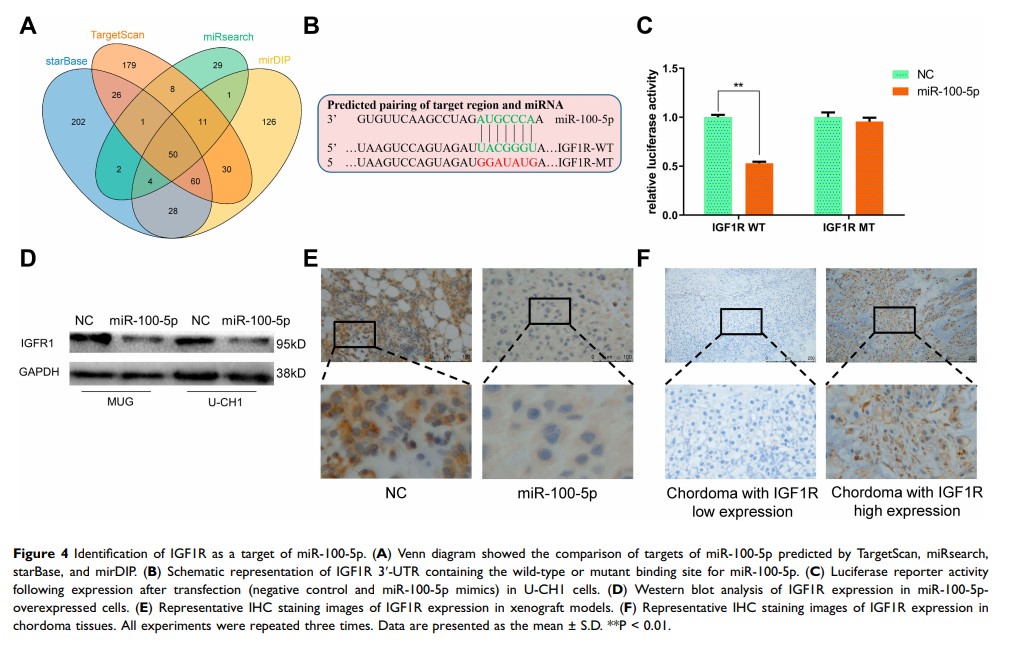
Results: miR-100-5p was downregulated in chordoma tissues. Overexpression of miR-100-5p could suppress the growth of chordoma both in vitro and in vivo, and miR-100-5p could inhibit the migration and invasion of chordoma cells partially by suppressing epithelial–mesenchymal transition (EMT). Furthermore, IGF1R was validated as the target gene of miR-100-5p and expressed in most chordoma tissues.
Conclusion: In conclusion, our results showed that miR-100-5p was lowly expressed in chordoma and inhibited tumor malignant progression by targeting IGF1R.
Keywords: chordoma, miRNA, miR-100-5p, IGF1R