115195
论文已发表
注册即可获取德孚的最新动态
IF 收录期刊
- 3.6 Breast Cancer (Dove Med Press)
- 4.3 Clin Epidemiol
- 2.6 Cancer Manag Res
- 3.2 Infect Drug Resist
- 4.1 Clin Interv Aging
- 6.1 Drug Des Dev Ther
- 4.1 Int J Chronic Obstr
- 8.7 Int J Nanomed
- 2.5 Int J Women's Health
- 3.2 Neuropsych Dis Treat
- 2.4 OncoTargets Ther
- 2.6 Patient Prefer Adher
- 2.6 Ther Clin Risk Manag
- 3.1 J Pain Res
- 3.5 Diabet Metab Synd Ob
- 4.5 Psychol Res Behav Ma
- 3.4 Nat Sci Sleep
- 2.4 Pharmgenomics Pers Med
- 2.6 Risk Manag Healthc Policy
- 4.6 J Inflamm Res
- 2.3 Int J Gen Med
- 3.9 J Hepatocell Carcinoma
- 3.3 J Asthma Allergy
- 2.5 Clin Cosmet Investig Dermatol
- 3.0 J Multidiscip Healthc

预测严重骨髓抑制及其对接受甲氨蝶呤单药化疗的低风险妊娠滋养细胞肿瘤患者生育力影响的因素
Authors Tu X, Chen R, Huang G, Lu N, Chen Q, Bai X, Li B
Received 5 March 2020
Accepted for publication 6 May 2020
Published 2 June 2020 Volume 2020:12 Pages 4107—4116
DOI https://doi.org/10.2147/CMAR.S252664
Checked for plagiarism Yes
Review by Single-blind
Peer reviewer comments 2
Editor who approved publication: Dr Eileen O'Reilly
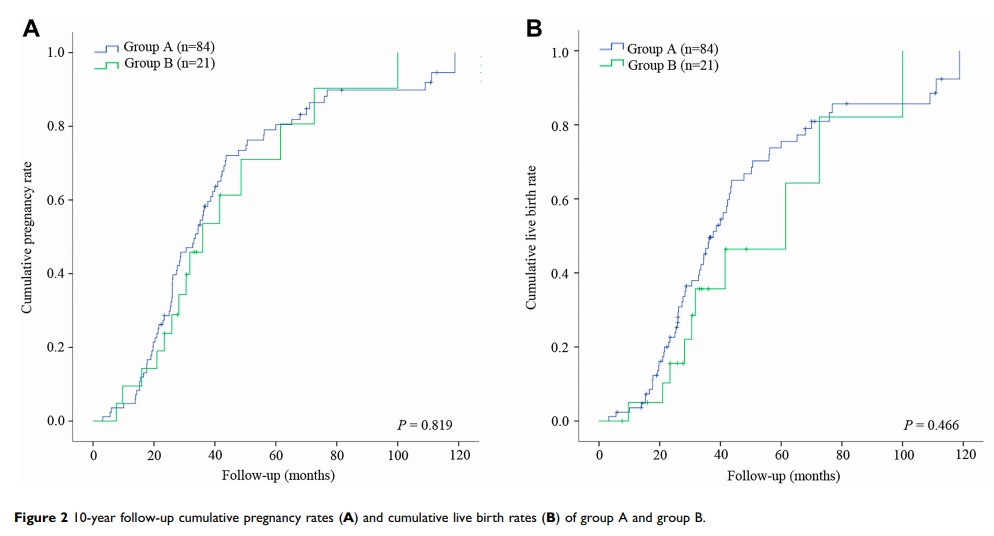
Purpose: To investigate the potential factors to predict severe myelosuppression among low-risk gestational trophoblastic neoplasia (GTN) patients with single-agent methotrexate (MTX) chemotherapy. To analyze reproductive outcomes of patients with or without severe myelosuppression after achieving complete remission (CR).
Patients and Methods: The retrospective study included 319 low-risk GTN patients registered from January 2008 to December 2018 in our hospital. Patients were divided into two groups according to myelosuppression grading. Their clinical data and reproductive outcomes were compared and analyzed.
Results: A higher proportion of patients in group A received second-line chemotherapy than group B (P < 0.001). The number of total chemotherapy courses was more in group A than group B (P =0.001), while the number of MTX chemotherapy courses was more in group B than group A (P =0.001). When the joint predictor of pretreatment albumin (ALB) was not more than 44.5 g/L, pretreatment serum creatinine (Scr) was not less than 75.6 μmol/L, and the number of MTX chemotherapy courses was not less than four, there was a moderate predictive value. There was no significant difference of reproductive outcomes between the two groups after achieving CR.
Conclusion: Although some patients developed severe myelosuppression, MTX was still the effective first-line treatment for low-risk GTN patients. Patient’s pretreatment ALB was not more than 44.5 g/L, pretreatment Scr was not less than 75.6 μmol/L, and the number of MTX chemotherapy courses not less than four could be used as combined predictors to recognize the risk of severe myelosuppression. Severe myelosuppression had no significant adverse influence on fertility after achieving CR.
Keywords: gestational trophoblastic neoplasia, methotrexate, myelosuppression, fertility