115195
论文已发表
注册即可获取德孚的最新动态
IF 收录期刊
- 3.6 Breast Cancer (Dove Med Press)
- 4.3 Clin Epidemiol
- 2.6 Cancer Manag Res
- 3.2 Infect Drug Resist
- 4.1 Clin Interv Aging
- 6.1 Drug Des Dev Ther
- 4.1 Int J Chronic Obstr
- 8.7 Int J Nanomed
- 2.5 Int J Women's Health
- 3.2 Neuropsych Dis Treat
- 2.4 OncoTargets Ther
- 2.6 Patient Prefer Adher
- 2.6 Ther Clin Risk Manag
- 3.1 J Pain Res
- 3.5 Diabet Metab Synd Ob
- 4.5 Psychol Res Behav Ma
- 3.4 Nat Sci Sleep
- 2.4 Pharmgenomics Pers Med
- 2.6 Risk Manag Healthc Policy
- 4.6 J Inflamm Res
- 2.3 Int J Gen Med
- 3.9 J Hepatocell Carcinoma
- 3.3 J Asthma Allergy
- 2.5 Clin Cosmet Investig Dermatol
- 3.0 J Multidiscip Healthc

中度至重度阻塞性睡眠呼吸暂停低通气综合症(OSAHS)成人患者网络拓扑正规化:结构磁共振成像研究
Authors Liu W, Cao C, Hu B, Li D, Sun Y, Wu J, Zhang Q
Received 6 February 2020
Accepted for publication 11 May 2020
Published 8 June 2020 Volume 2020:12 Pages 333—345
DOI https://doi.org/10.2147/NSS.S248643
Checked for plagiarism Yes
Review by Single-blind
Peer reviewer comments 2
Editor who approved publication: Dr Sutapa Mukherjee
Objective: Patients with obstructive sleep apnea-hypopnea syndrome (OSAHS) exhibit neurocognitive impairments; however, the neuroimaging mechanism of neurocognitive impairments remains unclear. The aim of this study was to understand the neuroimaging mechanism in adult patients with moderate-to-severe OSAHS, from the perspective of the connectome.
Patients and Methods: Thirty-one untreated patients with moderate-to-severe OSAHS (mean age: 41.23± 8.22) were compared with 26 good sleepers (GS) (mean age: 39.50± 7.92) matched according to age, gender, handedness, and education level. All subjects underwent thin-slice T1WI scanning of the skull using a 3.0T MRI. Then, a large-scale structural covariance network was constructed based on the gray matter volume extracted from the structural MRI. Graph theory was then used to determine the topological changes in the structural covariance network of OSAHS patients.
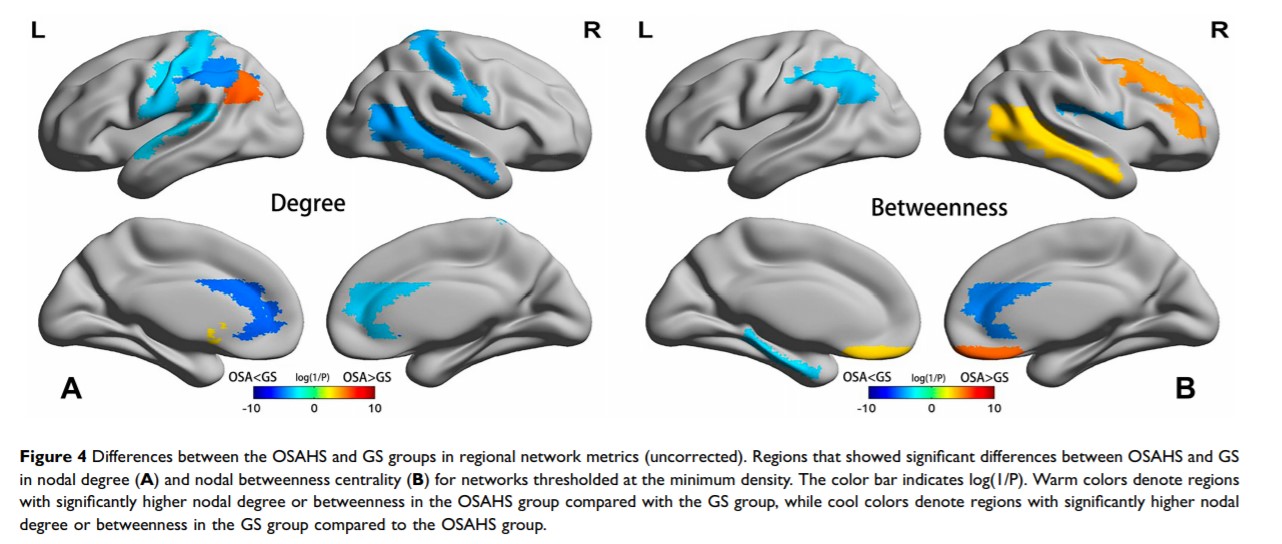
Results: Although small-world networks were retained,the structural covariance network exhibited topological irregularities in regular architecture as evidenced by an increase in the clustering coefficient (p =0.009), transfer coefficient (p =0.029) and local efficiency (p =0.031), and a local increase in the shortest path length (p < 0.05) compared with the GS group. Locally, OSAHS patients showed a decrease in nodal betweenness and degree in the left inferior parietal gyrus, left angular gyrus and right anterior cingulate cortex compared with the GS group (p < 0.05, uncorrected). In addition, the resistance of structural covariance networks in OSAHS patients to random fault is significantly lower than that of the GS group (p =0.044).
Conclusion: Structural covariance networks are abnormal in terms of multiple network parameters, which provide network-level insight into the neuroimaging mechanism of cognitive impairments in adult OSAHS patients.
Keywords: obstructive sleep apnea-hypopnea syndrome, cognitive impairment, connectome, graph theory, gray matter volume