115195
论文已发表
注册即可获取德孚的最新动态
IF 收录期刊
- 3.6 Breast Cancer (Dove Med Press)
- 4.3 Clin Epidemiol
- 2.6 Cancer Manag Res
- 3.2 Infect Drug Resist
- 4.1 Clin Interv Aging
- 6.1 Drug Des Dev Ther
- 4.1 Int J Chronic Obstr
- 8.7 Int J Nanomed
- 2.5 Int J Women's Health
- 3.2 Neuropsych Dis Treat
- 2.4 OncoTargets Ther
- 2.6 Patient Prefer Adher
- 2.6 Ther Clin Risk Manag
- 3.1 J Pain Res
- 3.5 Diabet Metab Synd Ob
- 4.5 Psychol Res Behav Ma
- 3.4 Nat Sci Sleep
- 2.4 Pharmgenomics Pers Med
- 2.6 Risk Manag Healthc Policy
- 4.6 J Inflamm Res
- 2.3 Int J Gen Med
- 3.9 J Hepatocell Carcinoma
- 3.3 J Asthma Allergy
- 2.5 Clin Cosmet Investig Dermatol
- 3.0 J Multidiscip Healthc

关于转移性非小细胞肺癌(NSCLC)一线治疗中靶向治疗的卫生经济学评价的系统回顾:质量评估
Authors Zhao J, Du S, Zhu Y, Liang Y, Lu J, Chang F
Received 6 February 2020
Accepted for publication 4 May 2020
Published 9 June 2020 Volume 2020:12 Pages 4357—4368
DOI https://doi.org/10.2147/CMAR.S248471
Checked for plagiarism Yes
Review by Single-blind
Peer reviewer comments 2
Editor who approved publication: Dr Eileen O'Reilly
Background: Evolving practices in non-small cell lung cancer (NSCLC) therapy inevitably affect health care budgets, especially through the introduction of targeted therapies. This results in a rise of health economic evaluations (HEEs) in this domain. This article reviews the quality of the economic evidence of targeted therapies used in metastatic NSCLC.
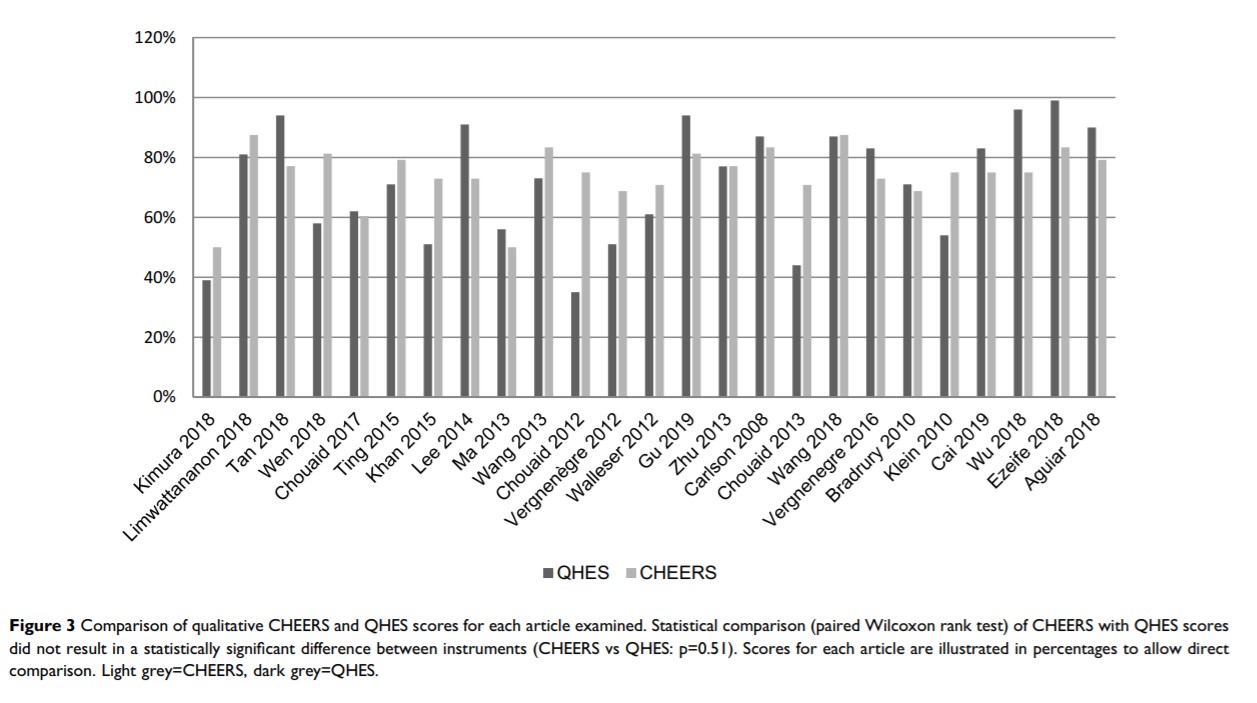
Methods: A literature search was conducted using PubMed, Cochrane, Embase and CRD (University of York Centre for Reviews and Dissemination) databases to identify topical original articles published between 1/1/2000 and 3/31/2019. A quality of reporting assessment using the CHEERS (Consolidated Health Economic Evaluation Reporting Standards statement) checklist was converted into a quantitative score and compared with the results of a QHES (Quality of Health Economic Studies) evaluation. Components of QHES were also used to analyze the validity of primary outcomes, consideration of heterogeneity and rationality of main assumptions of models in modeling studies.
Results: In total, 25 HEEs were obtained and analyzed. From the CHEERS assessment, it was found that method description integrity (including setting, perspective, time horizon and discount rate), justification of data sources and a heterogeneity description were often absent or incomplete. Only five examined studies met the accepted standard of good quality. Modeled articles were examined with the QHES instrument, and a lack of illustrated structure, population variability, formula of the transitioning probability and justification for the choice of the model were the most frequently observed problems in the selected studies. After quantification, the CHEERS scores and QHES scores did not differ significantly.
Conclusion: Current NSCLC models generally lack consideration for demographic heterogeneity and transparency of data description, and it would be difficult to transfer or generalize from the scientific literature to real-world evidence-based decision-making. Frameworks of future models should be informed and justified based on the validity of model results and the improvement of modeling accuracy.
Keywords: quality evaluation, targeted therapies for NSCLC, CHEERS, QHES