115195
论文已发表
注册即可获取德孚的最新动态
IF 收录期刊
- 3.6 Breast Cancer (Dove Med Press)
- 4.3 Clin Epidemiol
- 2.6 Cancer Manag Res
- 3.2 Infect Drug Resist
- 4.1 Clin Interv Aging
- 6.1 Drug Des Dev Ther
- 4.1 Int J Chronic Obstr
- 8.7 Int J Nanomed
- 2.5 Int J Women's Health
- 3.2 Neuropsych Dis Treat
- 2.4 OncoTargets Ther
- 2.6 Patient Prefer Adher
- 2.6 Ther Clin Risk Manag
- 3.1 J Pain Res
- 3.5 Diabet Metab Synd Ob
- 4.5 Psychol Res Behav Ma
- 3.4 Nat Sci Sleep
- 2.4 Pharmgenomics Pers Med
- 2.6 Risk Manag Healthc Policy
- 4.6 J Inflamm Res
- 2.3 Int J Gen Med
- 3.9 J Hepatocell Carcinoma
- 3.3 J Asthma Allergy
- 2.5 Clin Cosmet Investig Dermatol
- 3.0 J Multidiscip Healthc

肠道微生物组与结直肠癌进展之间关联的临床意义
Received 26 November 2019
Accepted for publication 3 April 2020
Published 9 June 2020 Volume 2020:12 Pages 4117—4128
DOI https://doi.org/10.2147/CMAR.S240108
Checked for plagiarism Yes
Review by Single-blind
Peer reviewer comments 2
Editor who approved publication: Dr Xueqiong Zhu
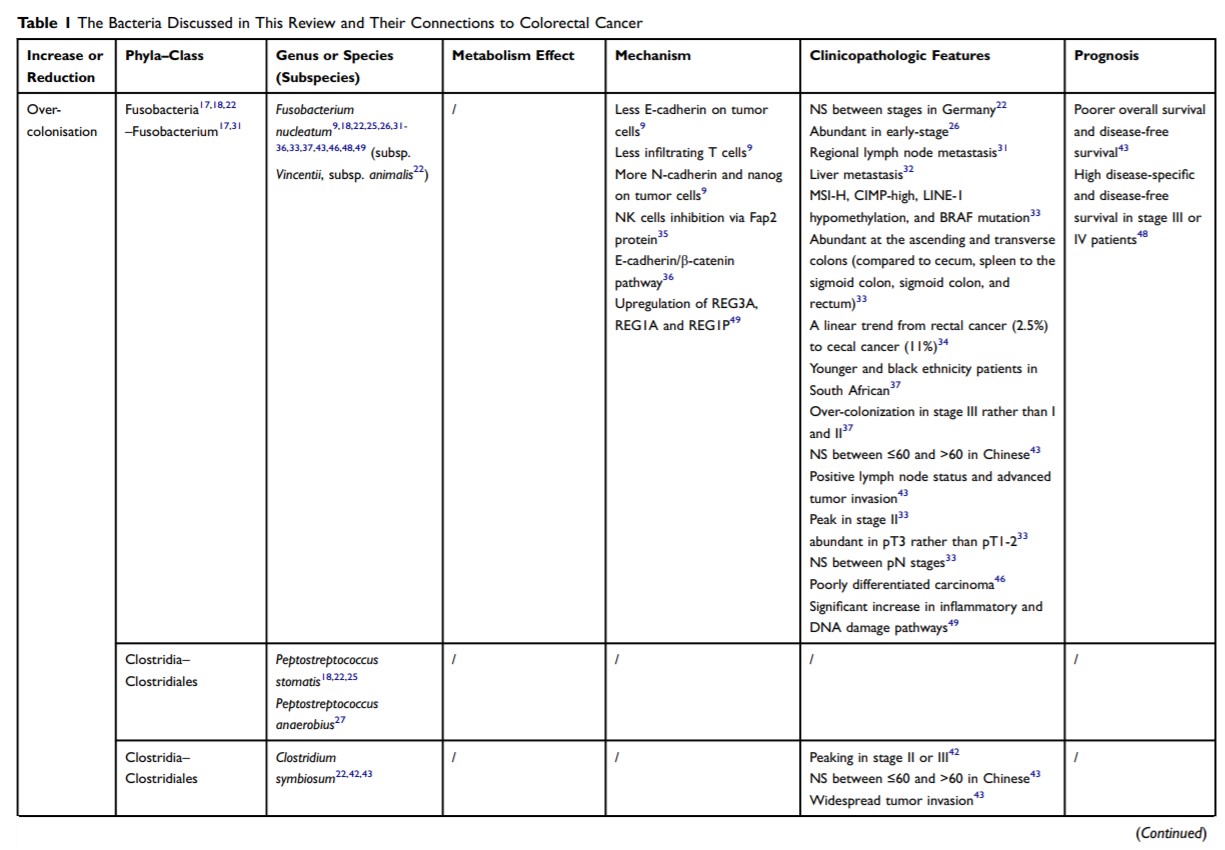
Abstract: Intestinal microbiome influences host immunity and several diseases, including cancer, in their areas of colonization. Microbial dysbiosis and over-colonization of specific microbes within the colorectal mucosa can impact the progress of carcinogenesis. Investigations initially focused on the mechanisms by which the intestinal microbiome initiates or promotes the development of colorectal cancer, including DNA damage, induction of chromosomal instability, and regulation of host immune responses. Some studies on the clinicopathological features have reported that specific strains present at high abundance are associated with advanced stage and positive lymph nodes in colorectal cancer. In this context, we reviewed the relationship between the intestinal microbiome and the clinical features (patient age, disease staging, prognosis, etc.) of patients with colorectal cancer, and evaluated the potential pathogenesis caused by the intestinal microbiome in disease progress. This article assessed whether changes in distinct species or strains occur during the period of cancer advancement. Overall, age grouping does not bring about significant differences in the constitution of microbiome. The disease stages show their distinct distribution in some species and strains. Oncogenic species are generally enriched in patients with poor prognosis, including low infiltration of CD3+ T cells, poor differentiation, widespread invasion, high microsatellite instability, CpG island methylator phenotype, BRAF mutation, short overall survival, and disease-free survival. The implications of those changes we discussed may assist in comprehensive understanding of the tumorigenesis of colorectal cancer from a microbiological perspective, finding potential biomarkers for colorectal cancer.
Keywords: colorectal cancer, intestinal microbiome, patient age, disease stage, prognosis