115195
论文已发表
注册即可获取德孚的最新动态
IF 收录期刊
- 3.6 Breast Cancer (Dove Med Press)
- 4.3 Clin Epidemiol
- 2.6 Cancer Manag Res
- 3.2 Infect Drug Resist
- 4.1 Clin Interv Aging
- 6.1 Drug Des Dev Ther
- 4.1 Int J Chronic Obstr
- 8.7 Int J Nanomed
- 2.5 Int J Women's Health
- 3.2 Neuropsych Dis Treat
- 2.4 OncoTargets Ther
- 2.6 Patient Prefer Adher
- 2.6 Ther Clin Risk Manag
- 3.1 J Pain Res
- 3.5 Diabet Metab Synd Ob
- 4.5 Psychol Res Behav Ma
- 3.4 Nat Sci Sleep
- 2.4 Pharmgenomics Pers Med
- 2.6 Risk Manag Healthc Policy
- 4.6 J Inflamm Res
- 2.3 Int J Gen Med
- 3.9 J Hepatocell Carcinoma
- 3.3 J Asthma Allergy
- 2.5 Clin Cosmet Investig Dermatol
- 3.0 J Multidiscip Healthc

lncRNA PART1 抑制可增加野生型的化学敏感性,但不增加 KRAS 突变型 NSCLC 细胞的化学敏感性
Authors Chen SC, Diao YZ, Zhao ZH, Li XL
Received 8 January 2020
Accepted for publication 14 April 2020
Published 10 June 2020 Volume 2020:12 Pages 4453—4460
DOI https://doi.org/10.2147/CMAR.S245257
Checked for plagiarism Yes
Review by Single-blind
Peer reviewer comments 2
Editor who approved publication: Dr Yong Teng
Background: Lung cancer has the highest incidence among solid tumors in men and is the third most common cancer in women. Despite improved understanding of genomic and mutational landscape in non-small cell lung cancer (NSCLC), the five-year survival in these patients has remained stagnant at a dismal 15%. The first line of treatment commonly adapted for NSCLC patients with somatic mutation in EGFR is tyrosine kinase inhibitor gefitinib or erlotinib. EGFR mutant cells seem to be intrinsically sensitive to tyrosine kinase inhibitors; however, the remaining 20– 30% patients are resistant to tyrosine kinase inhibitor.
Materials and Methods: Here we show, using in vitro normal and NSCLS cell lines, that the lncRNA Prostate androgen-regulated transcript 1 (PART1 ) is expressed at higher levels in NSCLC cells compared to normal lung epithelial cell line, corroborating two earlier studies.
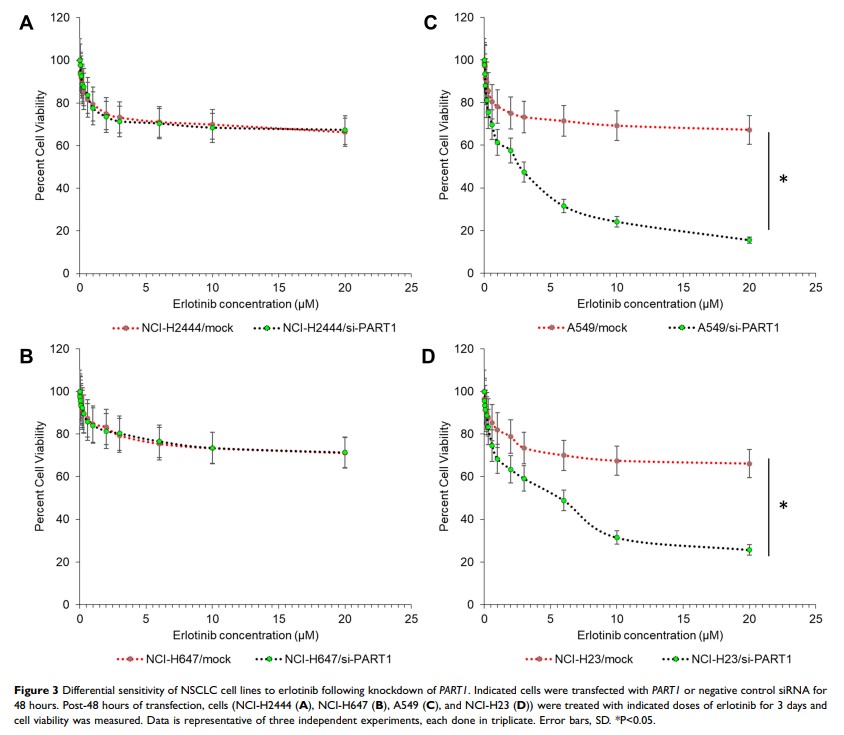
Results: We additionally show that these cells are resistant to erlotinib which is reversed in some, but not all, cell lines following suppression of PART1 expression. The differential response to erlotinib following siRNA-mediated knockdown of PART1 was found to be related to the mutational status of KRAS . Only in cells with wild-type KRAS suppression of PART1 sensitized them to erlotinib. Knockdown of mutant KRAS did not sensitize those cell lines to erlotinib. But knockdown of mutant KRAS along with suppression of PART1 sensitized the cells to treatment with erlotinib. The results from the study reveal a yet undefined and important role of lncRNA PART1 in defining sensitivity to erlotinib. This action is mediated by mutation status of KRAS .
Conclusion: Even though preliminary, our results indicate PART1 might be a potential candidate for targeted therapy or used as a predictor of chemosensitivity in patients with NSCLC.
Keywords: lncRNA, PART1, KRAS, non-small cell lung cancer, chemosensitivity, erlotinib