115195
论文已发表
注册即可获取德孚的最新动态
IF 收录期刊
- 3.6 Breast Cancer (Dove Med Press)
- 4.3 Clin Epidemiol
- 2.6 Cancer Manag Res
- 3.2 Infect Drug Resist
- 4.1 Clin Interv Aging
- 6.1 Drug Des Dev Ther
- 4.1 Int J Chronic Obstr
- 8.7 Int J Nanomed
- 2.5 Int J Women's Health
- 3.2 Neuropsych Dis Treat
- 2.4 OncoTargets Ther
- 2.6 Patient Prefer Adher
- 2.6 Ther Clin Risk Manag
- 3.1 J Pain Res
- 3.5 Diabet Metab Synd Ob
- 4.5 Psychol Res Behav Ma
- 3.4 Nat Sci Sleep
- 2.4 Pharmgenomics Pers Med
- 2.6 Risk Manag Healthc Policy
- 4.6 J Inflamm Res
- 2.3 Int J Gen Med
- 3.9 J Hepatocell Carcinoma
- 3.3 J Asthma Allergy
- 2.5 Clin Cosmet Investig Dermatol
- 3.0 J Multidiscip Healthc

木犀草素对化脓隐秘杆菌 的抗菌活性及作用机理
Authors Guo Y, Liu Y, Zhang Z, Chen M, Zhang D, Tian C, Liu M, Jiang G
Received 10 March 2020
Accepted for publication 16 May 2020
Published 10 June 2020 Volume 2020:13 Pages 1697—1711
DOI https://doi.org/10.2147/IDR.S253363
Checked for plagiarism Yes
Review by Single-blind
Peer reviewer comments 3
Editor who approved publication: Professor Suresh Antony
Purpose: This research aimed to investigate the antibacterial activity and potential mechanism of luteolin against T. pyogenes .
Materials and Methods: The broth microdilution method was used to determine the minimum inhibitory concentrations (MICs) of luteolin against various T. pyogenes strains. The potential mechanism of action of luteolin was elucidated through testing and analysing the luteolin-induced alterations of T. pyogenes in several aspects, including cell wall, cell membrane, protein expression, nucleic acid content, topoisomerase activity and energy metabolism.
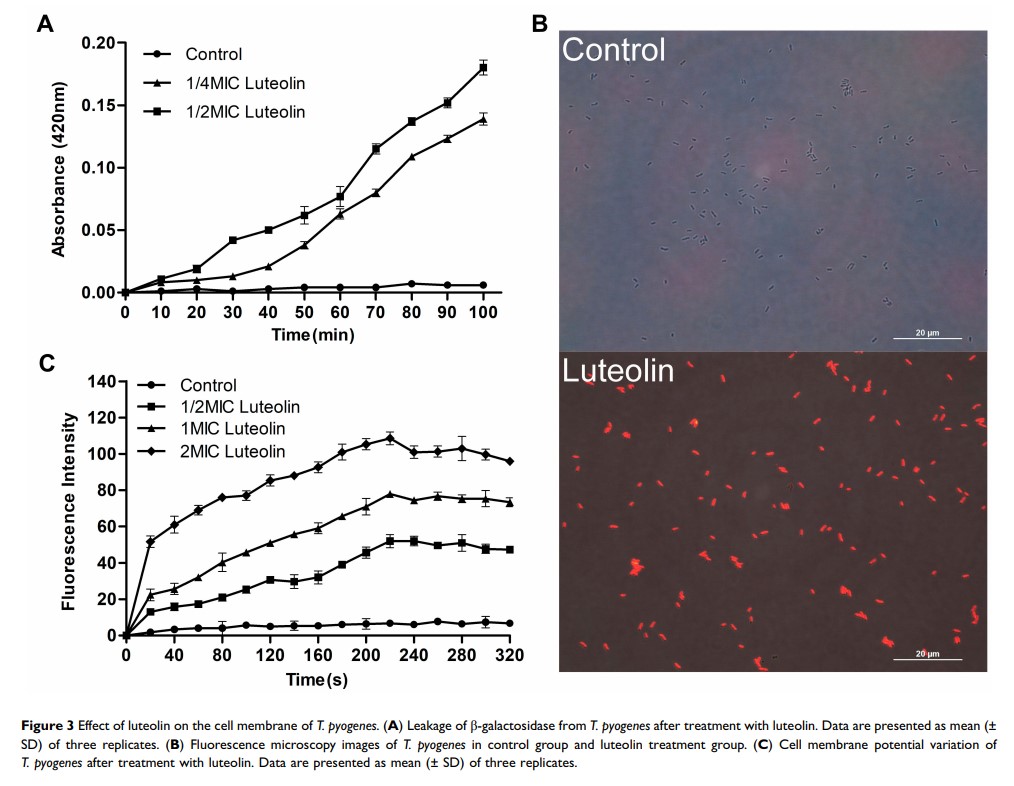
Results: The MIC values of luteolin against various T. pyogenes isolates and ATCC19411 were 78 μg/mL. The increased cell membrane permeability, destruction of cell wall integrity and TEM images after exposure to luteolin showed that the cell wall and membrane were damaged. The content of total protein and nucleic acid in T. pyogenes decreased significantly after treatment with luteolin (1/2 MIC) for 12, 24, and 36 h. Moreover, a hypochromic effect was observed in the absorption spectrum of luteolin when deoxyribonucleic acid (DNA) was added. In addition, after treatment with luteolin, a decrease in nicked or relaxed DNA content, which was catalysed by T. pyogenes -isolated DNA topoisomerase, was observed. In addition, the adenosine triphosphate (ATP) content in cells and the activity of succinate dehydrogenase (SDH) both decreased when T. pyogenes was exposed to different concentrations (1/4 MIC, 1/2 MIC, 1 MIC, 2 MIC) of luteolin for 1 h.
Conclusion: Luteolin showed distinct antibacterial activity against T. pyogenes by multiple actions, which mainly include destroying the integrity of the cell wall and cell membrane, influencing the expression of proteins, inhibiting nucleic acid synthesis, and interfering with energy metabolism.
Keywords: luteolin, Trueperella pyogenes , antibacterial activity, antibacterial mechanism