115195
论文已发表
注册即可获取德孚的最新动态
IF 收录期刊
- 3.6 Breast Cancer (Dove Med Press)
- 4.3 Clin Epidemiol
- 2.6 Cancer Manag Res
- 3.2 Infect Drug Resist
- 4.1 Clin Interv Aging
- 6.1 Drug Des Dev Ther
- 4.1 Int J Chronic Obstr
- 8.7 Int J Nanomed
- 2.5 Int J Women's Health
- 3.2 Neuropsych Dis Treat
- 2.4 OncoTargets Ther
- 2.6 Patient Prefer Adher
- 2.6 Ther Clin Risk Manag
- 3.1 J Pain Res
- 3.5 Diabet Metab Synd Ob
- 4.5 Psychol Res Behav Ma
- 3.4 Nat Sci Sleep
- 2.4 Pharmgenomics Pers Med
- 2.6 Risk Manag Healthc Policy
- 4.6 J Inflamm Res
- 2.3 Int J Gen Med
- 3.9 J Hepatocell Carcinoma
- 3.3 J Asthma Allergy
- 2.5 Clin Cosmet Investig Dermatol
- 3.0 J Multidiscip Healthc

在宿主间传播和演化期间,耐多药的 ST11 型肺炎克雷伯菌毒力异质性的表型和基因组表征
Authors Liu C, Du P, Zhao J, Li B, Wang C, Sun L, Lu B, Wang Y, Liu Y, Cao B
Received 26 December 2019
Accepted for publication 26 April 2020
Published 10 June 2020 Volume 2020:13 Pages 1713—1721
DOI https://doi.org/10.2147/IDR.S243836
Checked for plagiarism Yes
Review by Single-blind
Peer reviewer comments 2
Editor who approved publication: Dr Eric Nulens
Background: Multidrug-resistant (MDR) ST11 hypervirulent Klebsiella pneumoniae (hvKp) is emerging in China.
Purpose: The aim of this study was to track the transmission and evolution of hvKp.
Materials and Methods: A retrospective study focused on Kp infection was conducted. Clinical data were collected from electronic medical records. Whole-genome sequencing of Kp strains was performed. Single-nucleotide polymorphisms (SNPs) were analyzed and a transmission map was constructed. Sequence type, and antimicrobial and virulence-associated genes were characterized. Strains with some combination of the virulence genes, p rmpA, p rmpA2, iucA, iroB , and peg-344, were defined as hvKp. Kp virulence phenotypes were evaluated using the Galleria mellonella model.
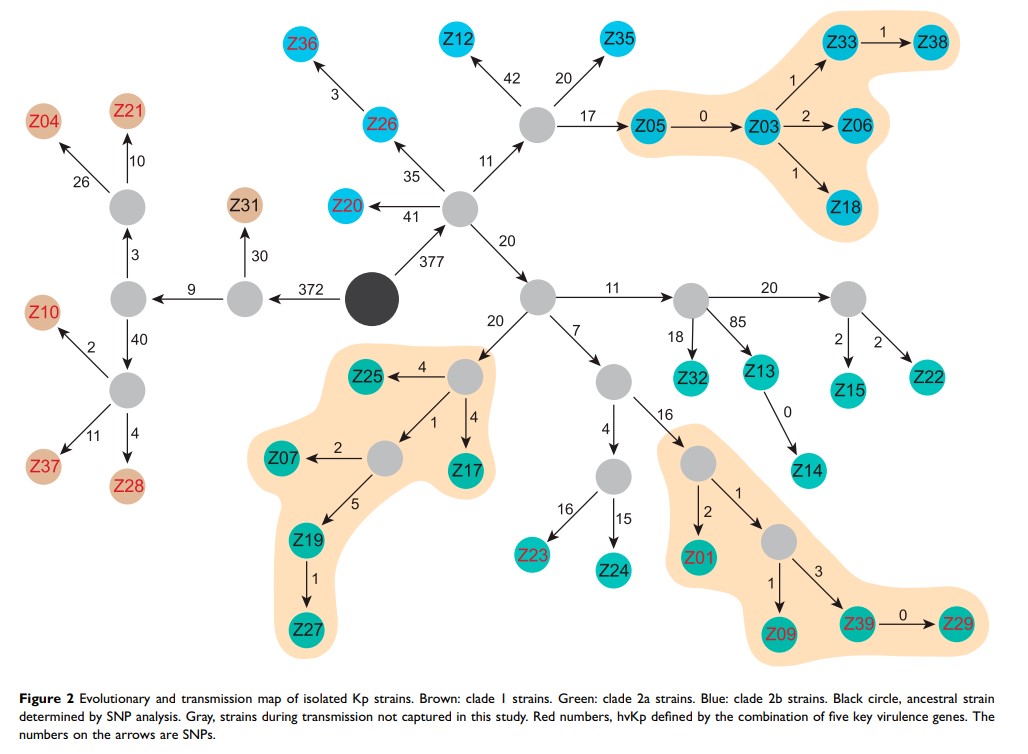
Results: All 33 Kp strains were MDR-Kp and 13 (39.4%) were hvKp. Most hvKp strains (84.6%, 11/13) were hospital-acquired infections (HAIs). Two unique combinations of virulence-associated genes were detected among hvKp strains. Eleven cases were associated with p rmpA2 +iucA and two strains presented with peg-344 +p rmpA+p rmpA2 +iucA . Surprisingly, two community-acquired MDR-hvKp infection cases were identified. Eight hvKp strains (61.5%, 8/13) exhibited a hypervirulent phenotype in the G. mellonella model. Five MDR-hvKp strains with the hypervirulence phenotype originated from a single cluster. Additionally, nine clones were identified among the two clades, six of which were hvKp. Moreover, the hvKp in clade 1 carried the IncHI1B plasmid replicon, whereas none of the hvKp strains in clade 2 harbored IncHI1B. These data, showing that different hvKp clones distributed into separate clades, indicate that transmission and evolution occurred within the hospital.
Conclusion: During inter-host evolution and transmission, various virulence clusters of the epidemic clone, MDR-ST11, converged, conferring phenotypic virulence heterogeneity and spread within the hospital and possibly the community. Mobile/conjugative genetic elements associated with virulence-encoding gene clusters might emerge and have been transmitted within the hospital, suggesting that enhanced ongoing surveillance is essential.
Keywords: hypervirulent Klebsiella pneumoniae , multidrug resistance, whole-genome sequencing, hospital-acquired infection, community-acquired infection