115195
论文已发表
注册即可获取德孚的最新动态
IF 收录期刊
- 3.6 Breast Cancer (Dove Med Press)
- 4.3 Clin Epidemiol
- 2.6 Cancer Manag Res
- 3.2 Infect Drug Resist
- 4.1 Clin Interv Aging
- 6.1 Drug Des Dev Ther
- 4.1 Int J Chronic Obstr
- 8.7 Int J Nanomed
- 2.5 Int J Women's Health
- 3.2 Neuropsych Dis Treat
- 2.4 OncoTargets Ther
- 2.6 Patient Prefer Adher
- 2.6 Ther Clin Risk Manag
- 3.1 J Pain Res
- 3.5 Diabet Metab Synd Ob
- 4.5 Psychol Res Behav Ma
- 3.4 Nat Sci Sleep
- 2.4 Pharmgenomics Pers Med
- 2.6 Risk Manag Healthc Policy
- 4.6 J Inflamm Res
- 2.3 Int J Gen Med
- 3.9 J Hepatocell Carcinoma
- 3.3 J Asthma Allergy
- 2.5 Clin Cosmet Investig Dermatol
- 3.0 J Multidiscip Healthc

血清视黄酸水平降低可预测缺血性卒中患者的预后不良
Authors Xu M, Xu L, Du H, Shan W, Feng J, Zhai G, Yang X
Received 19 March 2020
Accepted for publication 16 May 2020
Published 10 June 2020 Volume 2020:16 Pages 1483—1491
DOI https://doi.org/10.2147/NDT.S254591
Checked for plagiarism Yes
Review by Single-blind
Peer reviewer comments 2
Editor who approved publication: Professor Jun Chen
Background and Aims: Decreased serum retinoic acid (RA) levels have been shown to be linked with increased mortality in cardiovascular diseases. This study aimed to investigate the relationship between serum RA and 3-month functional outcome after ischemic stroke.
Methods: Between January 2019 and September 2019, we prospectively recruited ischemic stroke patients within 24 hrs of symptom onset. Serum RA levels were measured for all patients at admission. The primary outcome was defined as poor functional outcome (modified Rankin Scale 3– 6) at 90 days. The secondary outcome was defined as early neurological deterioration (END), which is considered as an increase of ≥ 1 point in motor power or total National Institutes of Health Stroke Scale score of ≥ 2 points within 7 days.
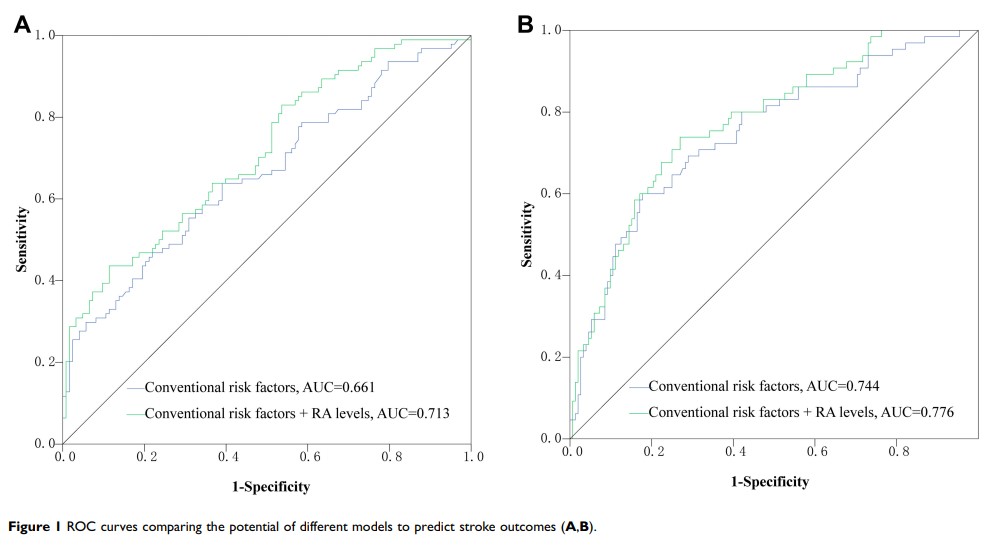
Results: A total of 217 patients were included in the analysis. The median RA levels were 2.9 ng/mL. Ninety-four (43.3%) and 65 (30.0%) patients experienced 3-month poor outcome and END, respectively. After adjusted for potential confounders, decreased levels of serum RA were associated with a higher risk of poor outcome (P for trend = 0.001) and END (P for trend = 0.002). Adding RA quartile to the existing risk factors improved risk prediction for poor outcome [net reclassification improvement (NRI) = 42.6%, P = 0.001; integrated discrimination improvement (IDI) = 5.7%, P = 0.001] and END (NRI index = 45.4%, P = 0.001; IDI = 4.3%; P = 0.005).
Conclusion: Low serum RA levels at baseline were associated with poor prognosis at 90 days after ischemic stroke, suggesting that RA may be a potential prognostic biomarker for ischemic stroke.
Keywords: acute ischemic stroke, retinoic acid, early neurological deterioration, functional outcome