115195
论文已发表
注册即可获取德孚的最新动态
IF 收录期刊
- 3.6 Breast Cancer (Dove Med Press)
- 4.3 Clin Epidemiol
- 2.6 Cancer Manag Res
- 3.2 Infect Drug Resist
- 4.1 Clin Interv Aging
- 6.1 Drug Des Dev Ther
- 4.1 Int J Chronic Obstr
- 8.7 Int J Nanomed
- 2.5 Int J Women's Health
- 3.2 Neuropsych Dis Treat
- 2.4 OncoTargets Ther
- 2.6 Patient Prefer Adher
- 2.6 Ther Clin Risk Manag
- 3.1 J Pain Res
- 3.5 Diabet Metab Synd Ob
- 4.5 Psychol Res Behav Ma
- 3.4 Nat Sci Sleep
- 2.4 Pharmgenomics Pers Med
- 2.6 Risk Manag Healthc Policy
- 4.6 J Inflamm Res
- 2.3 Int J Gen Med
- 3.9 J Hepatocell Carcinoma
- 3.3 J Asthma Allergy
- 2.5 Clin Cosmet Investig Dermatol
- 3.0 J Multidiscip Healthc

诺斯卡品通过 PTEN/PI3K/mTOR 信号通路调节线粒体损伤和 Warburg 效应,诱导人结肠癌细胞凋亡
Authors Tian X, Liu M, Huang X, Zhu Q, Liu W, Chen W, Zou Y, Cai Y, Huang S, Chen A, Zhan T, Huang M, Chen X, Han Z, Tan J
Received 23 September 2019
Accepted for publication 18 May 2020
Published 11 June 2020 Volume 2020:13 Pages 5419—5428
DOI https://doi.org/10.2147/OTT.S232137
Checked for plagiarism Yes
Review by Single-blind
Peer reviewer comments 3
Editor who approved publication: Dr Cho
Background: Noscapine is an opium alkaloid that has recently been shown to potentiate anti-cancer therapeutic effects by inducing apoptosis in various malignant cells without any detectable toxicity. However, the mechanism by which noscapine induces apoptosis in colon cancer cells remains unclear.
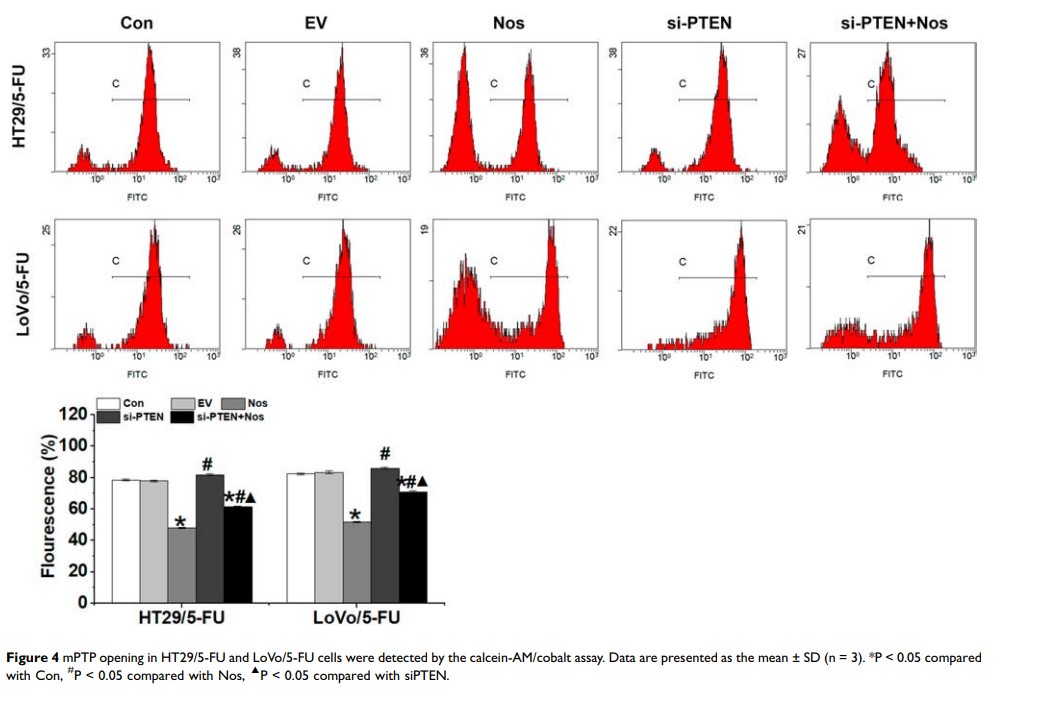
Materials and Methods: In this study, we explored the anti-cancer activity of noscapine in 5-fluorouracil (5-FU)-resistant human colon cancer cell lines HT29/5-FU and LoVo/5-FU and investigated the possible underlying mechanism. The apoptosis and mitochondrial morphology of cells were detected by TUNEL assay and transmission electron microscopy (TEM). The mitochondrial membrane potential (MMP) was determined using JC-1. The mitochondrial permeability transition pore (mPTP) opening was detected by the calcein-AM/cobalt assay. The levels of glucose, lactic, and ATP in cells were evaluated by ELISA kits. Relative protein expression levels were detected by Western blot.
Results: We verified that PTEN was involved in noscapine-induced apoptosis in HT29/5-FU and LoVo/5-FU cells. Noscapine greatly increased mitochondrial damage by altering mitochondrial morphology, inducing mitochondrial membrane potential depolarization, and enabling mitochondrial permeability transition pore opening in HT29/5-FU and LoVo/5-FU cells. In addition, noscapine inhibited the Warburg effect by decreasing the levels of glucose, lactic acid, and ATP and inhibiting the protein expression of glucose transporter 1, lactate dehydrogenase-B, hexokinase 2, and pyruvate kinase M2 in HT29/5-FU and LoVo/5-FU cells. However, PTEN interference counteracted the effect of noscapine on mitochondrial damage and the Warburg effect in HT29/5-FU and LoVo/5-FU cells by decreasing the activation of PI3K/mTOR signaling.
Conclusion: These results indicated that noscapine induced the apoptosis of HT29/5-FU and LoVo/5-FU human colon cancer cells by regulating mitochondria damage and the Warburg effect via PTEN, and the process is closely related to the PI3K/mTOR signaling pathway.
Keywords: colon cancer, noscapine, mitochondrial damage, PTEN, PI3K/mTOR