115195
论文已发表
注册即可获取德孚的最新动态
IF 收录期刊
- 3.6 Breast Cancer (Dove Med Press)
- 4.3 Clin Epidemiol
- 2.6 Cancer Manag Res
- 3.2 Infect Drug Resist
- 4.1 Clin Interv Aging
- 6.1 Drug Des Dev Ther
- 4.1 Int J Chronic Obstr
- 8.7 Int J Nanomed
- 2.5 Int J Women's Health
- 3.2 Neuropsych Dis Treat
- 2.4 OncoTargets Ther
- 2.6 Patient Prefer Adher
- 2.6 Ther Clin Risk Manag
- 3.1 J Pain Res
- 3.5 Diabet Metab Synd Ob
- 4.5 Psychol Res Behav Ma
- 3.4 Nat Sci Sleep
- 2.4 Pharmgenomics Pers Med
- 2.6 Risk Manag Healthc Policy
- 4.6 J Inflamm Res
- 2.3 Int J Gen Med
- 3.9 J Hepatocell Carcinoma
- 3.3 J Asthma Allergy
- 2.5 Clin Cosmet Investig Dermatol
- 3.0 J Multidiscip Healthc

三阴性乳腺癌 MDA-MB-231 细胞球体模型的表征
Authors Huang Z, Yu P, Tang J
Received 14 February 2020
Accepted for publication 12 May 2020
Published 11 June 2020 Volume 2020:13 Pages 5395—5405
DOI https://doi.org/10.2147/OTT.S249756
Checked for plagiarism Yes
Review by Single-blind
Peer reviewer comments 2
Editor who approved publication: Dr Leo Jen-Liang Su
Background: The tumor three-dimensional (3D) spheroid model in vitro is effective on detecting malignant cells and tumorigenesis, and assessing drug resistance. Compared with two-dimensional (2D) monolayer culture, breast cancer (BC) spheroids more accurately reflect the complex microenvironment in vivo, which have been extensively reported in BC research. MDA-MB-231 cells, the triple-negative breast cancer (TNBC) cell line, display representative epithelial to mesenchymal transition (EMT) associated with BC metastasis. However, the characterization of MDA-MB-231 spheroids has been largely unknown at present, which requires further attention.
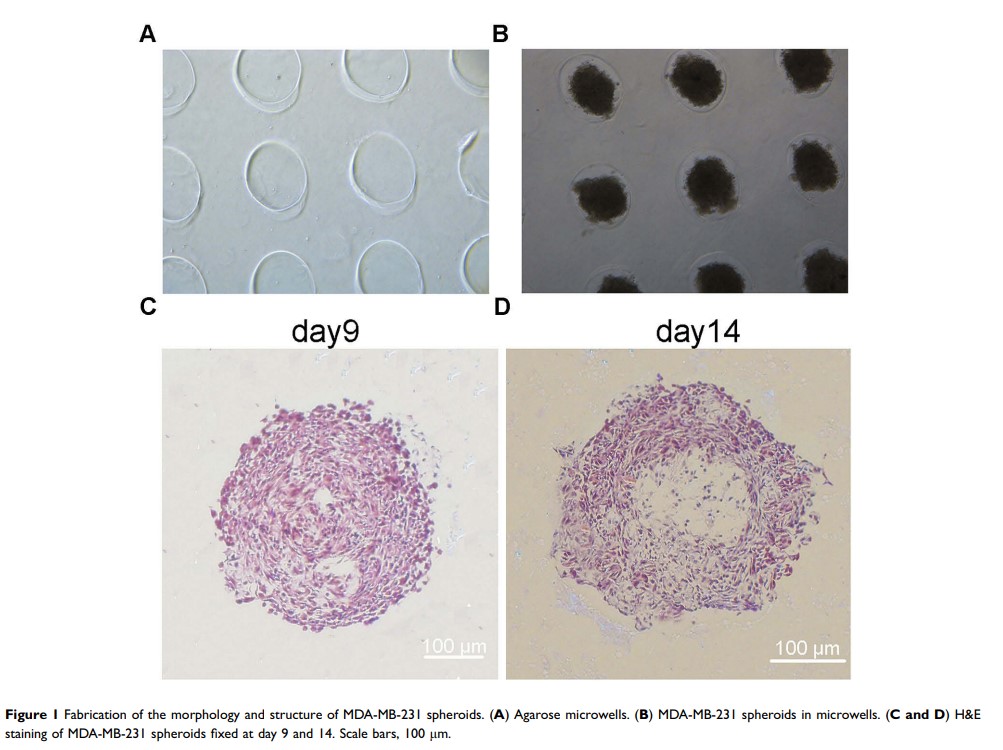
Materials and Methods: Microwell array was conducted for the formation of MDA-MB-231 spheroids. In addition, H&E staining, immunohistochemistry (IHC), CellTiter-Glo® 3D cell viability assay, and flow cytometry were performed to investigate the structure and growth characteristics. Besides, Transwell and scratch healing assays were carried out to detect the migratory capacities compared with 2D culture. Western blotting and confocal fluorescence were selected to detect the expression of EMT-associated proteins. Additionally, the half maximal inhibitory concentration (IC50) values of antitumor compounds Carboplatin and Doxorubicin were measured to assess drug resistance.
Results: The MDA-MB-231 spheroids were viable, which maintained a compact structure with zonation features for up to 9 days. Moreover, those spheroids had a slower growth rate than those cultured as a monolayer and differential zones of proliferation. The migratory capacities were significantly enhanced by transferring the spheroids to 2D adherent culture. Compared with 2D culture, the levels of EMT-associated proteins were significantly up-regulated in spheroids. Furthermore, toxicity assessment showed that spheroids exhibited an increased resistance to the antitumor compounds.
Conclusion: This study develops the simple spheroids and demonstrates their structure, growth and proliferation characteristics. According to our results, the spheroids are associated with superior EMT and high resistance to toxicological response compared with the standard 2D monocultures.
Keywords: triple-negative breast cancer, spheroid, epithelial to mesenchymal transition, three-dimensional culture