115195
论文已发表
注册即可获取德孚的最新动态
IF 收录期刊
- 3.6 Breast Cancer (Dove Med Press)
- 4.3 Clin Epidemiol
- 2.6 Cancer Manag Res
- 3.2 Infect Drug Resist
- 4.1 Clin Interv Aging
- 6.1 Drug Des Dev Ther
- 4.1 Int J Chronic Obstr
- 8.7 Int J Nanomed
- 2.5 Int J Women's Health
- 3.2 Neuropsych Dis Treat
- 2.4 OncoTargets Ther
- 2.6 Patient Prefer Adher
- 2.6 Ther Clin Risk Manag
- 3.1 J Pain Res
- 3.5 Diabet Metab Synd Ob
- 4.5 Psychol Res Behav Ma
- 3.4 Nat Sci Sleep
- 2.4 Pharmgenomics Pers Med
- 2.6 Risk Manag Healthc Policy
- 4.6 J Inflamm Res
- 2.3 Int J Gen Med
- 3.9 J Hepatocell Carcinoma
- 3.3 J Asthma Allergy
- 2.5 Clin Cosmet Investig Dermatol
- 3.0 J Multidiscip Healthc

静脉利输注多卡因对接受脊柱内肿瘤切除术的患者术后疼痛的影响:一项前瞻性随机对照试验的研究方案
Authors Yue H, Zhou M, Lu Y, Chen L, Cui W
Received 11 February 2020
Accepted for publication 26 May 2020
Published 12 June 2020 Volume 2020:13 Pages 1401—1410
DOI https://doi.org/10.2147/JPR.S249359
Checked for plagiarism Yes
Review by Single-blind
Peer reviewer comments 3
Editor who approved publication: Dr Robert B. Raffa
Purpose: Patients undergoing intraspinal tumor resection usually experience severe acute pain, delaying postoperative rehabilitation, and increasing incidence of chronic pain. Recently, an increasing number of studies have found that low-dose intravenous lidocaine infusion during and/or after surgery can reduce opioid usage and the incidence of related side effects, inhibit hyperalgesia and promote recovery. Thus far, no studies have evaluated the analgesic effect and safety of perioperative intravenous lidocaine infusion for intraspinal tumor resection, especially the long-term analgesic effects of patient-controlled analgesia (PCA) with lidocaine during the first postoperative 48 hours. This study tests the hypothesis that intra- and postoperative systemic lidocaine infusion for patients undergoing intraspinal tumor resection can relieve postoperative acute or chronic pain and reduce the opioid dosage and incidence of related side effects without other problems.
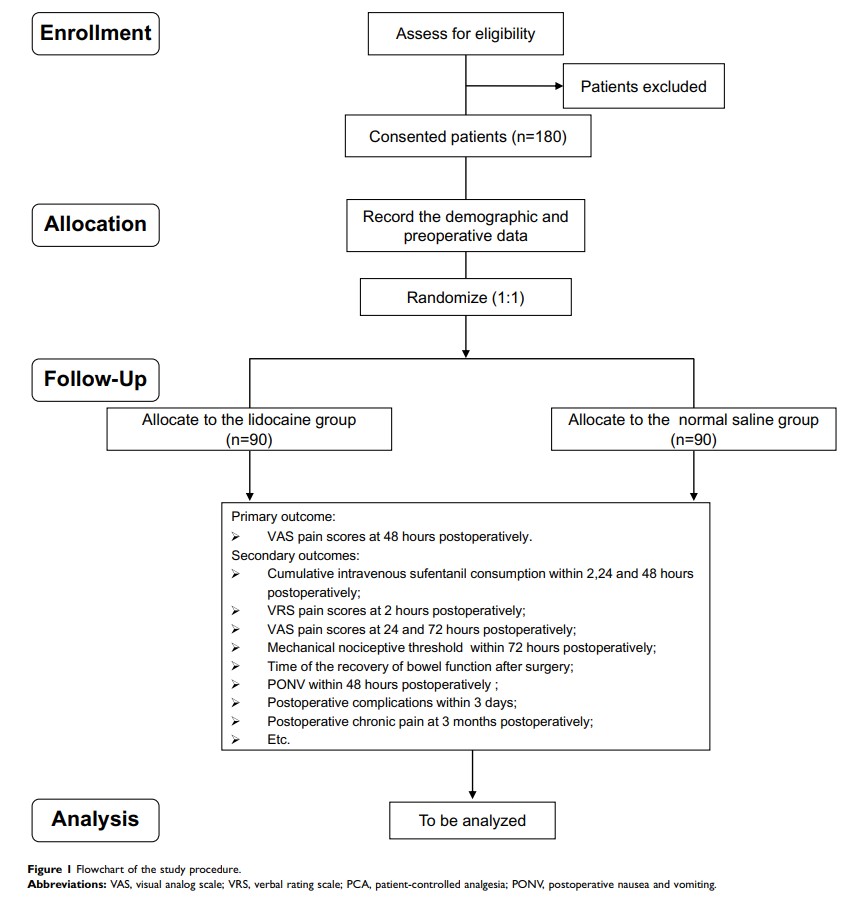
Study Design and Methods: This is a prospective, randomized, placebo-controlled, and double-blinded study. In total, 180 participants scheduled for intraspinal tumor resection will be randomly divided into lidocaine and placebo groups. The lidocaine group will be administered lidocaine intravenously during anesthesia and postoperative pain management during the first 48 postoperative hours; the placebo group will be administered normal saline at the same volume, infusion rate, and timing. The primary outcome will be the postoperative visual analog scale (VAS) score. Secondary outcomes will be postoperative cumulative sufentanil consumption, indicators of postoperative recovery, and the incidence of perioperative adverse events.
Discussion: This study investigates the effect of continuous intravenous lidocaine infusion on postoperative sufentanil consumption and VAS scores. The findings will provide a new strategy of anesthesia and analgesia management for intraspinal tumor resection.
Keywords: postoperative pain, intraspinal tumor resection, lidocaine, opiates