115195
论文已发表
注册即可获取德孚的最新动态
IF 收录期刊
- 3.6 Breast Cancer (Dove Med Press)
- 4.3 Clin Epidemiol
- 2.6 Cancer Manag Res
- 3.2 Infect Drug Resist
- 4.1 Clin Interv Aging
- 6.1 Drug Des Dev Ther
- 4.1 Int J Chronic Obstr
- 8.7 Int J Nanomed
- 2.5 Int J Women's Health
- 3.2 Neuropsych Dis Treat
- 2.4 OncoTargets Ther
- 2.6 Patient Prefer Adher
- 2.6 Ther Clin Risk Manag
- 3.1 J Pain Res
- 3.5 Diabet Metab Synd Ob
- 4.5 Psychol Res Behav Ma
- 3.4 Nat Sci Sleep
- 2.4 Pharmgenomics Pers Med
- 2.6 Risk Manag Healthc Policy
- 4.6 J Inflamm Res
- 2.3 Int J Gen Med
- 3.9 J Hepatocell Carcinoma
- 3.3 J Asthma Allergy
- 2.5 Clin Cosmet Investig Dermatol
- 3.0 J Multidiscip Healthc

恩格列净可通过调节缺氧诱导因子 1-α 来预防高糖诱导的近端肾小管上皮细胞损伤
Authors Ndibalema AR, Kabuye D, Wen S, Li L, Li X, Fan Q
Received 20 December 2019
Accepted for publication 13 May 2020
Published 12 June 2020 Volume 2020:13 Pages 1953—1967
DOI https://doi.org/10.2147/DMSO.S243170
Checked for plagiarism Yes
Review by Single-blind
Peer reviewer comments 4
Editor who approved publication: Prof. Dr. Muthuswamy Balasubramanyam
Background: Evidence from both animal and human studies clearly supports the renal beneficial effects of empagliflozin (emp), a sodium glucose co-transporter 2 (SGLT2) inhibitor, but the mechanism in which it exerts its effect is not well understood. In this study, we investigated the capability of emp on reducing hyperglycemia-induced renal proximal tubular epithelial cells injury and we evaluated if the renoprotective effect of emp associates with hypoxia-inducible factor-1α (HIF-1α).
Materials and Methods: Human kidney cell lines (HK-2 cells) were incubated in normoxia, high glucose with or without emp treatment for 72 hours to evaluate the induction of HIF-1α, glucose transporter-1, SGLT2, the fibrosis signal pathway and epithelial–mesenchymal transition (EMT) markers.
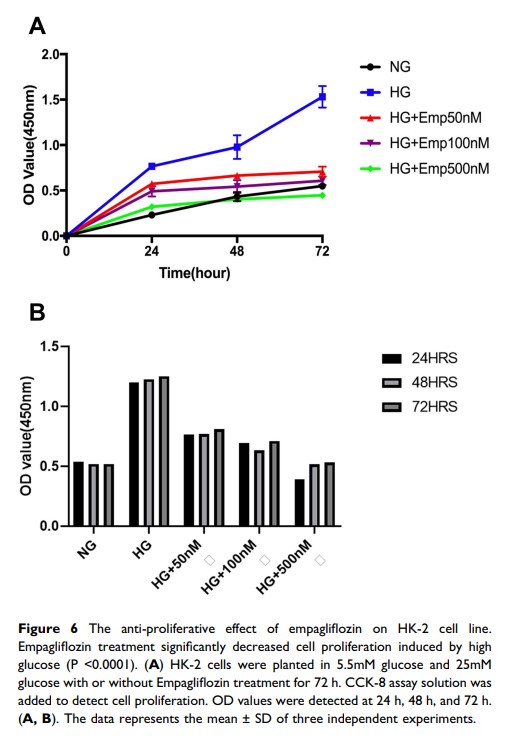
Results: High glucose (HG) increased expression of Collagen IV, Fibronectin, transforming growth factor-beta1 (TGF-β 1). However, emp treatment remarkably decreased expression of TGF-β 1, accumulation of extracellular matrix proteins (Fibronectin, Collagen IV), as well as (phosphorylated-smad3) P-smad3. HG increased SGLT2 protein expression compared to normal glucose (NG) while emp significantly decreased SGLT2 expression. Furthermore, emp decreased high glucose-induced alpha-smooth muscle actin (α-SMA) expression and reversed epithelial marker (E-catherin) suppression induced by high glucose. In addition, emp treatment for 72 h increased expression of HIF-1α protein (95% CI: -0.5918 to – 0.002338, at 100nM, P < 0.05, 95% CI – 0.6631 to – 0.07367 at 500nM, P < 0.05) in hyperglycemic normoxic HK-2 cells. Furthermore, we observed increased expression of GLUT-1 protein after emp treatment and remarkably decreased cell proliferation.
Conclusion: Emp treatment protected proximal renal tubular cells injury induced by high glucose. Induction of HIF-1α expression by emp may play an essential role in the protection of high glucose-induced proximal renal tubular epithelial cells injury.
Keywords: humans, animals, transforming growth factor-beta1, empagliflozin, diabetic nephropathies, glucose