115195
论文已发表
注册即可获取德孚的最新动态
IF 收录期刊
- 3.6 Breast Cancer (Dove Med Press)
- 4.3 Clin Epidemiol
- 2.6 Cancer Manag Res
- 3.2 Infect Drug Resist
- 4.1 Clin Interv Aging
- 6.1 Drug Des Dev Ther
- 4.1 Int J Chronic Obstr
- 8.7 Int J Nanomed
- 2.5 Int J Women's Health
- 3.2 Neuropsych Dis Treat
- 2.4 OncoTargets Ther
- 2.6 Patient Prefer Adher
- 2.6 Ther Clin Risk Manag
- 3.1 J Pain Res
- 3.5 Diabet Metab Synd Ob
- 4.5 Psychol Res Behav Ma
- 3.4 Nat Sci Sleep
- 2.4 Pharmgenomics Pers Med
- 2.6 Risk Manag Healthc Policy
- 4.6 J Inflamm Res
- 2.3 Int J Gen Med
- 3.9 J Hepatocell Carcinoma
- 3.3 J Asthma Allergy
- 2.5 Clin Cosmet Investig Dermatol
- 3.0 J Multidiscip Healthc

通过生物电阻抗分析测量的躯干骨骼肌质量和相位角与极高龄人群股骨颈骨折的发生率有关
Authors Chen J, Lu K, Chen H, Hu N, Chen J, Liang X, Qin J, Huang W
Received 20 February 2020
Accepted for publication 19 May 2020
Published 12 June 2020 Volume 2020:15 Pages 889—895
DOI https://doi.org/10.2147/CIA.S250629
Checked for plagiarism Yes
Review by Single-blind
Peer reviewer comments 2
Editor who approved publication: Dr Zhi-Ying Wu
Background: The study aimed to investigate the potential association of trunk skeletal muscle mass (tSM) and phase angle measured by bioelectrical impedance analysis (BIA) with the chance of femoral neck fractures in very elderly people.
Patients and Methods: This case-control study enrolled 78 femoral neck fracture patients aged over 75 years (29 males) and 1:2 matched healthy controls. All participants were subjected to BIA examination by specialists. tSM, the corrected values by height squared of tSM (tSMI) and phase angle were compared between fracture patients and controls. Multivariate logistic regression was performed to explore the strength of association of femoral neck fracture with tSM, tSMI, and phase angle.
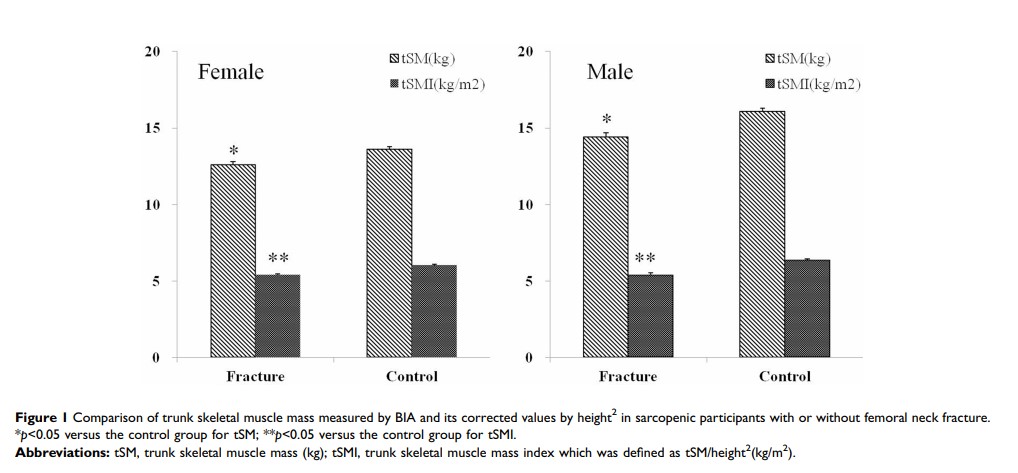
Results: tSM (kg) of fracture patients was significantly lower than those of controls in all participants (women: 13.49± 0.42 vs 15.44± 0.39, p < 0.05; men: 15.30± 0.71 vs 17.54± 0.78, p < 0.05). In the sarcopenic subgroup, fracture patients also got a lower tSM than controls (women: 12.58± 0.21 vs 13.62± 0.16, p < 0.05; men:14.41± 0.29 vs 16.07± 0.21, p < 0.05). The comparison of tSMI between the two groups was similar to that of tSM. Phase angle (°) at 50 kHz in fracture patients was significantly lower than that of controls in women and men (women: 3.70± 0.32 vs 4.61± 0.21, p < 0.05; men: 3.50± 0.20 vs 3.84± 0.22, p < 0.05). Multivariate logistic regression analysis demonstrated higher fracture chance with significantly associated decreased tSM [women: OR (95% CI): 0.78(0.67– 0.91); men: 0.74(0.64– 0.86)] and tSMI [women: OR (95% CI): 0.72(0.61– 0.85); men: 0.69 (0.59– 0.81)]. In addition, per 1° increase of phase angle in the trunk could decrease the fracture risk by 14% for women [OR (95% CI): 0.86 0.79– 0.94)] and 29% for men [OR (95% CI): 0.71 (0.64– 0.79)].
Conclusion: This study indicates a decrease in tSM, tSMI, and phase angle measured by BIA is significantly related to the increased chance of femoral neck fracture in people aged over 75 years. Strengthening the mass and strength of trunk skeletal muscles may help reduce the risk of femoral neck fracture in elderly patients.
Keywords: bioelectrical impedance analysis, skeletal muscle mass, phase angle, femoral neck fracture