115195
论文已发表
注册即可获取德孚的最新动态
IF 收录期刊
- 3.6 Breast Cancer (Dove Med Press)
- 4.3 Clin Epidemiol
- 2.6 Cancer Manag Res
- 3.2 Infect Drug Resist
- 4.1 Clin Interv Aging
- 6.1 Drug Des Dev Ther
- 4.1 Int J Chronic Obstr
- 8.7 Int J Nanomed
- 2.5 Int J Women's Health
- 3.2 Neuropsych Dis Treat
- 2.4 OncoTargets Ther
- 2.6 Patient Prefer Adher
- 2.6 Ther Clin Risk Manag
- 3.1 J Pain Res
- 3.5 Diabet Metab Synd Ob
- 4.5 Psychol Res Behav Ma
- 3.4 Nat Sci Sleep
- 2.4 Pharmgenomics Pers Med
- 2.6 Risk Manag Healthc Policy
- 4.6 J Inflamm Res
- 2.3 Int J Gen Med
- 3.9 J Hepatocell Carcinoma
- 3.3 J Asthma Allergy
- 2.5 Clin Cosmet Investig Dermatol
- 3.0 J Multidiscip Healthc

微量稀释法与琼脂稀释法进行淋球菌抗生素敏感性试验的比较
Authors Chen SC, Liu JW, Wu XZ, Cao WL, Wang F, Huang JM, Han Y, Zhu XY, Zhu BY, Gan Q, Tang XZ, Shen X, Qin XL, Yu YQ, Zheng HP, Yin YP
Received 13 March 2020
Accepted for publication 26 May 2020
Published 15 June 2020 Volume 2020:13 Pages 1775—1780
DOI https://doi.org/10.2147/IDR.S253811
Checked for plagiarism Yes
Review by Single-blind
Peer reviewer comments 2
Editor who approved publication: Dr Eric Nulens
Introduction: Antimicrobial resistance (AMR) of Neisseria gonorrhoeae (N. gonorrhoeae ) becomes a grave public health problem in the world. A strengthened Antimicrobial Resistance Surveillance Program is needed to track the trend of AMR development. However, the lack of a proper antimicrobial susceptibility test (AST) method is a barrier to expand the AMR surveillance in China. Traditional agar dilution (AD) method is laborious and E-test strips have no approval license for clinical use. Herein, a Chinese group modified the microdilution (MD) method for clinical ASTs. The objective of this study is to compare the MD method with the AD method for N. gonorrhoeae AST.
Materials and Methods: A total of 166 clinical isolates were tested for antimicrobial susceptibility of ceftriaxone, spectinomycin, azithromycin, ciprofloxacin, tetracycline, and penicillin using MD and AD method simultaneously. Results of MD method were read manually or automatically. Rates of essential agreement (EA), category agreement (CA), minor error, and very major error were compared.
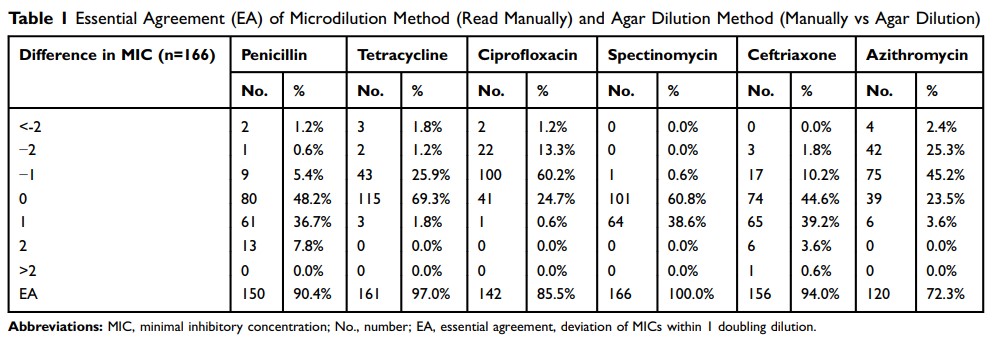
Results: The total EAs (compared with results read manually) of penicillin, tetracycline, ciprofloxacin, spectinomycin, ceftriaxone, and azithromycin were 90.4%, 97.0%, 85.5%, 100.0%, 94%, and 72.3%; and CAs were 82.5%, 94.0%, 100%, 100%, 95.2%, and 94%, respectively.
Conclusion: We conclude that the MD method might be an alternative for clinical AST of N. gonorrhoeae in China. In particular, MD method has the potency of accurate differentiation of isolates resistant to ceftriaxone or azithromycin, which were empirically recommended for gonococcal treatment, but its quality remained suboptimal, and further improvement is needed for clinical use.
Keywords: Neisseria gonorrhoeae , antimicrobial susceptibility test