115195
论文已发表
注册即可获取德孚的最新动态
IF 收录期刊
- 3.6 Breast Cancer (Dove Med Press)
- 4.3 Clin Epidemiol
- 2.6 Cancer Manag Res
- 3.2 Infect Drug Resist
- 4.1 Clin Interv Aging
- 6.1 Drug Des Dev Ther
- 4.1 Int J Chronic Obstr
- 8.7 Int J Nanomed
- 2.5 Int J Women's Health
- 3.2 Neuropsych Dis Treat
- 2.4 OncoTargets Ther
- 2.6 Patient Prefer Adher
- 2.6 Ther Clin Risk Manag
- 3.1 J Pain Res
- 3.5 Diabet Metab Synd Ob
- 4.5 Psychol Res Behav Ma
- 3.4 Nat Sci Sleep
- 2.4 Pharmgenomics Pers Med
- 2.6 Risk Manag Healthc Policy
- 4.6 J Inflamm Res
- 2.3 Int J Gen Med
- 3.9 J Hepatocell Carcinoma
- 3.3 J Asthma Allergy
- 2.5 Clin Cosmet Investig Dermatol
- 3.0 J Multidiscip Healthc

抑制 ERKs/Akt 介导的 c-Fos 表达是荜茇酰胺诱导的 Cyclin D1 下调和大肠癌细胞的肿瘤抑制所必需的
Authors Gao F, Zhou L, Li M, Liu W, Yang S, Li W
Received 25 February 2020
Accepted for publication 20 May 2020
Published 15 June 2020 Volume 2020:13 Pages 5591—5603
DOI https://doi.org/10.2147/OTT.S251295
Checked for plagiarism Yes
Review by Single-blind
Peer reviewer comments 3
Editor who approved publication: Dr Federico Perche
Background: Deregulation of Cyclin D1 and cell cycle progression plays a critical role in tumorigenesis. The natural compound piperlongumine (PL) exhibits potential anticancer effects in various cancer models, but the underlying mechanism needs further elucidation.
Methods: The inhibitory effect of PL on colorectal cancer (CRC) cells was determined by anchorage-dependent and -independent assays. The protein level of Cyclin D1 was examined by immunoblot (IB) and immunohistochemical staining (IHC). The mRNA level was determined by qRT-PCR. Phosphorylation of histone H3 was analyzed by immunofluorescence (IF). The cell cycle was examined by flow cytometry. The in vivo antitumor effect was validated by the xenograft mouse model.
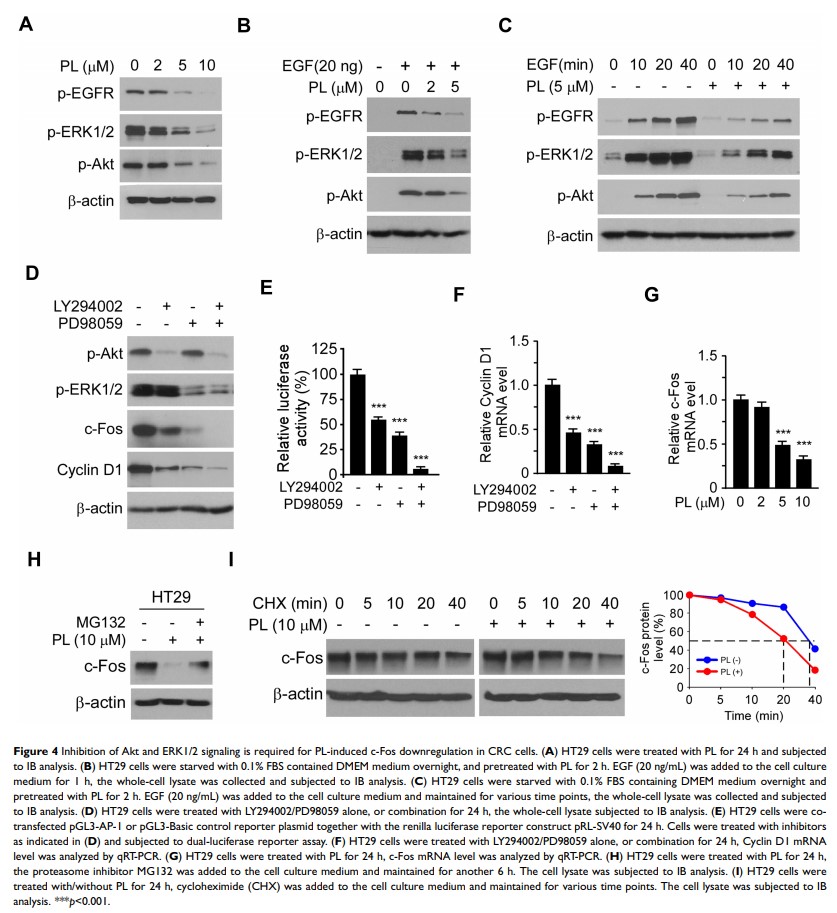
Results: Cyclin D1 was overexpressed in CRC tissues and cells, and was required for maintaining cell growth, colony formation, and in vivo tumorigenesis. PL decreased the protein level of c-Fos, which eventually reduced the transcriptional activity of AP-1 and the mRNA level of Cyclin D1. Mechanism study showed that PL impaired EGF-induced activation of ERK1/2 and Akt signalings, which resulted in a reduction of c-Fos transcription. Furthermore, PL reduced the half-life of c-Fos and caused the ubiquitination-dependent degradation of c-Fos. Finally, the in vivo antitumor effect of PL on CRC cells was examined using a xenograft mouse model.
Conclusion: Our data indicate that PL is a promising antitumor agent that deserves further study for CRC treatment.
Keywords: colorectal cancer, piperlongumine, c-Fos, Cyclin D1