115195
论文已发表
注册即可获取德孚的最新动态
IF 收录期刊
- 3.6 Breast Cancer (Dove Med Press)
- 4.3 Clin Epidemiol
- 2.6 Cancer Manag Res
- 3.2 Infect Drug Resist
- 4.1 Clin Interv Aging
- 6.1 Drug Des Dev Ther
- 4.1 Int J Chronic Obstr
- 8.7 Int J Nanomed
- 2.5 Int J Women's Health
- 3.2 Neuropsych Dis Treat
- 2.4 OncoTargets Ther
- 2.6 Patient Prefer Adher
- 2.6 Ther Clin Risk Manag
- 3.1 J Pain Res
- 3.5 Diabet Metab Synd Ob
- 4.5 Psychol Res Behav Ma
- 3.4 Nat Sci Sleep
- 2.4 Pharmgenomics Pers Med
- 2.6 Risk Manag Healthc Policy
- 4.6 J Inflamm Res
- 2.3 Int J Gen Med
- 3.9 J Hepatocell Carcinoma
- 3.3 J Asthma Allergy
- 2.5 Clin Cosmet Investig Dermatol
- 3.0 J Multidiscip Healthc

中国社区人口参考范围内的血清促甲状腺激素与代谢综合征之间的关联
Authors Li M, Zhang X, Zhou X, Han X, Zhang R, Fu Z, Wang L, Gao Y, Li Y, Ji L
Received 3 March 2020
Accepted for publication 29 April 2020
Published 16 June 2020 Volume 2020:13 Pages 2001—2011
DOI https://doi.org/10.2147/DMSO.S252154
Checked for plagiarism Yes
Review by Single-blind
Peer reviewer comments 3
Editor who approved publication: Prof. Dr. Juei-Tang Cheng
Purpose: We aimed to ascertain the association between thyrotropin (TSH) levels in euthyroid state and the prevalence of metabolic syndrome (MetS) in a community-based Chinese population.
Participants and Methods: Based on a large and well-characterized community cohort in Beijing, China, 1831 men and 1742 women with serum TSH levels within the reference range (0.50– 4.78 μIU/mL) were stratified by quartiles of TSH (Q1-4). MetS was identified according to the criteria of International Diabetes Federation guidelines. Poisson regression models were used to estimate the association between serum TSH and the prevalence of MetS and its components before and after adjustment for potential confounding factors. The reported association was measured using the prevalence ratio (PR) with its respective 95% confidence interval (95% CI).
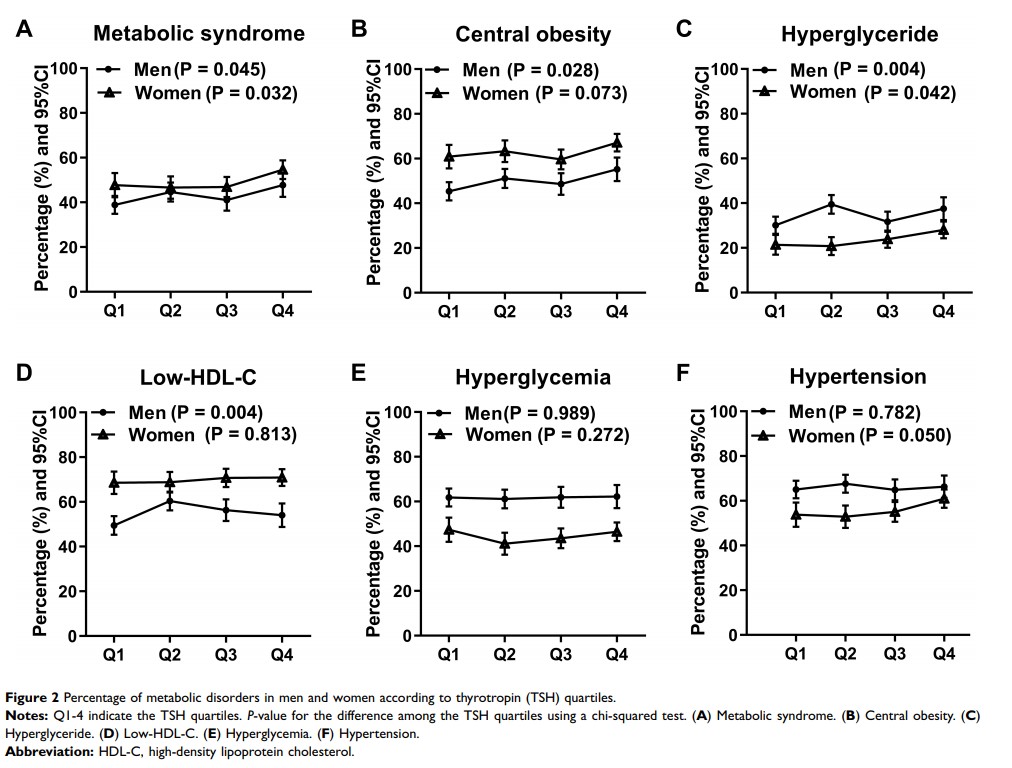
Results: The prevalence of MetS in euthyroid population across TSH quartiles (Q1-4) was 38.9%, 44.6%, 41.0%, and 47.7%, respectively, in men (P = 0.045), and 47.7%, 46.6%, 46.9%, and 54.6%, respectively, in women (P = 0.032). Compared with the reference group TSH-Q1, the prevalence of MetS was higher among TSH-Q4 group both in men (PR = 1.27; 95% CI: 1.09, 1.48, P = 0.002) and women (PR = 1.21; 95% CI: 1.07, 1.37, P = 0.003) even after adjustment for age, lifestyle factors, serum levels of free triiodothyronine (FT3), and free thyroxine (FT4). Most of the components of MetS were common in higher serum TSH levels within the normal range.
Conclusion: The prevalence of MetS and most of its components increased in the higher TSH group in euthyroid Chinese population.
Keywords: thyroid hormones, obesity, hypertension, hyperglycemia