115195
论文已发表
注册即可获取德孚的最新动态
IF 收录期刊
- 3.6 Breast Cancer (Dove Med Press)
- 4.3 Clin Epidemiol
- 2.6 Cancer Manag Res
- 3.2 Infect Drug Resist
- 4.1 Clin Interv Aging
- 6.1 Drug Des Dev Ther
- 4.1 Int J Chronic Obstr
- 8.7 Int J Nanomed
- 2.5 Int J Women's Health
- 3.2 Neuropsych Dis Treat
- 2.4 OncoTargets Ther
- 2.6 Patient Prefer Adher
- 2.6 Ther Clin Risk Manag
- 3.1 J Pain Res
- 3.5 Diabet Metab Synd Ob
- 4.5 Psychol Res Behav Ma
- 3.4 Nat Sci Sleep
- 2.4 Pharmgenomics Pers Med
- 2.6 Risk Manag Healthc Policy
- 4.6 J Inflamm Res
- 2.3 Int J Gen Med
- 3.9 J Hepatocell Carcinoma
- 3.3 J Asthma Allergy
- 2.5 Clin Cosmet Investig Dermatol
- 3.0 J Multidiscip Healthc

用于具有磷酸化 STAT3 和白细胞介素 31 免疫浸润相关基因的卵巢癌患者的综合风险评估模型
Authors Wang X, Lin F, Li J, Wang H
Received 25 March 2020
Accepted for publication 22 May 2020
Published 16 June 2020 Volume 2020:13 Pages 5617—5628
DOI https://doi.org/10.2147/OTT.S254494
Checked for plagiarism Yes
Review by Single-blind
Peer reviewer comments 2
Editor who approved publication: Dr Federico Perche
Introduction: Ovarian carcinoma is a malignant tumor with a high mortality rate and a lack of effective treatment options for patients at advanced stages. For improving outcomes and helping patients with poor prognosis, choose a suitable therapy and an excellent risk assessment model and new treatment options are needed.
Materials and Methods: Ovarian cancer gene expression profile of GSE32062 was downloaded from the NCBI GEO database for screening differentially expressed genes (DEGs) between well and poor prognosis groups using limma package in R (version 3.4.1). Prognosis-related genes and clinical prognostic factors were obtained from univariate and multivariate Cox regression analyses, and a comprehensive risk assessment model was constructed using a Pathway Dysregulation Score (PDS) matrix, Cox-Proportional Hazards (Cox-PH) regression, as well as L1-least absolute shrinkage and selection operator (L1-LASSO) penalization. Then, significant DEGs were converted to pathways and optimal prognosis-related pathways were screened. Finally, risk prediction models based on pathways, genes involved in pathways, and comprehensive clinical risk factors with pathways were built. Their prognostic functions were assessed in verification sets. Besides, genes involved in immune-pathways were checked for immune infiltration using immunohistochemistry.
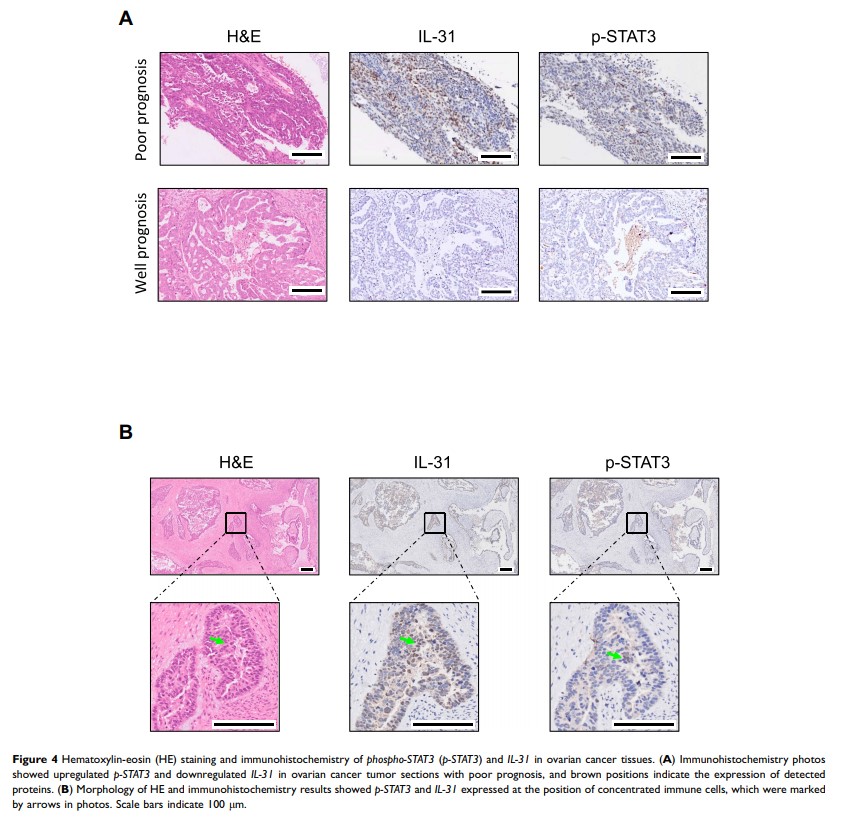
Results: A superior risk assessment model involving 9 optimal combinations of pathways and one clinical factor was constructed. The pathway-based model was found to be superior to the gene-based model. Phospho-STAT3 (from JAK-STAT signaling pathway) and IL-31 (from DEGs) were found to be related to immune infiltration.
Conclusion: We have generated a comprehensive risk assessment model consisting of a clinical risk factor and pathways that showed a possible bright foreground. The set of significant pathways might play as a better prognosis model which is more accurate and applicable than the DEG set. Besides, p-STAT3 and IL-31 showing correlation to immune infiltration of ovarian cancer tissues may be potential therapeutic targets for treating ovarian cancers.
Keywords: ovarian cancer, prognosis-related pathways, comprehensive risk assessment model, immune infiltration