115195
论文已发表
注册即可获取德孚的最新动态
IF 收录期刊
- 3.6 Breast Cancer (Dove Med Press)
- 4.3 Clin Epidemiol
- 2.6 Cancer Manag Res
- 3.2 Infect Drug Resist
- 4.1 Clin Interv Aging
- 6.1 Drug Des Dev Ther
- 4.1 Int J Chronic Obstr
- 8.7 Int J Nanomed
- 2.5 Int J Women's Health
- 3.2 Neuropsych Dis Treat
- 2.4 OncoTargets Ther
- 2.6 Patient Prefer Adher
- 2.6 Ther Clin Risk Manag
- 3.1 J Pain Res
- 3.5 Diabet Metab Synd Ob
- 4.5 Psychol Res Behav Ma
- 3.4 Nat Sci Sleep
- 2.4 Pharmgenomics Pers Med
- 2.6 Risk Manag Healthc Policy
- 4.6 J Inflamm Res
- 2.3 Int J Gen Med
- 3.9 J Hepatocell Carcinoma
- 3.3 J Asthma Allergy
- 2.5 Clin Cosmet Investig Dermatol
- 3.0 J Multidiscip Healthc

KIAA1522 通过激活 Wnt/β-连环蛋白信号通路促进肝细胞癌的进展
Authors Jiang S, Zhang Y, Li Q, Qiu L, Bian B
Received 24 February 2020
Accepted for publication 18 May 2020
Published 16 June 2020 Volume 2020:13 Pages 5657—5668
DOI https://doi.org/10.2147/OTT.S251157
Checked for plagiarism Yes
Review by Single-blind
Peer reviewer comments 2
Editor who approved publication: Dr Leo Jen-Liang Su
Purpose: KIAA1522 was previously identified to play a crucial role in cancer development and progression. However, its functions and underlying mechanisms in hepatocellular carcinoma (HCC) remain elusive.
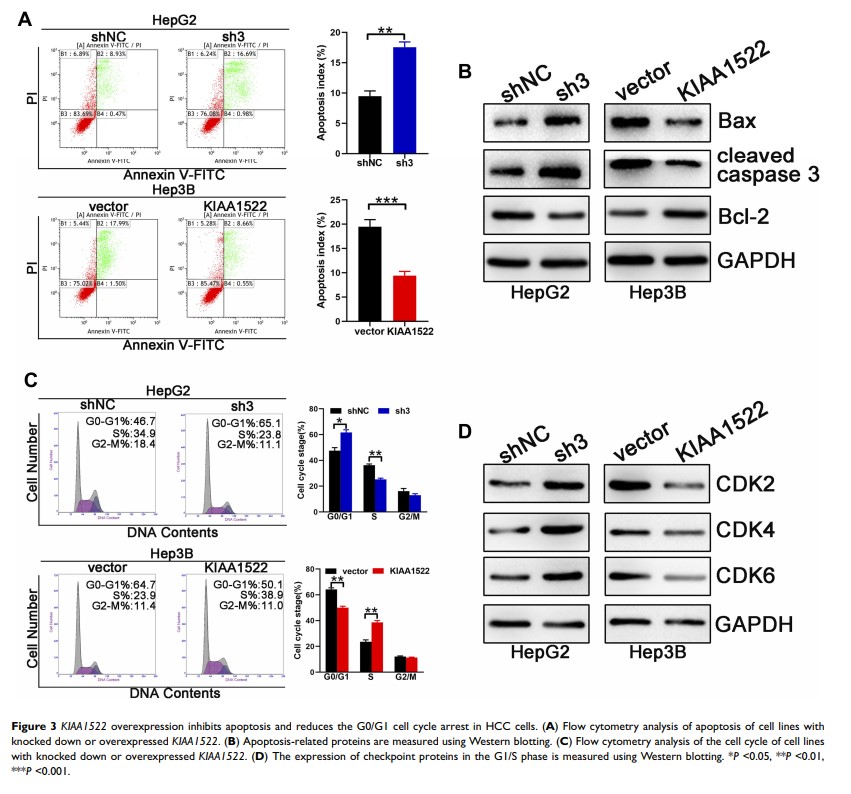
Materials and Methods: To elucidate the role of KIAA1522 in HCC, its expression was assessed using The Cancer Genome Atlas and GEPIA databases. Next, these results were validated by quantitative reverse transcription-polymerase chain reaction, Western blotting, and immunohistochemistry of HCC tissues and cell lines. Flow cytometry, CCK-8, EDU, colony formation, Transwell invasion, and wound healing assays were performed to explore the function of KIAA1522 in HCC in vivo and in vitro. Finally, gene set enrichment analysis was used to identify the pathways involved.
Results: Our results demonstrated that KIAA1522 was highly expressed in HCC tissues and cell lines. Furthermore, KIAA1522 overexpression was associated with unfavorable clinicopathological characteristics. Survival analyses revealed that KIAA1522 overexpression predicted lower recurrence-free and overall survival rates in patients with HCC. Functional studies suggested that KIAA1522 facilitated HCC proliferation, migration, and invasion both in vitro and in vivo. Moreover, KIAA1522 up-regulated the Wnt/β-catenin signaling pathway, as confirmed by TOP-flash/FOP-flash luciferase reporter assays and Western blotting.
Conclusion: In conclusion, we highlighted the oncogenic role of KIAA1522 in HCC and determined its potential as a therapeutic target for HCC.
Keywords: hepatocarcinogenesis, KIAA1522, prognosis, Wnt/β-catenin signaling pathway