115195
论文已发表
注册即可获取德孚的最新动态
IF 收录期刊
- 3.6 Breast Cancer (Dove Med Press)
- 4.3 Clin Epidemiol
- 2.6 Cancer Manag Res
- 3.2 Infect Drug Resist
- 4.1 Clin Interv Aging
- 6.1 Drug Des Dev Ther
- 4.1 Int J Chronic Obstr
- 8.7 Int J Nanomed
- 2.5 Int J Women's Health
- 3.2 Neuropsych Dis Treat
- 2.4 OncoTargets Ther
- 2.6 Patient Prefer Adher
- 2.6 Ther Clin Risk Manag
- 3.1 J Pain Res
- 3.5 Diabet Metab Synd Ob
- 4.5 Psychol Res Behav Ma
- 3.4 Nat Sci Sleep
- 2.4 Pharmgenomics Pers Med
- 2.6 Risk Manag Healthc Policy
- 4.6 J Inflamm Res
- 2.3 Int J Gen Med
- 3.9 J Hepatocell Carcinoma
- 3.3 J Asthma Allergy
- 2.5 Clin Cosmet Investig Dermatol
- 3.0 J Multidiscip Healthc

静息巯基氧化酶1通过 PI3K/Akt 信号通路调节人胶质母细胞瘤细胞的增殖、迁移和侵袭
Authors Geng Y, Xu C, Wang Y, Zhang L
Received 1 April 2020
Accepted for publication 27 May 2020
Published 17 June 2020 Volume 2020:13 Pages 5721—5729
DOI https://doi.org/10.2147/OTT.S255941
Checked for plagiarism Yes
Review by Single-blind
Peer reviewer comments 2
Editor who approved publication: Dr Cho
Background: Quiescin sulfhydryl oxidase 1 (QSOX1) involves in the formation of disulfide bonds and participates in the protein folding process. In recent years, accumulating evidences have shown that QSOX1 is a biomarker for tumor development and prognosis. However, the biological function of QSOX1 in glioblastoma (GBM) remains unclear.
Materials and Methods: QSOX1 expression in glioma and overall survival of glioma patients were analyzed through The Cancer Genome Atlas (TCGA) and the Chinese Glioma Genome Atlas (CGGA) databases. shRNAs were used to decrease the expression of QSOX1 in U87 and U251 cells. Celltiter-Glo and colony formation assays were used to assess cell proliferation. Transwell and scratch assays were utilized to determine cell migration and invasion, the xenograft mouse models were established to evaluate the effect of QSOX1 knockdown in vivo. Western blot assays were used to detect the changes of E-cadherin/N-cadherin/vimentin and PI3K/Akt pathway.
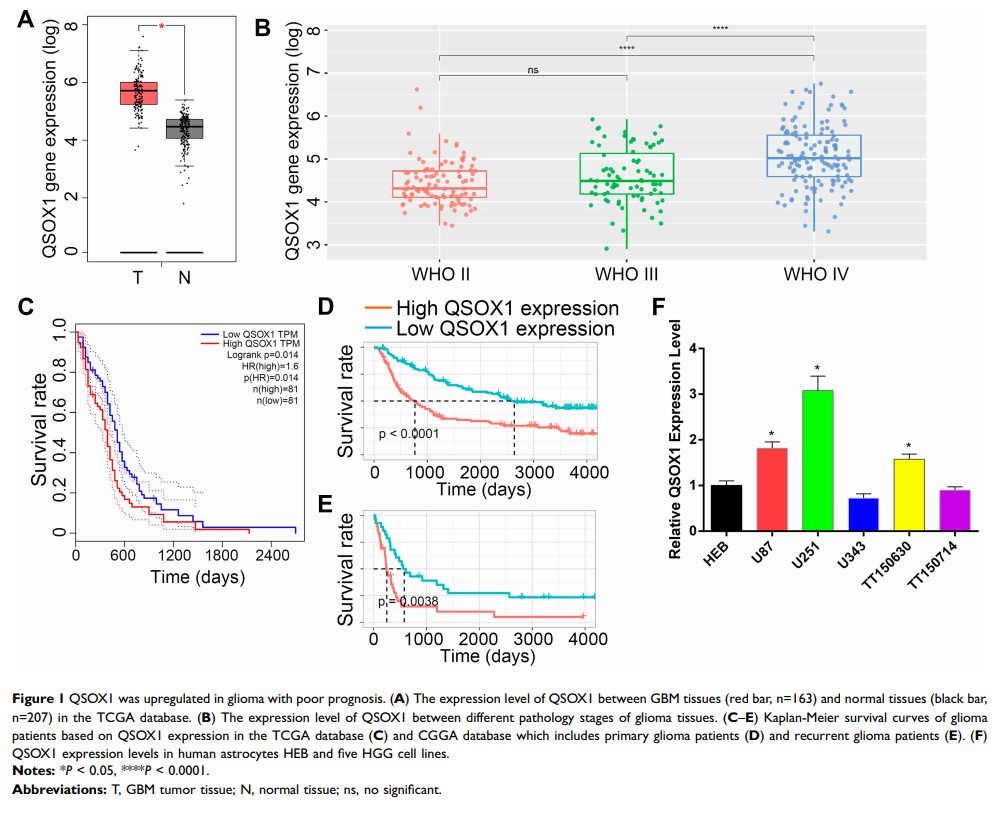
Results: We found that QSOX1 was upregulated in glioma, especially in GBM. Upregulation of QSOX1 was correlated with poor prognosis in glioma patients. We discovered for the first time that suppression of QSOX1 expression inhibited proliferation, migration and invasion, as well as epithelial-mesenchymal transition (EMT) in GBM cell lines. In addition, phosphorylated PI3K and Akt were downregulated in the QSOX1-knockdown groups. Moreover, QSOX1 knockdown-impaired cell growth was partially rescued by Akt activator.
Conclusion: Our findings revealed that QSOX1 was a novel biomarker for GBM patients and QSOX1 promoted cell proliferation, migration and invasion through regulating PI3K/Akt pathway in GBM.
Keywords: QSOX1, glioblastoma, xenograft, epithelial-mesenchymal transition, PI3K/Akt pathway