115195
论文已发表
注册即可获取德孚的最新动态
IF 收录期刊
- 3.6 Breast Cancer (Dove Med Press)
- 4.3 Clin Epidemiol
- 2.6 Cancer Manag Res
- 3.2 Infect Drug Resist
- 4.1 Clin Interv Aging
- 6.1 Drug Des Dev Ther
- 4.1 Int J Chronic Obstr
- 8.7 Int J Nanomed
- 2.5 Int J Women's Health
- 3.2 Neuropsych Dis Treat
- 2.4 OncoTargets Ther
- 2.6 Patient Prefer Adher
- 2.6 Ther Clin Risk Manag
- 3.1 J Pain Res
- 3.5 Diabet Metab Synd Ob
- 4.5 Psychol Res Behav Ma
- 3.4 Nat Sci Sleep
- 2.4 Pharmgenomics Pers Med
- 2.6 Risk Manag Healthc Policy
- 4.6 J Inflamm Res
- 2.3 Int J Gen Med
- 3.9 J Hepatocell Carcinoma
- 3.3 J Asthma Allergy
- 2.5 Clin Cosmet Investig Dermatol
- 3.0 J Multidiscip Healthc

通过在体内外调节 TGF-β/Smad 信号通路降低氧化应激和炎症反应,青藤碱可减轻对乙酰氨基酚所致急性肝损伤
Authors Chen H, Wang Y, Jiao FZ, Yang F, Li X, Wang LW
Received 7 February 2020
Accepted for publication 24 April 2020
Published 17 June 2020 Volume 2020:14 Pages 2393—2403
DOI https://doi.org/10.2147/DDDT.S248823
Checked for plagiarism Yes
Review by Single-blind
Peer reviewer comments 2
Editor who approved publication: Dr Anastasios Lymperopoulos
Introduction: Liver disease is common and often life-threatening. Sinomenine (SIN) is an active ingredient extracted from Sinomenium acutum . This study investigated the protective effect and mechanism of sinomenine (SIN) on acetaminophen (APAP)-induced liver injury from in vitro and in vivo.
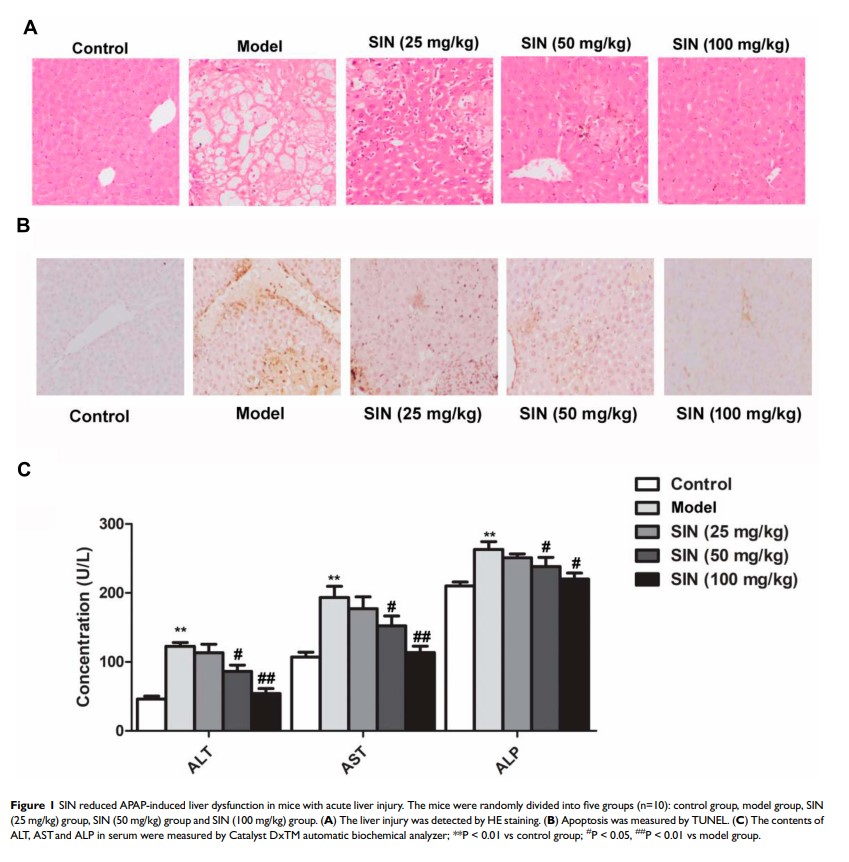
Methods: In vivo experiments, mice were randomly divided into six groups (n=10): control group, model group, SIN (25 mg/kg) group, SIN (50 mg/kg) group, SIN (100 mg/kg) group and SIN (100 mg/kg) + SRI-011381 group. Alanine transaminases (ALT), aspartate transaminases (AST) and alkaline phosphatase (ALP) were detected. The pathological lesion was measured by HE staining. Apoptosis was measured by TUNEL staining. In vitro experiments, BRL-3A cells were treated with APAP (7.5 mM) and then subjected to various doses of SIN (10, 50 and 100 μg/mL) at 37°C for 24 h. Inflammatory factors and oxidative stress index were measured by ELISA. The expression of proteins was detected by Western blot.
Results: The results showed that compared with the control group, the levels of ALT, AST and ALP in the serum of APAP-induced mice were significantly increased, followed by liver histological damage and hepatocyte apoptosis. Besides, APAP reduced the activity of SOD and GSH-Px, while increasing the content of MDA and LDH. Notably, APAP also promoted the expression of NLRP3, ASC, caspase-1 and IL-1β. Interestingly, SIN treatment dose-dependently reduced APAP-induced liver injury and oxidative stress, inhibited the activation of NLRP3 inflammasomes, and reduced the levels of inflammatory cytokines. In vitro studies have shown that SIN treatment significantly reduced the viability of BRL-3A cells and oxidative stress and inflammation. In addition, the Western blotting analysis showed that SIN inhibited the activation of TGF-β/Smad pathway in a dose-dependent manner in vitro and in vivo. These effects were significantly reversed by TGF-β/Smad activator SRI-011381 or TGF-β overexpression.
Discussion: The study indicates that SIN attenuates APAP-induced acute liver injury by decreasing oxidative stress and inflammatory response via TGF-β/Smad pathway in vitro and in vivo.
Keywords: Sinomenine, acetaminophen, inflammatory response, oxidative stress, TGF-β/Smad pathway, acute liver injury