115195
论文已发表
注册即可获取德孚的最新动态
IF 收录期刊
- 3.6 Breast Cancer (Dove Med Press)
- 4.3 Clin Epidemiol
- 2.6 Cancer Manag Res
- 3.2 Infect Drug Resist
- 4.1 Clin Interv Aging
- 6.1 Drug Des Dev Ther
- 4.1 Int J Chronic Obstr
- 8.7 Int J Nanomed
- 2.5 Int J Women's Health
- 3.2 Neuropsych Dis Treat
- 2.4 OncoTargets Ther
- 2.6 Patient Prefer Adher
- 2.6 Ther Clin Risk Manag
- 3.1 J Pain Res
- 3.5 Diabet Metab Synd Ob
- 4.5 Psychol Res Behav Ma
- 3.4 Nat Sci Sleep
- 2.4 Pharmgenomics Pers Med
- 2.6 Risk Manag Healthc Policy
- 4.6 J Inflamm Res
- 2.3 Int J Gen Med
- 3.9 J Hepatocell Carcinoma
- 3.3 J Asthma Allergy
- 2.5 Clin Cosmet Investig Dermatol
- 3.0 J Multidiscip Healthc

CFTR 通过抑制 NF-κB 信号通路来调节宫颈癌细胞的增殖、迁移和侵袭
Authors Wu Z, Li J, Zhang Y, Hu L, Peng X
Received 3 March 2020
Accepted for publication 7 May 2020
Published 18 June 2020 Volume 2020:12 Pages 4685—4697
DOI https://doi.org/10.2147/CMAR.S252296
Checked for plagiarism Yes
Review by Single-blind
Peer reviewer comments 2
Editor who approved publication: Dr Seema Singh
Background: The cystic fibrosis transmembrane conductance regulator (CFTR) and nuclear factor κB (NF-κB) signalling pathways are currently regarded as co-regulators of the occurrence of cervical cancer. However, the detailed mechanism of CFTR- and NF-κB-mediated effects in cervical cancer remains to be elucidated. This study aimed to investigate the mechanism by which CFTR and NF-κB influence the development of cervical cancer.
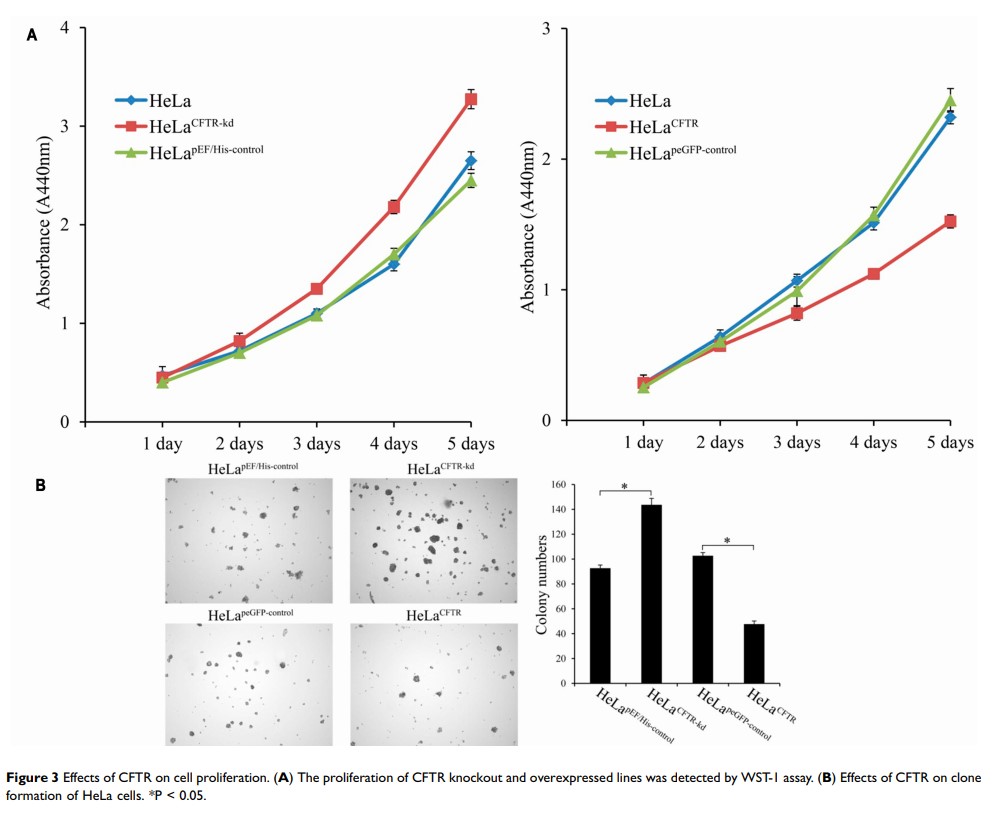
Patients and Methods: CFTR ΔF508 mutation and CFTR promoter methylation were detected in cervical tissue samples. NF-κB p65 and IκBα protein levels were tested in HeLa cells with CFTR overexpression and knockdown by Western blotting. The effects of CFTR on cell proliferation, migration, and invasion were examined in HeLa cells by WST-1 and soft agar assays, cell wound scratch assay, and Matrigel invasion assays, respectively. The protein–protein interaction (PPI) network was constructed by using GeneMANIA. GeneCoDis3 was used to perform Gene Ontology (GO) and Kyoto Encyclopedia of Genes and Genomes (KEGG) functional enrichment analysis on genes in the PPI network.
Results: CFTR mutation and CFTR promoter methylation were not associated with the occurrence of cervical cancer. NF-κB p65 protein levels were decreased in CFTR overexpression lines and increased in CFTR knockdown lines, and IκBα levels were affected in the opposite manner, indicating that CFTR inhibited the NF-κB signalling pathway. CFTR also regulated the cell proliferation, migration, and invasion ability of cervical cancer cells. When CFTR was overexpressed, cell proliferation, migration, and invasion ability were decreased. There were 20 genes that interacted with CFTR. KEGG pathway analysis showed enrichment in the gastric acid secretion, chemokine signalling, bile secretion and apoptosis pathways.
Conclusion: CFTR plays an important role in cancer cell proliferation, migration and invasion by inhibiting the NF-κB signalling pathway in cervical cancer.
Keywords: cervical cancer, cystic fibrosis transmembrane conductance regulator, nuclear factor κB, signalling pathway