115195
论文已发表
注册即可获取德孚的最新动态
IF 收录期刊
- 3.6 Breast Cancer (Dove Med Press)
- 4.3 Clin Epidemiol
- 2.6 Cancer Manag Res
- 3.2 Infect Drug Resist
- 4.1 Clin Interv Aging
- 6.1 Drug Des Dev Ther
- 4.1 Int J Chronic Obstr
- 8.7 Int J Nanomed
- 2.5 Int J Women's Health
- 3.2 Neuropsych Dis Treat
- 2.4 OncoTargets Ther
- 2.6 Patient Prefer Adher
- 2.6 Ther Clin Risk Manag
- 3.1 J Pain Res
- 3.5 Diabet Metab Synd Ob
- 4.5 Psychol Res Behav Ma
- 3.4 Nat Sci Sleep
- 2.4 Pharmgenomics Pers Med
- 2.6 Risk Manag Healthc Policy
- 4.6 J Inflamm Res
- 2.3 Int J Gen Med
- 3.9 J Hepatocell Carcinoma
- 3.3 J Asthma Allergy
- 2.5 Clin Cosmet Investig Dermatol
- 3.0 J Multidiscip Healthc

玉女煎在体内和体外通过 mTOR 调节自噬和细胞凋亡
Authors He C, Liu G, Zhuang S, Zhang J, Chen Y, Li H, Huang Z, Zheng Y
Received 11 March 2020
Accepted for publication 15 May 2020
Published 18 June 2020 Volume 2020:13 Pages 2081—2092
DOI https://doi.org/10.2147/DMSO.S253494
Checked for plagiarism Yes
Review by Single-blind
Peer reviewer comments 2
Editor who approved publication: Dr Antonio Brunetti
Introduction: Yu Nu compound (YNJ) is a traditional Chinese medicine widely utilized to treat type 2 diabetes possibly through mediating autophagy. Abnormal podocyte autophagy and apoptosis could result in podocyte loss in diabetics nephropathy (DN). The mechanism of Yu Nu compound in DN is still unclear. Therefore, the study aims to investigate the effects of Yu Nu compound and analyze the potential mechanism.
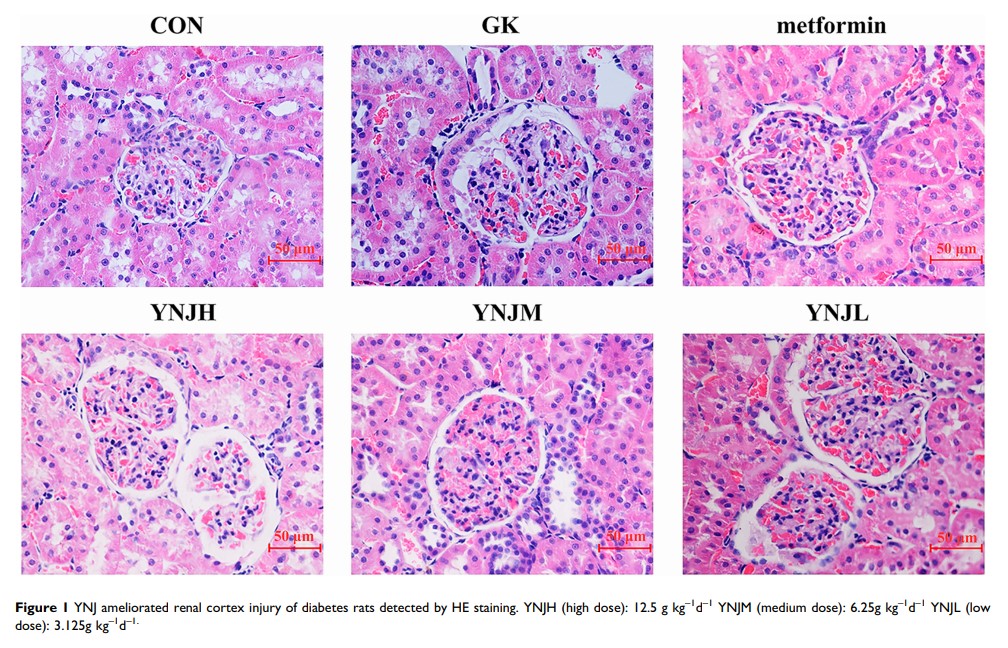
Methods: Goto-Kakizaki (GK) rats were administered using YNJ with different doses once a day by gavage for 4 weeks. The renal cortex injury was observed by HE staining and electron microscope. Cell apoptosis of renal cortex was analyzed by TUNNEL staining. The mTOR, autophagy-related proteins and apoptosis-related proteins were detected by Western blot or real-time PCR in vivo and vitro. MPC5 cells were exposed to high glucose (HG, 30mM) for 12h to simulate podocyte injury in DN. MPC5 cells were treated by serum containing YNJ with different dosages. Cell activities and apoptosis were, respectively, detected through Cell Counting Kit-8 (CCK8) assay and flow cytometry.
Results: The results showed that the medium dose of YNJ had better effects on decreasing blood glucose and improving renal injury in GK rats, followed by decreasing mTOR levels. The autophagy levels were enhanced in renal cortex, accompanied with the increase of cell apoptosis in vivo. Besides, the proteins regulating autophagy and apoptosis were significantly modulated by YNJ in GK rats. Then, we found that the decreasing endogenous mTOR could reverse the effects of YNJ on podocyte apoptosis and autophagy in vivo.
Discussion: The study suggested that YNJ recovered normal autophagy and suppressed apoptosis through regulating mTOR. The maintenance of normal basal autophagic activity possibly based on the effect of YNJ on multiple target was essential for maintaining podocyte function.
Keywords: traditional Chinese medicine, diabetics nephropathy, LC3, Bcl-2, mTOR