115195
论文已发表
注册即可获取德孚的最新动态
IF 收录期刊
- 3.6 Breast Cancer (Dove Med Press)
- 4.3 Clin Epidemiol
- 2.6 Cancer Manag Res
- 3.2 Infect Drug Resist
- 4.1 Clin Interv Aging
- 6.1 Drug Des Dev Ther
- 4.1 Int J Chronic Obstr
- 8.7 Int J Nanomed
- 2.5 Int J Women's Health
- 3.2 Neuropsych Dis Treat
- 2.4 OncoTargets Ther
- 2.6 Patient Prefer Adher
- 2.6 Ther Clin Risk Manag
- 3.1 J Pain Res
- 3.5 Diabet Metab Synd Ob
- 4.5 Psychol Res Behav Ma
- 3.4 Nat Sci Sleep
- 2.4 Pharmgenomics Pers Med
- 2.6 Risk Manag Healthc Policy
- 4.6 J Inflamm Res
- 2.3 Int J Gen Med
- 3.9 J Hepatocell Carcinoma
- 3.3 J Asthma Allergy
- 2.5 Clin Cosmet Investig Dermatol
- 3.0 J Multidiscip Healthc

在中国老年股骨粗隆间骨折患者中,短型头髓钉的前方皮质撞击的危险因素
Authors Nie S, Li M, Li J, Zhao Y, Cui X, Xu G, Zhang L, Zhang W, Tang P
Received 3 March 2020
Accepted for publication 31 May 2020
Published 18 June 2020 Volume 2020:16 Pages 523—530
DOI https://doi.org/10.2147/TCRM.S252214
Checked for plagiarism Yes
Review by Single-blind
Peer reviewer comments 2
Editor who approved publication: Professor Deyun Wang
Background: Anterior cortical impingement is a common phenomenon after intramedullary fixation in Asian patients with intertrochanteric fractures. It may cause thigh pain and even fracture of the femoral shaft, which may seriously affect postoperative rehabilitation and limb function of patients. However, little was known about risk factors for anterior cortical impingement in Chinese elderly after intramedullary nailing. Hence, the aim of this study was to certify the risk factors for anterior cortical impingement treated with intramedullary nails of intertrochanteric fracture, hoping to provide suggestions for surgical treatment.
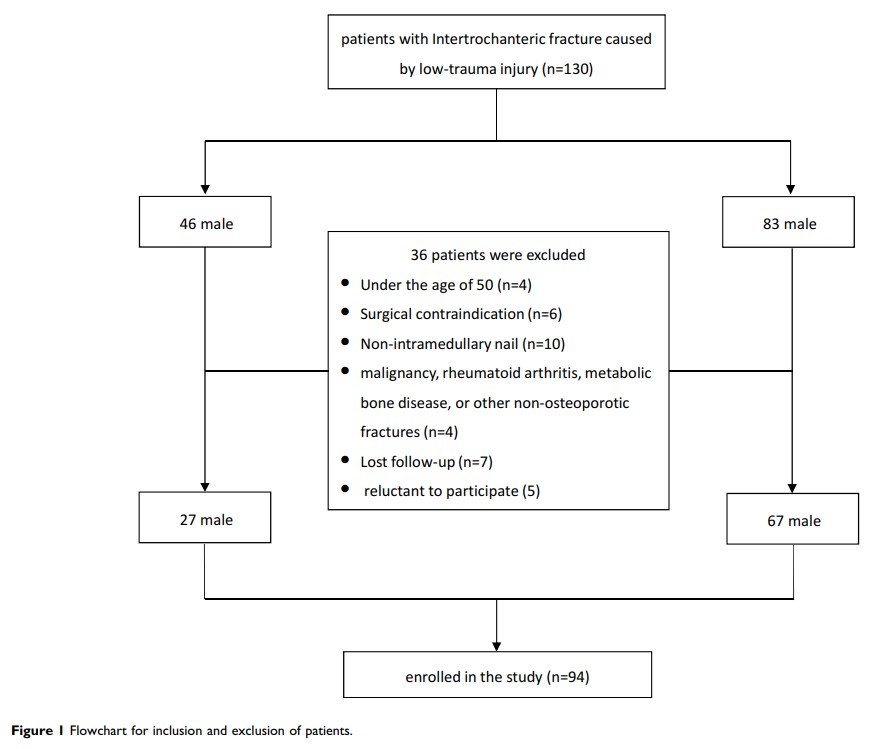
Patients and Methods: A retrospective consecutive series of 94 patients who had been diagnosed as intertrochanteric fracture at our institution was included from January 2019 to November 2019. All patients were treated with intramedullary fixation and followed up for at least 6 months. Demographic, surgical and anesthesiologic information, as well as radiographic data and complications were collected and reviewed.
Results: The ratio of anterior cortical impingement is significantly higher in female patients than that of males (80.4% vs 18.6%, P =0.041). Higher incidence of anterior cortical impingement was found in the longer intramedullary nail group, especially in females. Gender (as a female patient) and length of nail were significant risk factors for anterior cortical impingement in intertrochanteric fracture patients treated with intramedullary nail (OR =2.662, 95% CI =1.010– 7.018, P =0.447; OR =1.047, 95% CI =1.016– 1.079, respectively). The length of nail was a risk factor for anterior cortical impingement in female intertrochanteric fracture patients treated with intramedullary nail (OR =1.051, 95% CI =1.015– 1.089).
Conclusion: Elderly female patients with intertrochanteric fractures treated with intramedullary nails had a higher incidence of anterior cortical impingement. The length of short intramedullary nail is a risk factor for anterior cortical impingement. Patients with anterior cortical impingement may suffer serious complications.
Keywords: anterior cortical impingement, intramedullary nail, risk factors, intertrochanteric fracture