115195
论文已发表
注册即可获取德孚的最新动态
IF 收录期刊
- 3.6 Breast Cancer (Dove Med Press)
- 4.3 Clin Epidemiol
- 2.6 Cancer Manag Res
- 3.2 Infect Drug Resist
- 4.1 Clin Interv Aging
- 6.1 Drug Des Dev Ther
- 4.1 Int J Chronic Obstr
- 8.7 Int J Nanomed
- 2.5 Int J Women's Health
- 3.2 Neuropsych Dis Treat
- 2.4 OncoTargets Ther
- 2.6 Patient Prefer Adher
- 2.6 Ther Clin Risk Manag
- 3.1 J Pain Res
- 3.5 Diabet Metab Synd Ob
- 4.5 Psychol Res Behav Ma
- 3.4 Nat Sci Sleep
- 2.4 Pharmgenomics Pers Med
- 2.6 Risk Manag Healthc Policy
- 4.6 J Inflamm Res
- 2.3 Int J Gen Med
- 3.9 J Hepatocell Carcinoma
- 3.3 J Asthma Allergy
- 2.5 Clin Cosmet Investig Dermatol
- 3.0 J Multidiscip Healthc

青少年肌阵挛性癫痫的结果预测因子
Authors Chen Y, Chen J, Chen X, Wang R, Zeng J, Wang F, Miao J
Received 4 January 2020
Accepted for publication 12 May 2020
Published 19 June 2020 Volume 2020:13 Pages 609—613
DOI https://doi.org/10.2147/RMHP.S244725
Checked for plagiarism Yes
Review by Single-blind
Peer reviewer comments 2
Editor who approved publication: Dr Kent Rondeau
Background: Juvenile myoclonic epilepsy (JME) is the most common idiopathic generalized epilepsy syndrome, accounting for 10% of all epilepsy. However, there is limited information regarding the predictors of seizure outcome. The aim of this study was to determine the predictors of seizure outcome in JME patients.
Methods: A population-based retrospective study of JME patients who were treated at the Department of Neurology of affiliated Zhongshan Hospital, Xiamen University from 2008 to 2013.
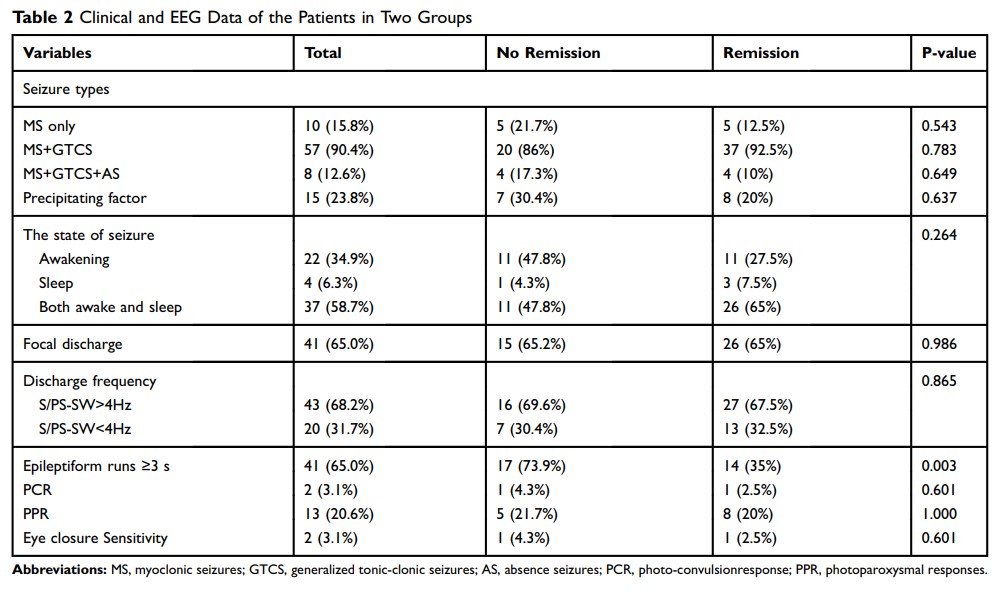
Results: Sixty-three patients (30 women and 33 men) were enrolled in this study. The median age at seizure onset was 14 years old, and the average duration of epilepsy was 5 years. The onset of JME at age < 16 years was found in 63.5% of patients. The epileptiform runs ≥ 3 s were observed in 35.8% patients. Febrile seizure was noted in 28.9% of patients. Among 63 patients, 40 patients (63.5%) had remission. Multivariate analysis identified the following factors as significant predictors of seizure outcome: the onset of JME at age < 16 years, epileptiform runs ≥ 3 s runs, and febrile seizure.
Conclusion: The onset of JME at age < 16 years, febrile seizures and epileptiform runs ≥ 3 s might be associated with poor long-term seizure outcome in patients with JME.
Keywords: juvenile myoclonic epilepsy, seizure, predictor, outcome