115195
论文已发表
注册即可获取德孚的最新动态
IF 收录期刊
- 3.6 Breast Cancer (Dove Med Press)
- 4.3 Clin Epidemiol
- 2.6 Cancer Manag Res
- 3.2 Infect Drug Resist
- 4.1 Clin Interv Aging
- 6.1 Drug Des Dev Ther
- 4.1 Int J Chronic Obstr
- 8.7 Int J Nanomed
- 2.5 Int J Women's Health
- 3.2 Neuropsych Dis Treat
- 2.4 OncoTargets Ther
- 2.6 Patient Prefer Adher
- 2.6 Ther Clin Risk Manag
- 3.1 J Pain Res
- 3.5 Diabet Metab Synd Ob
- 4.5 Psychol Res Behav Ma
- 3.4 Nat Sci Sleep
- 2.4 Pharmgenomics Pers Med
- 2.6 Risk Manag Healthc Policy
- 4.6 J Inflamm Res
- 2.3 Int J Gen Med
- 3.9 J Hepatocell Carcinoma
- 3.3 J Asthma Allergy
- 2.5 Clin Cosmet Investig Dermatol
- 3.0 J Multidiscip Healthc

饮酒频率(而非饮酒年数)可能与下尿路症状有关:对中国男性大规模横断面调查的结果
Authors Lu Z, Wu C, Zhang J, Ye Y, Zhang Z, Liao M, Huang L, Tian J, Tan A, Mo Z
Received 17 November 2019
Accepted for publication 19 May 2020
Published 23 June 2020 Volume 2020:13 Pages 633—642
DOI https://doi.org/10.2147/RMHP.S238012
Checked for plagiarism Yes
Review by Single-blind
Peer reviewer comments 2
Editor who approved publication: Dr Kent Rondeau
Objective: To evaluate the effect of the drinking frequency and years on lower urinary tract symptoms (LUTS) in a large Chinese male population.
Methods: The current data were obtained from a consecutive series of 3,229 men aged 18– 79 who participated in a routine physical examination in Fangchenggang First People’s Hospital, Guangxi, China. During a face-to-face interview, the detailed demographic variables about alcohol consumption, potential confounding factors were collected. LUTS were assessed by International Prostate Symptom Score (IPSS) and defined as total LUTS, irritative (IRR) and obstructive (OBS) symptoms, respectively. Multivariate logistic regression analysis was used to evaluate the risk of total LUTS, IRR and OBS symptoms affected by alcohol consumption.
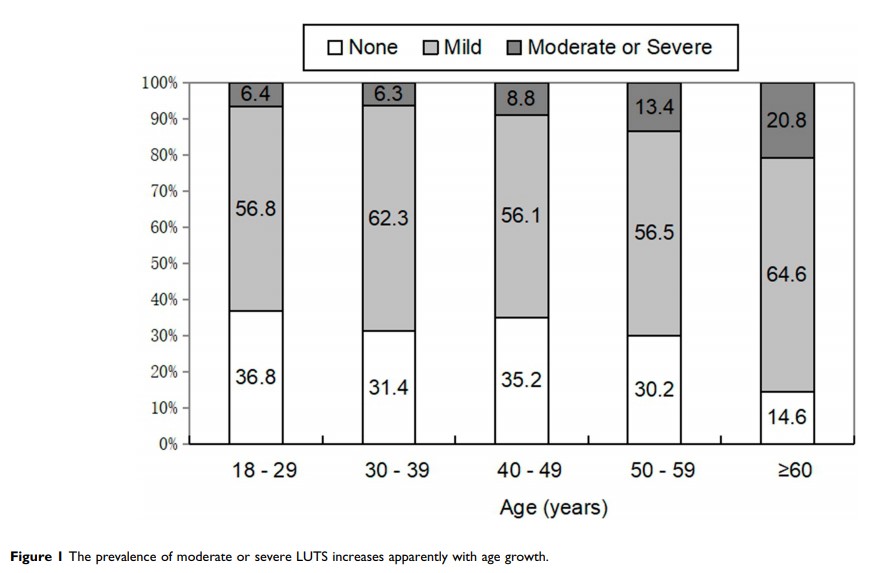
Results: The prevalence of moderate to severe LUTS was 8.3% and apparently increased with age (P < 0.001). A significant distribution presented in age, alcohol consumption, BMI, cigarette smoking, education attainment and hypertension among different strata of LUTS severity (P < 0.05). Men who drank 1– 2 times per week were less likely to have OBS symptoms (OR=0.45, 95% CI=0.29– 0.70) regardless of age (OR=0.52, 95% CI=0.33– 0.82) or multivariate adjusted (OR=0.52, 95% CI=0.33– 0.83). Nevertheless, we did not observe a significant negative or positive association presented between drinking years and the risk of total LUTS, OBS and IRR symptoms.
Conclusion: The current results imply that moderate drinking frequency may be protective against LUTS, and drinking years did not relate to worsening or improving LUTS.
Keywords: observational study, alcohol consumption, urinary tract, epidemiology