115195
论文已发表
注册即可获取德孚的最新动态
IF 收录期刊
- 3.6 Breast Cancer (Dove Med Press)
- 4.3 Clin Epidemiol
- 2.6 Cancer Manag Res
- 3.2 Infect Drug Resist
- 4.1 Clin Interv Aging
- 6.1 Drug Des Dev Ther
- 4.1 Int J Chronic Obstr
- 8.7 Int J Nanomed
- 2.5 Int J Women's Health
- 3.2 Neuropsych Dis Treat
- 2.4 OncoTargets Ther
- 2.6 Patient Prefer Adher
- 2.6 Ther Clin Risk Manag
- 3.1 J Pain Res
- 3.5 Diabet Metab Synd Ob
- 4.5 Psychol Res Behav Ma
- 3.4 Nat Sci Sleep
- 2.4 Pharmgenomics Pers Med
- 2.6 Risk Manag Healthc Policy
- 4.6 J Inflamm Res
- 2.3 Int J Gen Med
- 3.9 J Hepatocell Carcinoma
- 3.3 J Asthma Allergy
- 2.5 Clin Cosmet Investig Dermatol
- 3.0 J Multidiscip Healthc

评估隐睾症对睾丸精原细胞瘤临床分期的影响
Authors Wang X, Chen Z, Qiu S, Cao D, Jin K, Li J, Chen B, Huang Y, Bao Y, Liu L, Wei Q
Received 30 October 2019
Accepted for publication 12 May 2020
Published 23 June 2020 Volume 2020:12 Pages 4883—4888
DOI https://doi.org/10.2147/CMAR.S236618
Checked for plagiarism Yes
Review by Single-blind
Peer reviewer comments 2
Editor who approved publication: Dr Beicheng Sun
Objective: To study the effect of cryptorchidism on clinical stage (CS) of testicular seminoma (TS).
Patients and Methods: In the Surveillance Epidemiology and End Results (SEER) database (2006‐2016), people with TS were enrolled in our research. Multivariable logistic regression models were constructed to compare the impact of cryptorchidism on CS.
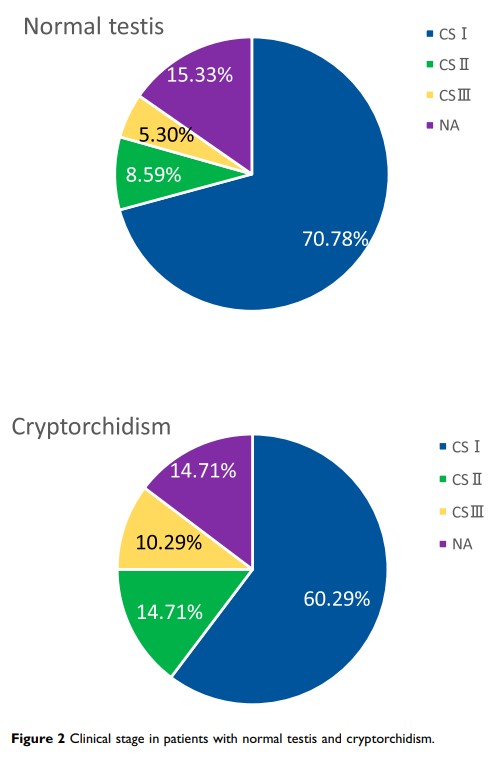
Results: This research was based on the registry information of 12,991 TS patients. All patients with a median age of 36 (13– 107) years were pathologically diagnosed with orchiectomy or needle biopsy specimens. Patients with CS I, II, and III TS accounted for 70.68% (n = 9182), 8.30% (n = 1078), and 5.75% (n = 747) of all patients, respectively; still there were 15.27% (n = 1984) of patients whose CS could not be identified or was not available. Among all included patients, 43.45% (n = 5644) of them had normal testis, 2.93% (n = 272) had cryptorchidism, and the primary site of 54.46% (n = 7075) of patients’ testis was unavailable. According to our study, patients with cryptorchidism were more likely to suffer advanced CS [OR=1.14, 95% CI (1.01– 1.28), p=0.0407]. Furthermore, this effect became more remarkable after adjusting for other factors including age, region, marital status, race, year of diagnosis and laterality [OR=1.23, 95% CI (1.13– 1.32), p< 0.0001].
Conclusion: According to this study, TS patients with cryptorchidism would be at a higher risk of suffering advanced cancer than patients with normal testis. It demonstrates that surgical correction for cryptorchidism should be timely, and specific management should be conducted on this kind of TS patients.
Keywords: testicular seminoma, cryptorchidism, clinical stage