115195
论文已发表
注册即可获取德孚的最新动态
IF 收录期刊
- 3.6 Breast Cancer (Dove Med Press)
- 4.3 Clin Epidemiol
- 2.6 Cancer Manag Res
- 3.2 Infect Drug Resist
- 4.1 Clin Interv Aging
- 6.1 Drug Des Dev Ther
- 4.1 Int J Chronic Obstr
- 8.7 Int J Nanomed
- 2.5 Int J Women's Health
- 3.2 Neuropsych Dis Treat
- 2.4 OncoTargets Ther
- 2.6 Patient Prefer Adher
- 2.6 Ther Clin Risk Manag
- 3.1 J Pain Res
- 3.5 Diabet Metab Synd Ob
- 4.5 Psychol Res Behav Ma
- 3.4 Nat Sci Sleep
- 2.4 Pharmgenomics Pers Med
- 2.6 Risk Manag Healthc Policy
- 4.6 J Inflamm Res
- 2.3 Int J Gen Med
- 3.9 J Hepatocell Carcinoma
- 3.3 J Asthma Allergy
- 2.5 Clin Cosmet Investig Dermatol
- 3.0 J Multidiscip Healthc

CRISPR/Cas 系统与肺炎克雷伯菌耐药性的相关性
Received 11 March 2020
Accepted for publication 9 June 2020
Published 23 June 2020 Volume 2020:13 Pages 1929—1935
DOI https://doi.org/10.2147/IDR.S253380
Checked for plagiarism Yes
Review by Single-blind
Peer reviewer comments 2
Editor who approved publication: Professor Suresh Antony
Background: Klebsiella pneumoniae is a common opportunistic pathogen and its production of extended-spectrum β-lactamases (ESBL) and carbapenemases leads to drug resistance. Clustered regularly interspaced short palindromic repeats (CRISPRs) and their associated genes (Cas) are widespread in the genome of many bacteria and are a defense mechanism against foreign invaders such as plasmids and viruses.
Purpose: To investigate the prevalence of the CRISPR/Cas system in wild type strains of K. pneumoniae in the hospital and its association with drug resistance.
Materials and Methods: A total of 136 strains were collected and characterized their susceptibility to antimicrobial agents. The prevalence of CRISPR/Cas system was detected by PCR and DNA sequencing was analyzed by CRISPRFinder. The statistical analysis of the results was performed by SPSS.
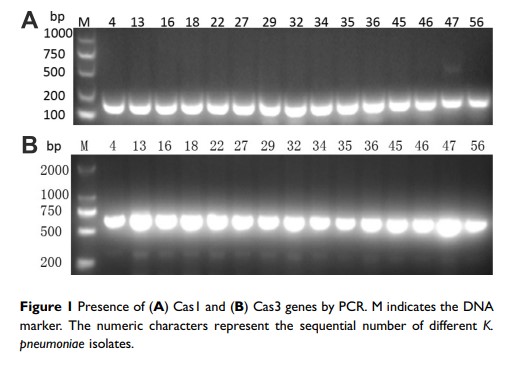
Results: We found that 50/136 (37%) isolates produced ESBL and 30/136 (22%) isolates were resistant to carbapenems. These isolates were liable to be multidrug resistant against β-lactams, quinolones, and aminoglycosides. Among the carbapenem-resistant isolates, blaKPC was the main drug resistance-associated gene and different types of ESBL and AmpC genes were present. Resistance to β-lactams, quinolones, aminoglycosides, tetracyclines, and β-lactams/enzyme inhibitor were higher in absence of the CRISPR/Cas system. Eighteen spacers within the CRISPR arrays matched with the genomes of plasmids or phages, some of which carried drug resistance genes.
Conclusion: ESBL-producing and carbapenem-resistant K. pneumoniae are more likely to develop multidrug resistance and show an inverse correlation between drug resistance and CRISPR/Cas system. Absence of CRISPR/Cas modules allow for the acquisition of external drug resistance genes.
Keywords: CRISPR/Cas, Klebsiella pneumoniae , extended-spectrum β-lactamases, carbapenemases, drug resistance