115195
论文已发表
注册即可获取德孚的最新动态
IF 收录期刊
- 3.6 Breast Cancer (Dove Med Press)
- 4.3 Clin Epidemiol
- 2.6 Cancer Manag Res
- 3.2 Infect Drug Resist
- 4.1 Clin Interv Aging
- 6.1 Drug Des Dev Ther
- 4.1 Int J Chronic Obstr
- 8.7 Int J Nanomed
- 2.5 Int J Women's Health
- 3.2 Neuropsych Dis Treat
- 2.4 OncoTargets Ther
- 2.6 Patient Prefer Adher
- 2.6 Ther Clin Risk Manag
- 3.1 J Pain Res
- 3.5 Diabet Metab Synd Ob
- 4.5 Psychol Res Behav Ma
- 3.4 Nat Sci Sleep
- 2.4 Pharmgenomics Pers Med
- 2.6 Risk Manag Healthc Policy
- 4.6 J Inflamm Res
- 2.3 Int J Gen Med
- 3.9 J Hepatocell Carcinoma
- 3.3 J Asthma Allergy
- 2.5 Clin Cosmet Investig Dermatol
- 3.0 J Multidiscip Healthc

髂骨取骨技术用于骨重建:三皮质骨取骨术与活板门植骨术的比较研究
Authors Zhu JF, Xu WX, Hu Q, Wu TQ, Liu H
Received 8 April 2020
Accepted for publication 31 May 2020
Published 23 June 2020 Volume 2020:16 Pages 559—565
DOI https://doi.org/10.2147/TCRM.S257336
Checked for plagiarism Yes
Review by Single-blind
Peer reviewer comments 2
Editor who approved publication: Professor Deyun Wang
Objective: To investigate the effects of trapdoor-procedure-based bone harvesting and tricortical iliac bone harvesting on the iliac bone-graft donor site pain experienced by patients and their clinical effects.
Methods: A retrospective analysis was performed using the clinical data of 65 patients with tibial plateau fractures who received autologous iliac bone-supporting grafts in two hospitals between January 2014 and January 2019. The patients who received trapdoor-procedure-based bone harvesting (34 cases) were in the experimental group, and those who received tricortical iliac bone harvesting (31 cases) were in the control group. This study compared differences in iliac bone-graft donor site incision length, intraoperative blood loss, amount of bones harvested, operation time, and postoperative complications between the two bone-harvesting methods. Subsequently, it evaluated the pain experienced by the two patient groups in their iliac bone-graft donor sites and their clinical effects.
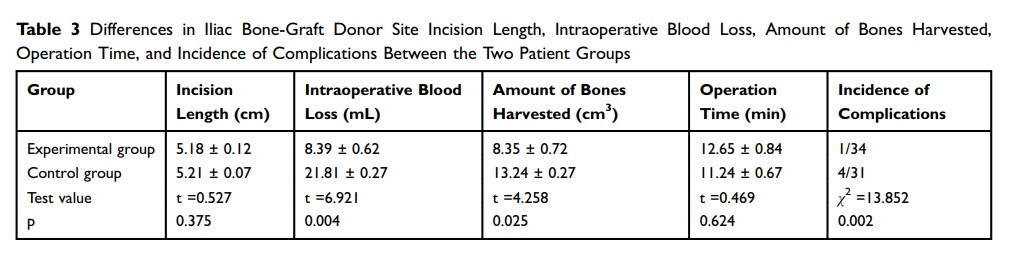
Results: One week after surgery, the differences between the iliac bone-graft donor site pain score (measured using SF-MPQ-2) of the experimental group and the control group were not statistically different. However, 3 weeks, 5 weeks, and 3 months after surgery, the iliac bone-graft donor site pain scores of the experimental group were significantly lower than those of the control group. The iliac bone-graft donor site incision length and operation time of the experimental group were not significantly different from those of the control group. However, the iliac bone-graft donor site intraoperative blood loss, amount of bones harvested and the incidence of complications of the experimental group were significantly lower than those of the control group.
Conclusion: Trapdoor-procedure-based bone harvesting has lower donor site pain, intraoperative blood loss, and postoperative complications. However, for bone grafting in regions with significant bone loss, tricortical iliac bone harvesting remains the optimal option.
Keywords: iliac bone, bone grafting, pain, clinical effect