115195
论文已发表
注册即可获取德孚的最新动态
IF 收录期刊
- 3.6 Breast Cancer (Dove Med Press)
- 4.3 Clin Epidemiol
- 2.6 Cancer Manag Res
- 3.2 Infect Drug Resist
- 4.1 Clin Interv Aging
- 6.1 Drug Des Dev Ther
- 4.1 Int J Chronic Obstr
- 8.7 Int J Nanomed
- 2.5 Int J Women's Health
- 3.2 Neuropsych Dis Treat
- 2.4 OncoTargets Ther
- 2.6 Patient Prefer Adher
- 2.6 Ther Clin Risk Manag
- 3.1 J Pain Res
- 3.5 Diabet Metab Synd Ob
- 4.5 Psychol Res Behav Ma
- 3.4 Nat Sci Sleep
- 2.4 Pharmgenomics Pers Med
- 2.6 Risk Manag Healthc Policy
- 4.6 J Inflamm Res
- 2.3 Int J Gen Med
- 3.9 J Hepatocell Carcinoma
- 3.3 J Asthma Allergy
- 2.5 Clin Cosmet Investig Dermatol
- 3.0 J Multidiscip Healthc

对于中国一家综合医院,拟香味类香菌在医院内导管相关性感染中的分子流行病学
Authors Yang S, Liu Q, Shen Z, Wang H, He L
Received 27 February 2020
Accepted for publication 14 June 2020
Published 25 June 2020 Volume 2020:13 Pages 1981—1993
DOI https://doi.org/10.2147/IDR.S251626
Checked for plagiarism Yes
Review by Single-blind
Peer reviewer comments 2
Editor who approved publication: Dr Eric Nulens
Purpose: Catheter-related infection (CRI) is one of the most frequent causes of hospitalizations for immunocompromised patients. A major challenge is the increased prevalence of Myroides odoratimimus . The purpose of the present study was to evaluate the clinical features and molecular characteristics of M. odoratimimus collected from a general hospital in Shanghai, China.
Patients and Methods: From July 2015 to August 2016, a total of 22 isolates of M. odoratimimus were collected from inpatients respectively from the biliary and pancreatic surgery (6/22) and the urology department (16/22). Clonal relatedness among the isolates was assessed using pulsed-field gel electrophoresis (PFGE) and matrix-assisted laser desorption/ionization time-of-flight mass spectrometry (MALDI-TOF MS). Moreover, the antimicrobial susceptibility tests were carried out using the Clinical and Laboratory Standards Institute (CLSI) broth microdilution method. The presence of antibiotic resistance genes was screened using the polymerase chain reaction (PCR) assay. Additionally, protein structure prediction was analyzed using PSIPRED and RaptorX.
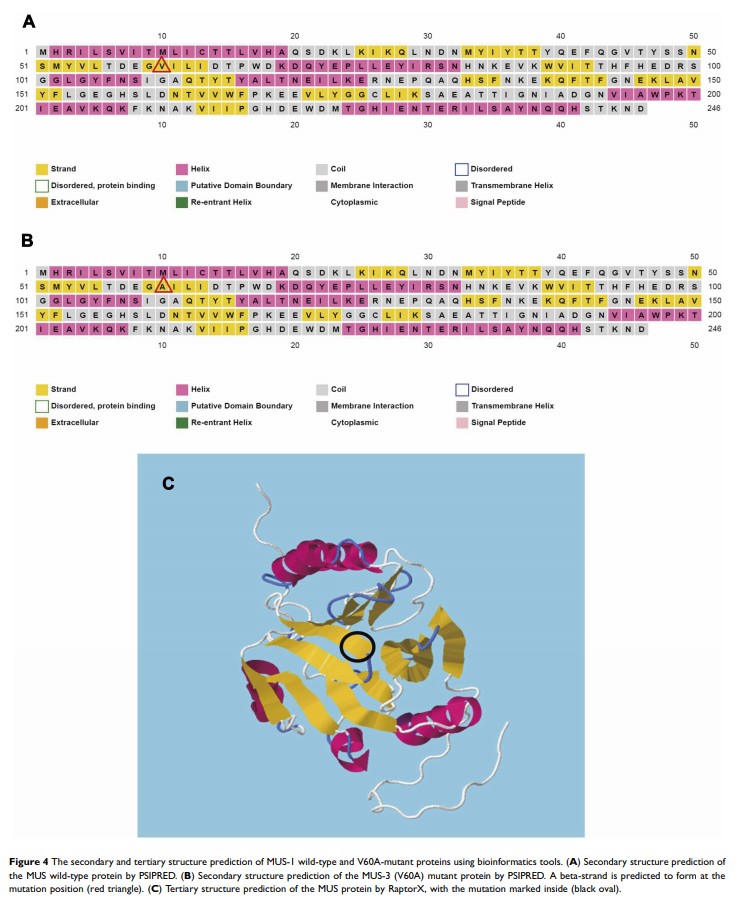
Results: PFGE differentiated these isolates into six possibly related clones from two different departments obtained during a distinct period, indicating clonal dissemination in the two departments. We compared the dendrograms of M. odoratimimus isolates obtained by MALDI-TOF MS with those obtained by PFGE and found that the coincidence rate between them was only 68.2%. All the M. odoratimimus isolates were highly resistant to most available antibiotics, including carbapenems. Furthermore, chromosome-encoded β-lactamases MUS-1 was confirmed by PCR in 6 of 22 Myroides odoratimimus isolates. Herein, we also reported a novel variant of blaMUS-1 in the remaining 16 isolates, which encodes MUS-3 protein at position 60 (Valine to Alanine), differing from the structure of MUS-1.
Conclusion: The opportunistic and extensively antibiotic-resistant Myroides odoratimimus has a small range of epidemics in these two different departments. Clinicians should be aware that M. odoratimimus may induce a severe nosocomial outbreak of catheter-related infections, particularly in immunocompromised patients.
Keywords: Flavobacterium, Myroides odoratimimus , MUS-1, nosocomial, outbreak