115195
论文已发表
注册即可获取德孚的最新动态
IF 收录期刊
- 3.6 Breast Cancer (Dove Med Press)
- 4.3 Clin Epidemiol
- 2.6 Cancer Manag Res
- 3.2 Infect Drug Resist
- 4.1 Clin Interv Aging
- 6.1 Drug Des Dev Ther
- 4.1 Int J Chronic Obstr
- 8.7 Int J Nanomed
- 2.5 Int J Women's Health
- 3.2 Neuropsych Dis Treat
- 2.4 OncoTargets Ther
- 2.6 Patient Prefer Adher
- 2.6 Ther Clin Risk Manag
- 3.1 J Pain Res
- 3.5 Diabet Metab Synd Ob
- 4.5 Psychol Res Behav Ma
- 3.4 Nat Sci Sleep
- 2.4 Pharmgenomics Pers Med
- 2.6 Risk Manag Healthc Policy
- 4.6 J Inflamm Res
- 2.3 Int J Gen Med
- 3.9 J Hepatocell Carcinoma
- 3.3 J Asthma Allergy
- 2.5 Clin Cosmet Investig Dermatol
- 3.0 J Multidiscip Healthc

北京地区稳定 COPD 患者的临床症状和痰液炎症标志物与空气污染物的相关性
Authors Guo C, Sun X, Diao W, Shen N, He B
Received 16 March 2020
Accepted for publication 8 May 2020
Published 26 June 2020 Volume 2020:15 Pages 1507—1517
DOI https://doi.org/10.2147/COPD.S254129
Checked for plagiarism Yes
Review by Single-blind
Peer reviewer comments 2
Editor who approved publication: Prof. Dr. Chunxue Bai
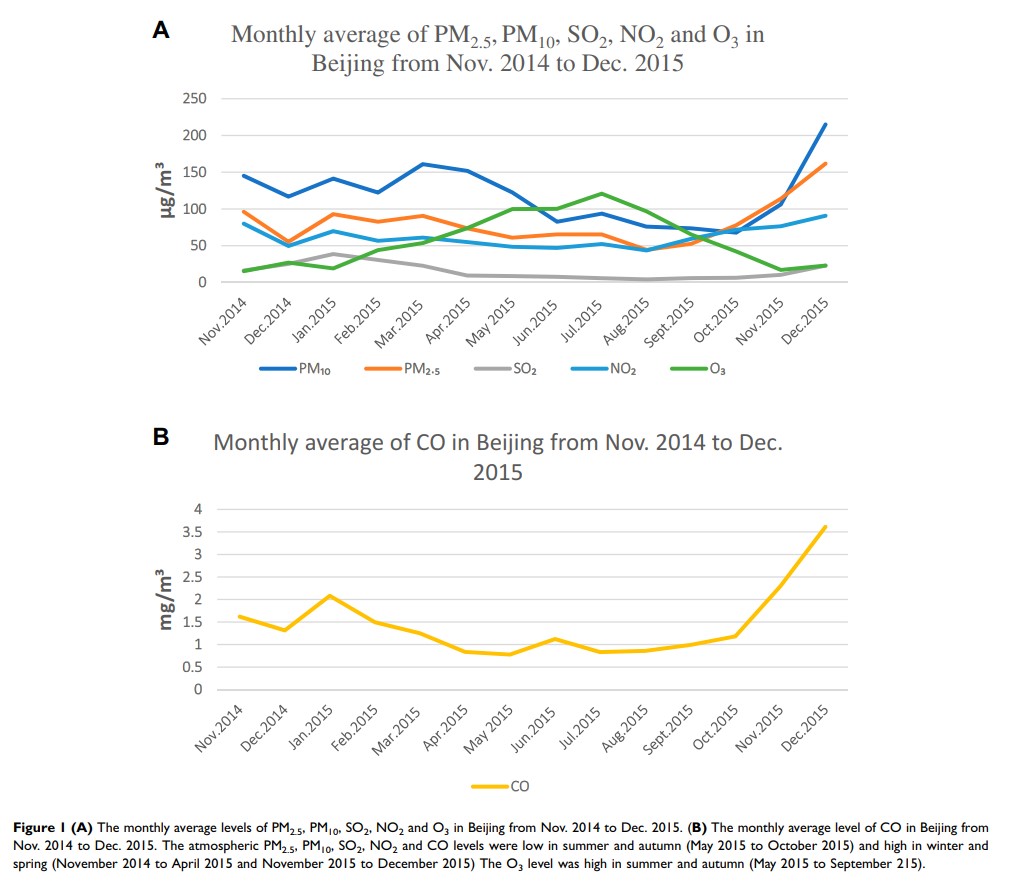
Abstract: Short-term exposure to major air pollutants can increase the risk of acute exacerbation in chronic obstructive pulmonary disease (COPD) patients. However, evidence on the mechanism of acute exacerbation of COPD (AECOPD) caused by air pollutants is still limited. A total of 78 patients with stable COPD and 58 healthy controls were recruited in Peking University Third Hospital in China from December 2014 to January 2015. The correlation and lag effect over 7 days (lag1– 7) of 6 air pollutants with clinical symptoms and inflammatory markers in induced sputum were analyzed. PM2.5, NO2 and CO were positively correlated with the COPD assessment test (CAT) score at lag 5, PM10 was positively correlated with the CAT score at lag 3, MMP-9 and IL-8 were positively correlated with PM2.5, PM10 and NO2 at lag 2, and CO was positively correlated with each other marker at lag 4. Short-term exposure to PM2.5, PM10, NO2, and CO can cause a neutrophil-mediated airway inflammatory response, followed by increased clinical symptoms. If the PM2.5, PM10, NO2 and CO exposure levels increase during air pollution monitoring, the early usage of medication or reduction of exposure to pollutants can effectively reduce the clinical symptoms of patients.
Keywords: chronic obstructive pulmonary disease, air pollution, matrix metalloproteinase 9, interleukin 8, induced sputum