115195
论文已发表
注册即可获取德孚的最新动态
IF 收录期刊
- 3.6 Breast Cancer (Dove Med Press)
- 4.3 Clin Epidemiol
- 2.6 Cancer Manag Res
- 3.2 Infect Drug Resist
- 4.1 Clin Interv Aging
- 6.1 Drug Des Dev Ther
- 4.1 Int J Chronic Obstr
- 8.7 Int J Nanomed
- 2.5 Int J Women's Health
- 3.2 Neuropsych Dis Treat
- 2.4 OncoTargets Ther
- 2.6 Patient Prefer Adher
- 2.6 Ther Clin Risk Manag
- 3.1 J Pain Res
- 3.5 Diabet Metab Synd Ob
- 4.5 Psychol Res Behav Ma
- 3.4 Nat Sci Sleep
- 2.4 Pharmgenomics Pers Med
- 2.6 Risk Manag Healthc Policy
- 4.6 J Inflamm Res
- 2.3 Int J Gen Med
- 3.9 J Hepatocell Carcinoma
- 3.3 J Asthma Allergy
- 2.5 Clin Cosmet Investig Dermatol
- 3.0 J Multidiscip Healthc

尿糖排泄削弱了处于糖尿病前期的受试者的脂质蓄积产物与血清尿酸之间的关联
Authors Chen J, Liu Y, Guo H, Wang B, Sun Z, Yu J
Received 28 March 2020
Accepted for publication 10 June 2020
Published 30 June 2020 Volume 2020:13 Pages 2297—2305
DOI https://doi.org/10.2147/DMSO.S255908
Checked for plagiarism Yes
Review by Single-blind
Peer reviewer comments 2
Editor who approved publication: Professor Ming-Hui Zou
Purpose: Obesity is known to be strongly associated with hyperuricemia. Moreover, the impact of urine glucose excretion (UGE) on serum uric acid (UA) levels has gained much more attention in recent years. Yet concern is raised about whether UGE influences the relationship between obesity and hyperuricemia. The aim of this study was to assess the effect of UGE on the association between lipid accumulation product (LAP), a novel marker of visceral adipose accumulation, and UA in subjects with prediabetes.
Materials and Methods: Data were obtained from a cross-sectional study. A total of 3645 subjects with prediabetes were included in the present study. The separate and joint associations of LAP and UGE with hyperuricemia were examined using logistic regression analyses.
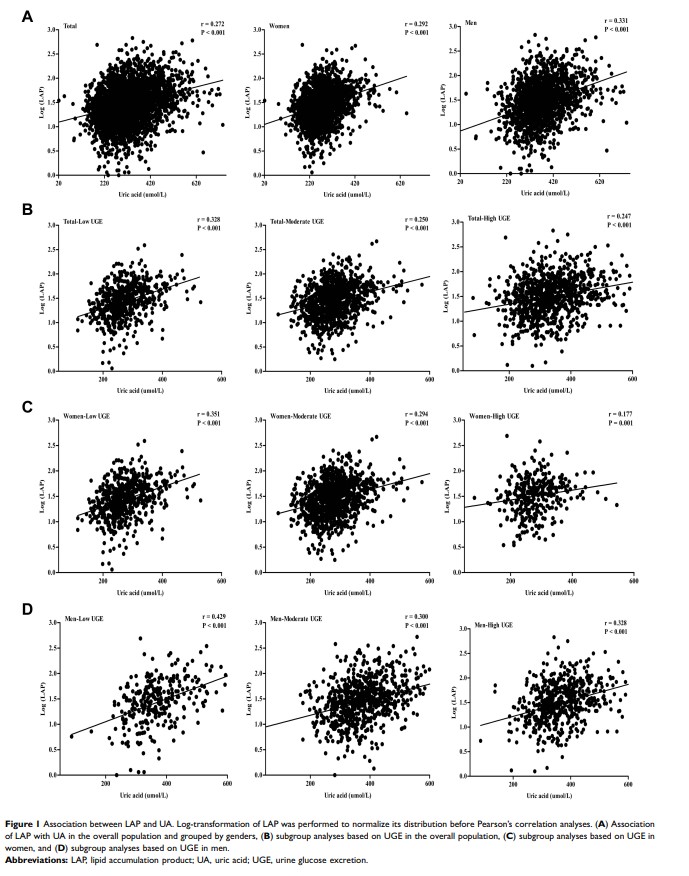
Results: LAP was positively associated with UA in both genders. Subgroup analysis based on UGE revealed that the association was strongest in subjects with low UGE (r = 0.328, p < 0.001), whereas the positive association was weakened, but still remained significant in subjects with moderate and high UGE. High LAP was significantly associated with an increased odds ratio for hyperuricemia after adjustment for potential confounders in the overall population (OR = 2.07, 95% CI: 1.66– 2.58, p < 0.001). However, a downward trend in odds ratios for hyperuricemia was observed across UGE categories. In addition, the joint association analysis confirmed that the relationship between LAP and hyperuricemia was attenuated by UGE.
Conclusion: The positive association between LAP and UA appears to be attenuated by UGE, indicating that promoting UGE may be an effective strategy for controlling UA levels, especially for people with obesity who are at increased risk for hyperuricemia.
Keywords: prediabetes, lipid accumulation product, uric acid, urine glucose excretion