115195
论文已发表
注册即可获取德孚的最新动态
IF 收录期刊
- 3.6 Breast Cancer (Dove Med Press)
- 4.3 Clin Epidemiol
- 2.6 Cancer Manag Res
- 3.2 Infect Drug Resist
- 4.1 Clin Interv Aging
- 6.1 Drug Des Dev Ther
- 4.1 Int J Chronic Obstr
- 8.7 Int J Nanomed
- 2.5 Int J Women's Health
- 3.2 Neuropsych Dis Treat
- 2.4 OncoTargets Ther
- 2.6 Patient Prefer Adher
- 2.6 Ther Clin Risk Manag
- 3.1 J Pain Res
- 3.5 Diabet Metab Synd Ob
- 4.5 Psychol Res Behav Ma
- 3.4 Nat Sci Sleep
- 2.4 Pharmgenomics Pers Med
- 2.6 Risk Manag Healthc Policy
- 4.6 J Inflamm Res
- 2.3 Int J Gen Med
- 3.9 J Hepatocell Carcinoma
- 3.3 J Asthma Allergy
- 2.5 Clin Cosmet Investig Dermatol
- 3.0 J Multidiscip Healthc

中国人群中 MET 14 外显子跳跃的 PD-L1 表达和发病率:利用 RNA 测序的非选择性 NSCLC 队列研究
Authors Xu Z, Li H, Dong Y, Cheng P, Luo F, Fu S, Gao M, Kong L, Che N
Received 5 December 2019
Accepted for publication 17 May 2020
Published 30 June 2020 Volume 2020:13 Pages 6245—6253
DOI https://doi.org/10.2147/OTT.S241231
Checked for plagiarism Yes
Review by Single-blind
Peer reviewer comments 2
Editor who approved publication: Prof. Dr. Takuya Aoki
Background: Mesenchymal–epithelial transition (MET ) exon14 skipping mutations represent a clinically unique molecular subtype of NSCLC. The prevalence rates of MET exon 14 skipping in lung adenocarcinoma (ADC) range from 0.9% to 4.0% in Asian populations. Since some somatic variants that do not encompass the MET exon 14 splice sites might also induce MET exon 14 skipping, the RNA-based sequencing is speculated as the most accurate method for detecting exon 14 skipping.
Patients and Methods: A total of 951 histochemistry (IHC) was performed in 405 samples simultaneously.
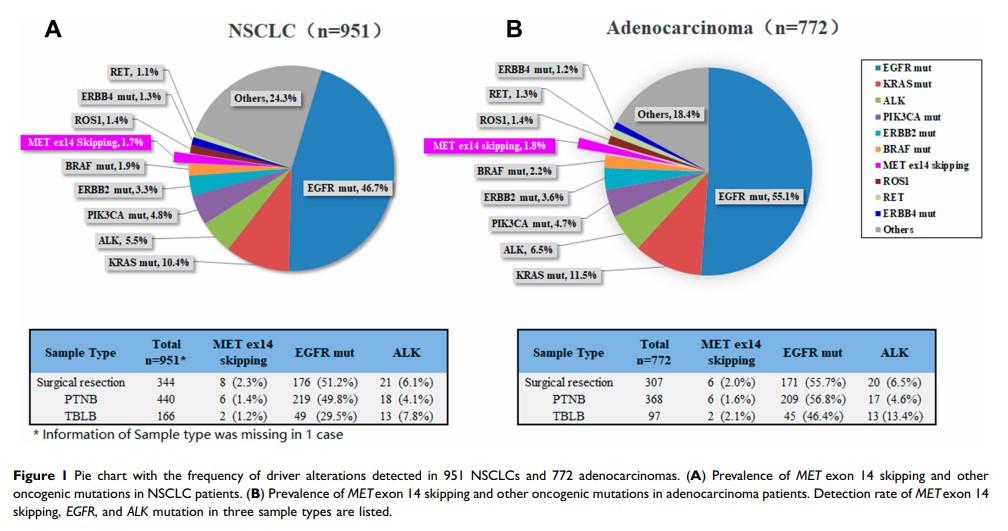
Results: The overall estimated prevalence of MET exon 1NSCLC patients from two hospitals were enrolled in this study. MET exon14 skipping was detected using RNA-based next-generation sequencing (NGS). Also, immuno4 skipping was approximately 1.8% in ADCs and 1.7% in NSCLCs. The detection rate of MET exon 14 skipping from surgical resection specimen was 2.3% in NSCLCs and 2.0% in ADCs. The MET exon 14 skipping was identified in 6.6% of EGFR /KRAS /ALK /ROS1 /RET -negative ADCs. Additionally, PD-L1 was found to be highly expressed in NSCLC patients harboring MET exon 14 skipping (P < 0.01).
Conclusion: The prevalence of MET exon14 skipping in lung ADCs in the East Asian population was similar to that of the Western population as assessed by RNA-based NGS. The NSCLC patients with MET exon 14 skipping were older than those with other oncogenic driver mutations, such as EGFR, ALK , and ROS1 . In addition, PD-L1 was highly expressed in NSCLC patients with MET exon 14 skipping.
Keywords: non-small cell lung cancer, MET exon14 skipping, next-generation sequencing, PD-L1