115195
论文已发表
注册即可获取德孚的最新动态
IF 收录期刊
- 3.6 Breast Cancer (Dove Med Press)
- 4.3 Clin Epidemiol
- 2.6 Cancer Manag Res
- 3.2 Infect Drug Resist
- 4.1 Clin Interv Aging
- 6.1 Drug Des Dev Ther
- 4.1 Int J Chronic Obstr
- 8.7 Int J Nanomed
- 2.5 Int J Women's Health
- 3.2 Neuropsych Dis Treat
- 2.4 OncoTargets Ther
- 2.6 Patient Prefer Adher
- 2.6 Ther Clin Risk Manag
- 3.1 J Pain Res
- 3.5 Diabet Metab Synd Ob
- 4.5 Psychol Res Behav Ma
- 3.4 Nat Sci Sleep
- 2.4 Pharmgenomics Pers Med
- 2.6 Risk Manag Healthc Policy
- 4.6 J Inflamm Res
- 2.3 Int J Gen Med
- 3.9 J Hepatocell Carcinoma
- 3.3 J Asthma Allergy
- 2.5 Clin Cosmet Investig Dermatol
- 3.0 J Multidiscip Healthc

幽门螺杆菌 CagA 蛋白通过上调细胞葡萄糖代谢来减弱胃癌细胞的 5-Fu 敏感性
Authors Gao S, Song D, Liu Y, Yan H, Chen X
Received 12 September 2019
Accepted for publication 15 May 2020
Published 1 July 2020 Volume 2020:13 Pages 6339—6349
DOI https://doi.org/10.2147/OTT.S230875
Checked for plagiarism Yes
Review by Single-blind
Peer reviewer comments 3
Editor who approved publication: Prof. Dr. Jianmin Xu
Introduction: Gastric cancer (GC) is one of the most malignancies leading to human mortality due to its development, progress, metastasis and poor prognosis, despite the development of remarkable chemotherapy and surgery. The 5-fluorouracil (5-Fu) is an effective anti-gastric cancer agent. However, a fraction of GC patients acquire 5-Fu chemoresistance.
Methods: In this study, the CagA protein was detected from CagA-positive gastric cancer patients by qRT-PCR and immunohistochemistry. The 5-Fu resistant gastric cancer cell line was generated from MKN45-CagA cells which was transfected with CagA overexpression vector. Cellular glucose metabolism was determined by measurements of glucose uptake, lactate product and glycolysis enzymes.
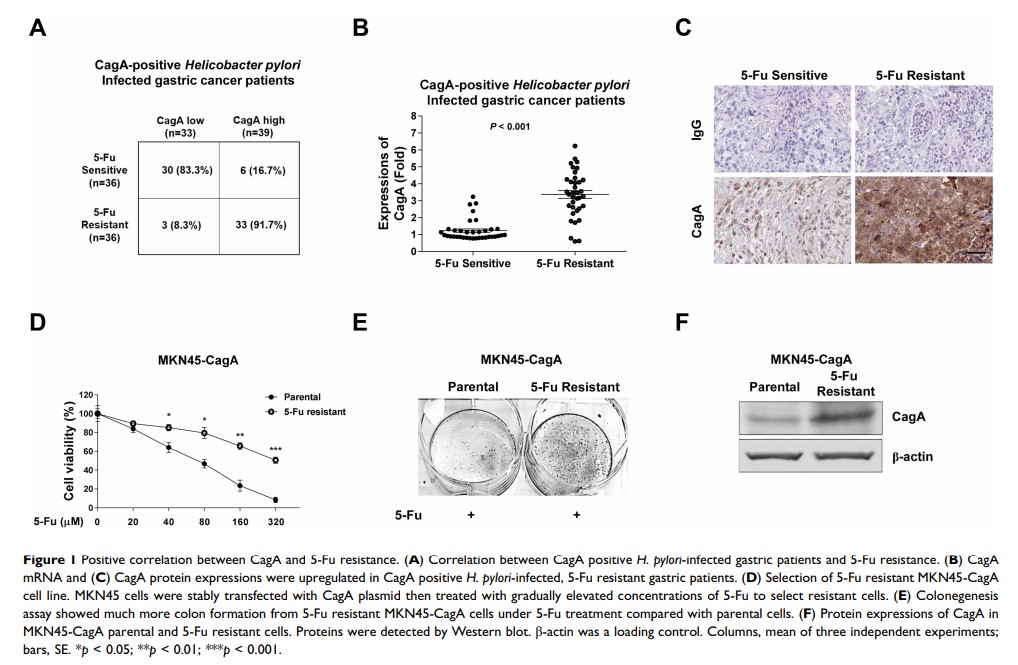
Results: We report that the Helicobacter pylori (H. pylori )-secreted Cytotoxin-associated gene A (CagA) oncoprotein is positively correlated with 5-Fu resistance of gastric cancer. From totally 72 CagA-positive gastric cancer patients, CagA high-expressed patients showed more resistance to 5-Fu than CagA low-expressed patients. Moreover, statistical analysis revealed that CagA mRNA and protein expressions were significantly upregulated in 5-Fu resistant gastric cancer patients. We observed that CagA protein is upregulated in 5-Fu resistant gastric cancer cells compared with sensitive cells. Interestingly, cellular glucose metabolism was upregulated; the glucose uptake and lactate production were significantly higher in 5-Fu resistant gastric cancer cells. The Akt phosphorylation and expressions of glycolysis key enzymes, Hexokinase 2 and LDHA, were significantly upregulated in 5-Fu resistant gastric cancer cells. On the other way, inhibition of glycolysis or Akt pathway effectively overcame 5-Fu resistance from both in vitro and in vivo models. Finally, we report that the combination of Akt or glycolysis inhibitor with 5-Fu could synergistically enhance the cytotoxicity of 5-Fu to CagA-overexpressed gastric cancer cells.
Discussion: In summary, our study demonstrated a CagA-Akt-glycolysis-5-Fu resistance axis, contributing to the development of new therapeutic agents against chemoresistant human gastric cancer.
Keywords: aerobic glycolysis, gastric cancer, 5-Fu resistance, CagA, Helicobacter pylori infection, Warburg effect, chemoresistance