115195
论文已发表
注册即可获取德孚的最新动态
IF 收录期刊
- 3.6 Breast Cancer (Dove Med Press)
- 4.3 Clin Epidemiol
- 2.6 Cancer Manag Res
- 3.2 Infect Drug Resist
- 4.1 Clin Interv Aging
- 6.1 Drug Des Dev Ther
- 4.1 Int J Chronic Obstr
- 8.7 Int J Nanomed
- 2.5 Int J Women's Health
- 3.2 Neuropsych Dis Treat
- 2.4 OncoTargets Ther
- 2.6 Patient Prefer Adher
- 2.6 Ther Clin Risk Manag
- 3.1 J Pain Res
- 3.5 Diabet Metab Synd Ob
- 4.5 Psychol Res Behav Ma
- 3.4 Nat Sci Sleep
- 2.4 Pharmgenomics Pers Med
- 2.6 Risk Manag Healthc Policy
- 4.6 J Inflamm Res
- 2.3 Int J Gen Med
- 3.9 J Hepatocell Carcinoma
- 3.3 J Asthma Allergy
- 2.5 Clin Cosmet Investig Dermatol
- 3.0 J Multidiscip Healthc

万古霉素和妥布霉素局部递送对骨髓基质细胞的成骨作用
Authors Yu L, Fei Q, Lin J, Yang Y, Xu Y
Received 13 May 2020
Accepted for publication 18 June 2020
Published 1 July 2020 Volume 2020:13 Pages 2083—2091
DOI https://doi.org/10.2147/IDR.S261767
Checked for plagiarism Yes
Review by Single-blind
Peer reviewer comments 2
Editor who approved publication: Professor Suresh Antony
Purpose: Bone tissue infections are a difficult problem in orthopedic surgery. Topical application of vancomycin and tobramycin powder has been proved to significantly reduce infection rates. However, the osteogenic effect of the topical application of these two antibiotics is unclear. In this study, the osteogenic effect of local delivery antibiotics on bone regeneration was investigated in vitro.
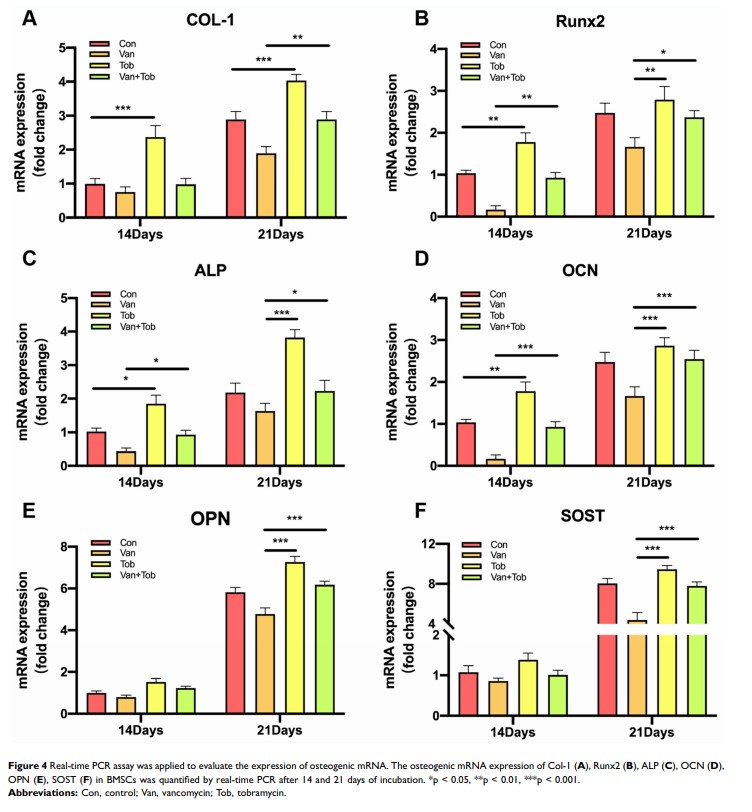
Methods: Bone marrow stromal cells (BMSCs) were incubated in the presence of vancomycin (14.28μg/mL), tobramycin (28.57μg/mL), or vancomycin combined with tobramycin (vancomycin 14.28μg/mL and tobramycin 28.57μg/mL). Cell viability, proliferation, and migration were analyzed. The alizarin red staining as well as the alkaline phosphatase staining was investigated. Then, the quantitative real-time (qRT)-PCR of osteogenic mRNA expression levels were also evaluated.
Results: The results showed that vancomycin combined with tobramycin has no adverse effect on the viability and proliferation of BMSCs. The topical application of vancomycin alone may interfere with the bone regenerative processes. However, the tobramycin can promote the osteogenic differentiation of BMSCs and also rescue the osteogenic potential of BMSCs inhibited by vancomycin both in vitro.
Conclusion: From this in vitro study, local application of vancomycin combined with tobramycin does not affect the osteogenic potential of BMSCs.
Keywords: vancomycin, tobramycin, osteogenesis, bone regeneration