115195
论文已发表
注册即可获取德孚的最新动态
IF 收录期刊
- 3.6 Breast Cancer (Dove Med Press)
- 4.3 Clin Epidemiol
- 2.6 Cancer Manag Res
- 3.2 Infect Drug Resist
- 4.1 Clin Interv Aging
- 6.1 Drug Des Dev Ther
- 4.1 Int J Chronic Obstr
- 8.7 Int J Nanomed
- 2.5 Int J Women's Health
- 3.2 Neuropsych Dis Treat
- 2.4 OncoTargets Ther
- 2.6 Patient Prefer Adher
- 2.6 Ther Clin Risk Manag
- 3.1 J Pain Res
- 3.5 Diabet Metab Synd Ob
- 4.5 Psychol Res Behav Ma
- 3.4 Nat Sci Sleep
- 2.4 Pharmgenomics Pers Med
- 2.6 Risk Manag Healthc Policy
- 4.6 J Inflamm Res
- 2.3 Int J Gen Med
- 3.9 J Hepatocell Carcinoma
- 3.3 J Asthma Allergy
- 2.5 Clin Cosmet Investig Dermatol
- 3.0 J Multidiscip Healthc

褪黑素可减轻高血糖大鼠脑出血后的神经元损伤
Authors Liang F, Wang J, Zhu X, Wang Z, Zheng J, Sun Z, Xu S, Zhang J, Zhou J, Shi L
Received 8 April 2020
Accepted for publication 16 June 2020
Published 2 July 2020 Volume 2020:14 Pages 2573—2584
DOI https://doi.org/10.2147/DDDT.S257333
Checked for plagiarism Yes
Review by Single-blind
Peer reviewer comments 2
Editor who approved publication: Dr Georgios D. Panos
Background: This study sought to investigate a novel effect of melatonin in reducing brain injury in an in vivo hyperglycemic intracerebral hemorrhage (ICH) model and further explore the mechanisms of protection.
Methods: Hyperglycemia ICH was induced in Sprague-Dawley rats by streptozocin injection followed by autologous blood injection into the striatum. A combined approach including RNA-specific depletion, electron microscopy, magnetic resonance, Western blots, and immunohistological staining was applied to quantify the brain injuries after ICH.
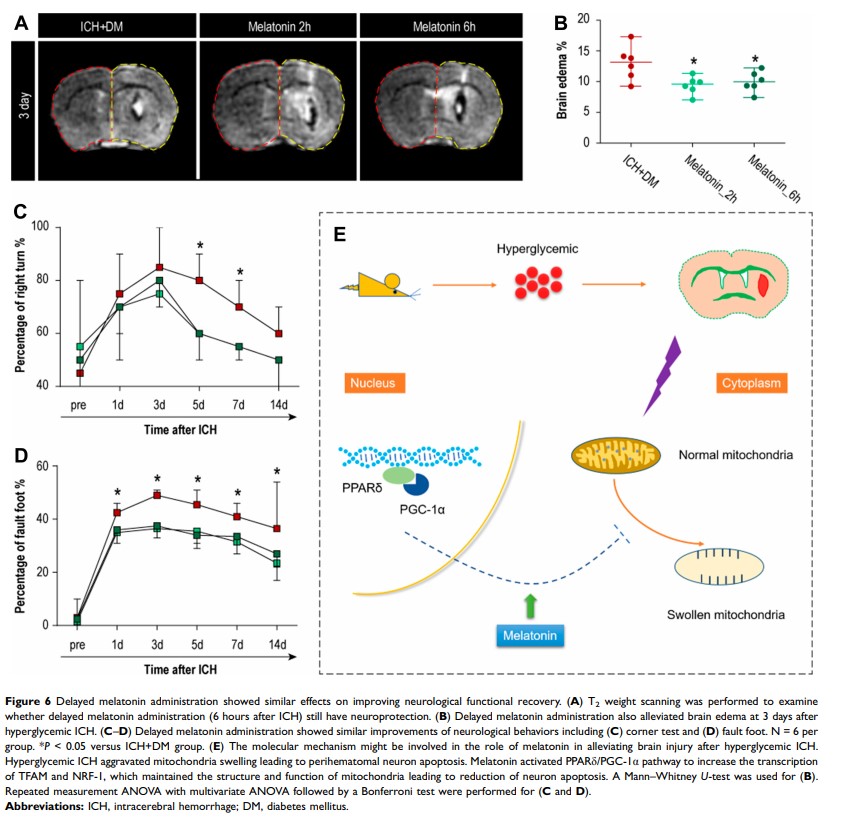
Results: Hyperglycemia resulted in enlarged hematoma volume, deteriorated brain edema, and aggravated neuronal mitochondria damage 3 days after ICH. Post-treatment with melatonin 2 hours after ICH dose-dependently improved neurological behavioral performance lasting out to 14 days after ICH. This improved neurological function was associated with enhanced structural and functional integrity of mitochondria. Mechanistic studies revealed that melatonin alleviated mitochondria damage in neurons via activating the PPARδ/PGC-1α pathway. Promisingly, melatonin treatment delayed until 6 hours after ICH still reduced brain edema and improved neurological functions. Melatonin supplementation reduces neuronal damage after hyperglycemic ICH by alleviating mitochondria damage in a PPARδ/PGC-1α-dependent manner.
Conclusion: Melatonin may represent a therapeutic strategy with a wide therapeutic window to reduce brain damage and improve long-term recovery after ICH.
Keywords: melatonin, intracerebral hemorrhage, hyperglycemia, mitochondria, apoptosis