115195
论文已发表
注册即可获取德孚的最新动态
IF 收录期刊
- 3.6 Breast Cancer (Dove Med Press)
- 4.3 Clin Epidemiol
- 2.6 Cancer Manag Res
- 3.2 Infect Drug Resist
- 4.1 Clin Interv Aging
- 6.1 Drug Des Dev Ther
- 4.1 Int J Chronic Obstr
- 8.7 Int J Nanomed
- 2.5 Int J Women's Health
- 3.2 Neuropsych Dis Treat
- 2.4 OncoTargets Ther
- 2.6 Patient Prefer Adher
- 2.6 Ther Clin Risk Manag
- 3.1 J Pain Res
- 3.5 Diabet Metab Synd Ob
- 4.5 Psychol Res Behav Ma
- 3.4 Nat Sci Sleep
- 2.4 Pharmgenomics Pers Med
- 2.6 Risk Manag Healthc Policy
- 4.6 J Inflamm Res
- 2.3 Int J Gen Med
- 3.9 J Hepatocell Carcinoma
- 3.3 J Asthma Allergy
- 2.5 Clin Cosmet Investig Dermatol
- 3.0 J Multidiscip Healthc

评估中国炎症性肠病患者的口服药物治疗依从性并确定低依从性的预测因子
Authors Hu W, Hu S, Zhu Y, Chen H, Chen Y
Received 23 February 2020
Accepted for publication 2 June 2020
Published 2 July 2020 Volume 2020:14 Pages 1083—1092
DOI https://doi.org/10.2147/PPA.S250935
Checked for plagiarism Yes
Review by Single-blind
Peer reviewer comments 2
Editor who approved publication: Dr Naifeng Liu
Background: Poor medication adherence in inflammatory bowel disease (IBD) had a negative impact on disease outcomes. In this study, we aimed to determine predictors of low adherence in the Chinese IBD populations and also aimed to compare a self-reported scale to a pharmacy refill index in assessing adherence of 5-ASA and azathioprine taken by Chinese IBD patients.
Patients and Methods: Adult patients with IBD who had been taking 5-ASA or azathioprine for at least 3 months were recruited from hospital outpatient clinics. The MPR was calculated from previous six-month pharmacy refill data and the self-reported Morisky Medication Adherence Scale (MMAS-8) was issued through QR code questionnaires. Intentional and unintentional adherence scores were calculated according to specific items. Non-adherence was defined as MMAS-8 scores < 6 or MPR < 0.8.
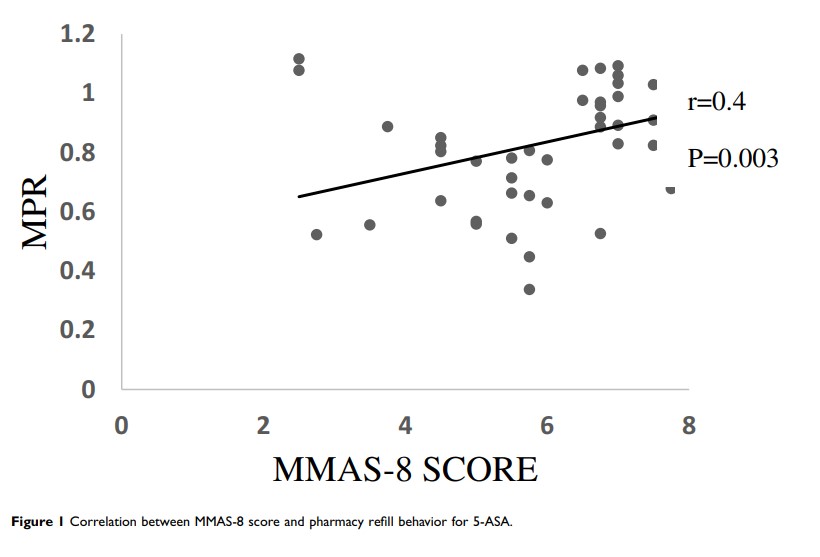
Results: The response rate in the IBD patients was as high as 97%. 5-ASA non-adherence rate assessed by MPR was 30% and 37% by MMAS-8, and azathioprine non-adherence rate assessed was 33% by both MPR and MMAS-8. In a linear regression analysis, MPR value was significantly correlated with MMAS-8 score in 5-ASA group (r=0.4, p=0.003), and significantly correlated with unintentional adherence score (r=0.47, p< 0.001). No significant correlation was observed between MPR value and MMAS-8 score in azathioprine group. Multivariate analysis demonstrated that age (OR: 1.08; 95% CI: 1.02– 1.13; P=0.0015) and previous abdominal surgery (OR: 3.18; 95% CI: 2.09– 4.27; P=0.04) were associated with high medication adherence. While patients who had small intestine lesion (OR: 0.09; 95% CI: 0.01– 0.17; P=0.006) were associated with low adherence.
Conclusion: Predictors of low adherence were young age, lesions on small intestine, whereas previous abdominal surgery was a protective factor. This study also demonstrated that the MMAS-8 scale was a valid instrument for assessing 5-ASA adherence in IBD patients. Unintentional non-adherence was significantly related to the total non-adherence, which would allow to use the tool to seek ways for adherence improvement.
Keywords: inflammatory bowel disease, medication adherence, self-reported Morisky Medication Adherence Scale, Medication possession ratio